Ma Pi Leng Pass
The name 'Ma Pi Leng' in the Hmong language is often translated to 'horse's nose,' suggesting a treacherous, steep path. But there's another, more poignant interpretation.
Full story unlocks in the tour
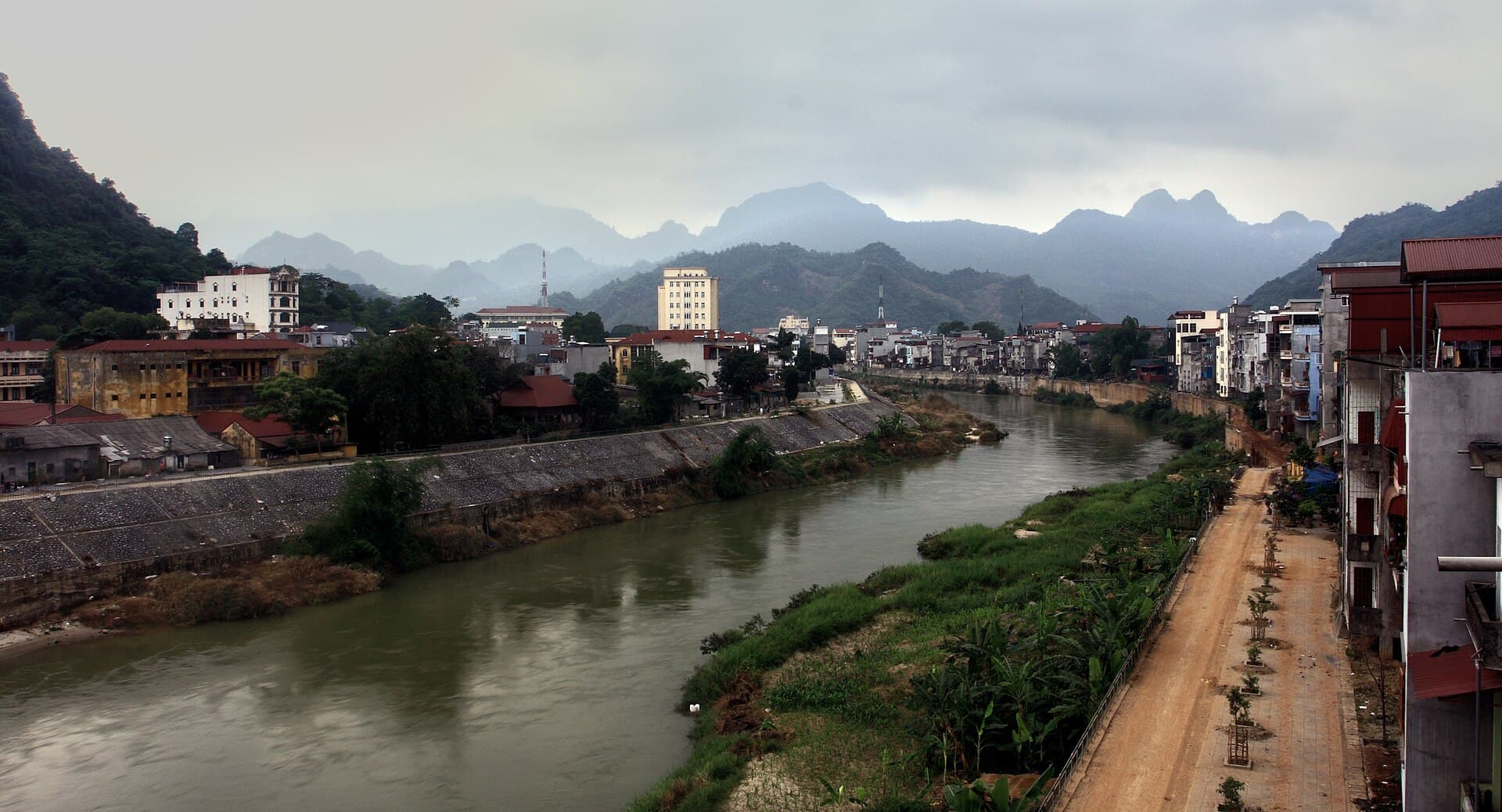 Idan Robbins / CC BY-SA 4.0, via Wikimedia Commons
Self-guided audio walking tour of Hà Giang — GPS route, offline playback, story-driven narration in 32 languages.
“Where limestone peaks meet ancient traditions, and the road unfurls like a whispered legend.”
Not the postcards. The stories even locals don't know — whispered in your ear, right where they happened.
The name 'Ma Pi Leng' in the Hmong language is often translated to 'horse's nose,' suggesting a treacherous, steep path. But there's another, more poignant interpretation.
At Vietnam's northernmost point, the Lung Cu Flag Tower stands tall, a symbol of national pride. But the land it occupies is said to have a mythical origin story.
This historic quarter, with houses dating back to the late 19th century, seems frozen in time. Yet, on certain nights, it transforms into a spectacle of light and tradition.
Discover every secret of Hà Giang
Every address, every reveal in full — in your ear, right where it happened.
You pick your stops. You walk. The voice reveals what the others miss.


Your self-guided audio tour of Hà Giang is ready — pick your landmarks, choose your language, and start the moment you arrive.
BuyLume has a built-in augmented-reality guide. Hold your phone up and its camera shows the street ahead of you, with a glowing arrow laid over the real view that always points to your next stop — no map to puzzle over, no wrong turns. Like everything in Lume, it works fully offline.
Hà Giang, Vietnam's northernmost province, is a land of raw, untamed beauty, where colossal limestone karsts pierce the sky and emerald rivers carve deep canyons. This remote frontier, sharing a 270 km border with China, offers a journey through some of Southeast Asia's most dramatic landscapes. It is a region where the grandeur of nature finds its match in the resilience and intricate cultural fabric of its people.
The province is a mosaic of over 20 distinct ethnic groups, including the Hmong, Tay, and Dao, who have preserved their unique customs, languages, and traditional attire for centuries. A journey to Hà Giang is an immersion into a way of life deeply connected to the land, where markets bustle with trade and cultural exchange, and ancient rituals continue to shape daily rhythms.
While the provincial capital, also named Hà Giang, serves as the gateway, the true allure lies in the winding roads and remote villages beyond. This region is best explored as a road trip, particularly the legendary Hà Giang Loop, a route revered by adventurers for its expansive vistas and challenging terrain.
Hà Giang's history is as layered and rugged as its mountainous terrain, stretching back over 10,000 years with archaeological evidence of human habitation in the area since prehistoric times. The region's narrative is deeply intertwined with the enduring heritage of its numerous ethnic minority groups, such as the Hmong, Tay, Dao, and Lo Lo, who have inhabited these mountains for centuries, some for as long as 500 to 800 years.
During the 19th century, the town of Hà Giang, then known as Vị Xuyên, began to gain prominence as a principal market town. It was incorporated into the Tuyên Quang Province in 1842. A significant historical landmark from this period is the Vuong Family's Palace in Sa Phin, often referred to as the H'Mong King's Palace. Constructed between 1898 and 1907 by Vuong Chinh Duc, a powerful H'Mong leader who controlled the regional opium trade, this fortified mansion showcases a unique blend of Chinese, French, and H'Mong architectural styles, built from green stone, Po mu wood, and terracotta tiles. Its carved motifs of dragons, phoenixes, and bats symbolize royalty and prosperity. This palace stands not as a relic in isolation, but as a living part of the H'Mong cultural landscape.
Following the French conquest in 1886, Hà Giang became an important French colonial military outpost. The region also played a role in Vietnam's struggle for independence, with the Việt Nam Quốc Dân Đảng taking power here during the August Revolution on August 13, 1945. The modern infrastructure of Hà Giang, particularly roads like the 'Happiness Road' which includes the perilous Ma Pi Leng Pass, was largely shaped by the Vietnam-China border conflicts that culminated in the 1979 war. The construction of the Happiness Road itself is a testament to incredible human endeavor, with tens of thousands of youth volunteers from 16 different ethnic groups spending nearly seven years (1959-1965) building it with rudimentary tools, particularly the section over Ma Pi Leng Pass, where workers chipped away at cliff faces for 11 months straight.
Since the end of the war, Hà Giang has seen significant economic growth and the development of modern infrastructure, though many local communities continue to face challenges. Throughout these historical shifts, the people of Hà Giang have steadfastly preserved their unique way of life, with traditional customs, lively festivals, and the melodies of ethnic instruments continuing to thrive amidst the majestic landscapes.
The dramatic landscapes of Hà Giang offer a wealth of sights. The Dong Van Karst Plateau Geopark, a UNESCO Global Geopark, is a compelling destination, spanning four districts and characterized by towering limestone formations, deep canyons, and a geological history stretching over 550 million years. Within the geopark, Ma Pi Leng Pass is a highlight, a 20-kilometer stretch of road offering unparalleled panoramic vistas of sheer cliffs plunging to the Nho Que River canyon. The pass is considered one of Vietnam's "four great passes" and is a pinnacle of the Hà Giang Loop.
Journey further north to the Lung Cu Flag Tower, a powerful symbol of Vietnamese sovereignty at the country's northernmost point. From its 33-meter height, a 54-square-meter flag (representing Vietnam's 54 ethnic groups) flies proudly, offering expansive views across terraced fields and into China. The Vuong Family's Palace (H'Mong King's Palace) in Sa Phin commune provides a glimpse into the region's past, with its unique architecture combining Chinese, French, and H'Mong styles. Explore the Dong Van Ancient Quarter, with its preserved houses dating back to 1890, offering a distinctive architectural complex and a lively Sunday market.
Hà Giang offers distinct beauty throughout the year. For pleasant, mild weather and spring blossoms, including peach, plum, and yellow flowers, visit from January to March. April brings comfortable temperatures and is when the unique Khau Vai Love Market Festival takes place. The period from September to October is highly recommended for its dry, cool weather and the iconic golden rice terraces, particularly in Hoang Su Phi, as the harvest season begins. November is ideal for witnessing the blooming buckwheat flower fields, with the Buckwheat Flower Festival usually held in Dong Van. While July and August can be warm with regular monsoons, the landscape is lush and green.
Hà Giang City, approximately 300 km from Hanoi, is the starting point for most adventures. Sleeper buses and VIP mini-vans run day and night from Hanoi, with journeys typically lasting around six hours. Public transport within Hà Giang Province is limited, making motorbikes or private cars the primary modes of exploration. Many visitors opt to rent a motorbike in Hà Giang City or book an 'Easy Rider' tour, where an experienced local guide drives. An International Driving Permit (IDP) is technically required to legally drive a motorbike.
Vietnamese Dong (VND) is the preferred currency, with ATMs available in Hà Giang City but limited in remote areas, so carrying cash is advisable. While no special vaccinations are required, standard travel vaccinations are recommended. Mountain weather can change rapidly, so pack layers to prepare for temperatures ranging from 5°C in winter to 35°C in summer. Internet and phone coverage can be sporadic in more remote regions.
Hà Giang in Korean, in Chinese or in Hebrew — and 29 more languages, every stop narrated by a native voice. The widest language range of any self-guided audio tour.
Available in: