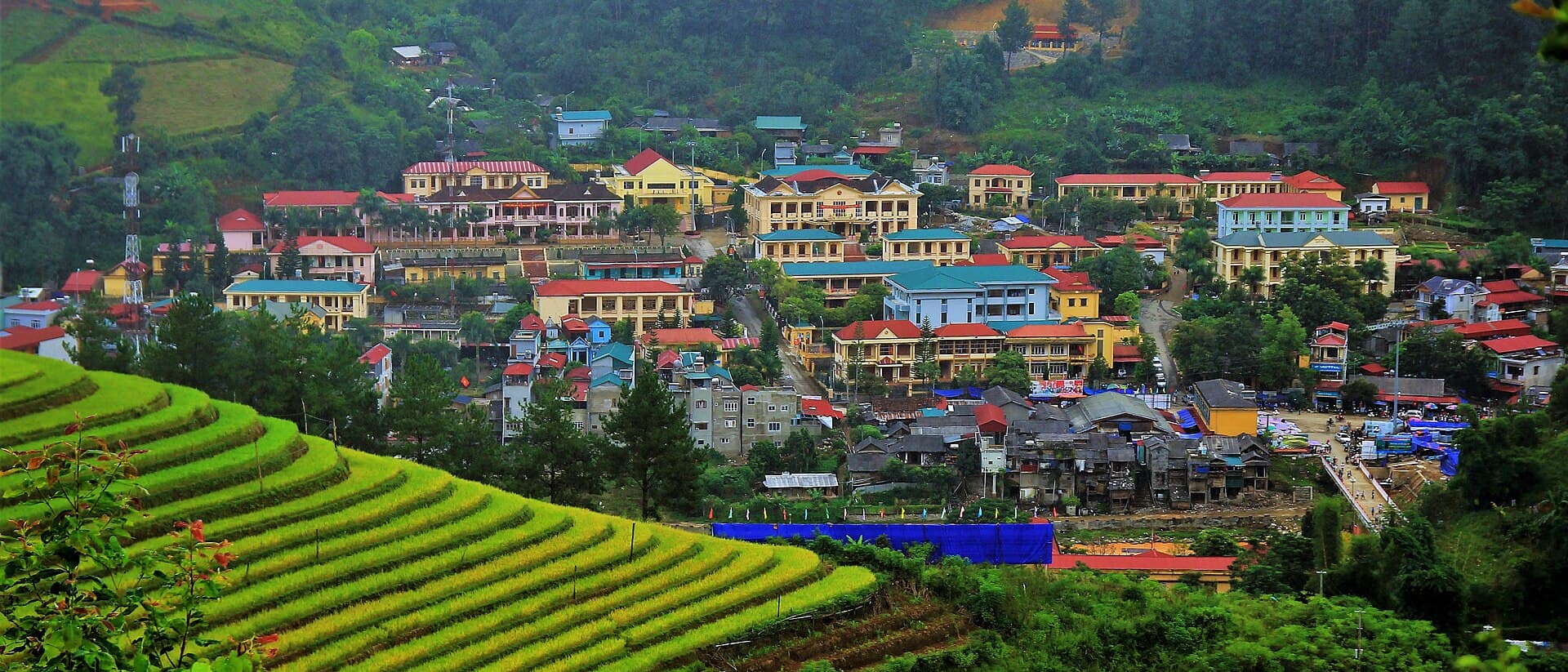
Khau Pha Pass
The name of this formidable mountain passage holds a secret, one that speaks to its often ethereal, cloud-shrouded nature.
Full story unlocks in the tour
 Khoitran1957 / CC BY-SA 4.0, via Wikimedia Commons
Self-guided audio walking tour of Mù Cang Chải — GPS route, offline playback, story-driven narration in 32 languages.
“Where mountains breathe in terraced emerald and gold.”
Not the postcards. The stories even locals don't know — whispered in your ear, right where they happened.
The name of this formidable mountain passage holds a secret, one that speaks to its often ethereal, cloud-shrouded nature.
This iconic viewpoint gets its name from a local delicacy, hinting at the unique, round shape of its rice terraces.
Despite living in mountainous terrain for centuries, the Hmong people here build their homes differently from many other ethnic groups in Vietnam.
Discover every secret of Mù Cang Chải
Every address, every reveal in full — in your ear, right where it happened.
You pick your stops. You walk. The voice reveals what the others miss.

Your self-guided audio tour of Mù Cang Chải is ready — pick your landmarks, choose your language, and start the moment you arrive.
BuyLume has a built-in augmented-reality guide. Hold your phone up and its camera shows the street ahead of you, with a glowing arrow laid over the real view that always points to your next stop — no map to puzzle over, no wrong turns. Like everything in Lume, it works fully offline.
Mù Cang Chải, a rural district in Vietnam's Yên Bái Province, presents a landscape sculpted by both nature and centuries of human endeavor. Situated in the grand Northwest region, approximately 300 kilometers from Hanoi, it is celebrated for its magnificent terraced rice fields. These terraces, carved into steep mountain slopes at altitudes ranging from 1,000 to 2,000 meters above sea level, stand as a testament to the ingenuity and diligent work of the local Hmong people.
Designated a National Heritage Site, Mù Cang Chải offers a quieter, more authentic experience compared to more commercialized destinations like Sapa. It is a place where the rhythms of agricultural life dictate the scenery, transforming from shimmering, water-filled basins in spring to verdant green carpets in summer, and finally to golden waves during the autumn harvest. Beyond the visual spectacle, Mù Cang Chải provides a deep immersion into the cultural fabric of its ethnic minority groups, primarily the Hmong, who comprise over 90% of the population.
The history of Mù Cang Chải is deeply intertwined with the Hmong people, who have lived in this mountainous region for hundreds of years. Facing challenging, steep terrain unsuitable for conventional farming, the Hmong developed an ingenious system of terraced rice fields. These intricate terraces, some dating back centuries, were meticulously constructed by hand using simple tools and traditional knowledge passed down through generations. This monumental effort transformed the rugged mountain slopes into fertile ground, allowing them to cultivate rice and sustain their communities.
The terraces are not merely an agricultural feat; they are a profound expression of Hmong culture and identity. Their design reflects a deep understanding of the land, utilizing ancient irrigation techniques to conserve water and soil. In 2007, recognizing their exceptional cultural and agricultural value, a significant portion of Mù Cang Chải's terraced rice fields, spanning nearly 500 hectares, was officially designated a National Heritage Site by the Vietnamese Ministry of Culture, Sports and Tourism. This acknowledgment cemented their status not just as a local marvel, but as a site of national and even global significance, often counted among the world's most beautiful terraced fields.
Today, Mù Cang Chải remains predominantly home to the Hmong people, who continue to practice their ancestral farming methods. Alongside the Hmong, other ethnic groups such as the Thai, Tay, and Dao also contribute to the district's cultural diversity, each with their own traditions and ways of life. The region's history is a living one, visible in the daily routines of farmers in the fields, the lively traditional festivals, and the enduring architecture of the villages.
The primary allure of Mù Cang Chải is its terraced rice fields, a landscape that shifts dramatically with the seasons. Key areas to witness these cascading wonders include La Pán Tẩn, Chế Cu Nha, and Dế Xu Phình, all recognized as National Heritage Sites. For sweeping views, ascend Khau Pha Pass, one of the 'four great mountain passes' in northern Vietnam, which offers broad vistas of the terraces and surrounding mountains. Mam Xoi Hill (Raspberry Hill) in La Pán Tẩn is particularly noted for its distinct, concentric rice terrace patterns, providing exceptional photographic opportunities.
Beyond the rice fields, explore the local culture by visiting Hmong villages like Mo De, La Pan Tan, Sang Nhu, and Mang Mu, where you can observe traditional ways of life and perhaps even witness local crafts like weaving. Consider a homestay experience in a traditional stilt house of the Thai ethnic group for an immersive cultural exchange. For those seeking adventure, paragliding over Khau Pha Pass during festival seasons offers a unique bird's-eye perspective of the golden fields. Other natural attractions include the Mù Cang Chải Bamboo Forest and the multi-tiered Pu Nhu Waterfall, located west of the district.
Mù Cang Chải offers distinct beauty throughout the year, but the most popular times to visit align with the rice cultivation cycle. The "water pouring season" from May to June sees the terraced fields irrigated, creating mirror-like reflections of the sky. The "golden harvest season" from late September to early October is widely considered the most picturesque, as the rice ripens to a brilliant golden yellow before harvest. This period often coincides with cultural festivals, adding to the lively atmosphere. For trekking, spring (March–May) and autumn (September–November) offer mild and agreeable weather conditions.
Mù Cang Chải is approximately 300 kilometers from Hanoi. The primary route is National Road QL32, accessible by both cars and motorcycles. Many visitors opt for overnight sleeper buses from Hanoi, with ticket prices ranging from 250,000 VND to 350,000 VND. Motorbike tours are a popular way to explore the region, offering flexibility and access to remote viewpoints.
Cash is essential in Mù Cang Chải, as card payments are rarely accepted, and money exchange services are limited. A stay of 2-3 days is generally recommended to experience the landscapes and cultural offerings. Accommodation options include homestays, particularly Hmong and Thai homestays, which provide authentic cultural immersion and often include delicious local meals. Local specialties to try include Tu Le sticky rice and green rice (com) made from young rice grains.
Mù Cang Chải in Korean, in Chinese or in Hebrew — and 29 more languages, every stop narrated by a native voice. The widest language range of any self-guided audio tour.
Available in: