Zondagmarkten van Mai Châu
Naast de levendige textiel en lokale producten, vindt er een ander soort uitwisseling plaats op de zondagmarkten.
Volledig verhaal ontgrendeld in de tour
 Viethavvh at vi.wikipedia / public domain, via Wikimedia Commons
Zelfgeleide audiowandeling door Mai Châu — GPS-route, offline afspelen, meeslepende vertelling in 32 talen.
“Waar smaragdgroene rijstvelden het ritme van het paalwoningleven ontmoeten.”
Niet de ansichtkaarten. De verhalen die zelfs locals niet kennen — gefluisterd in je oor, precies waar ze gebeurden.
Naast de levendige textiel en lokale producten, vindt er een ander soort uitwisseling plaats op de zondagmarkten.
De kenmerkende architectuur van de Witte Thai paalwoningen bevat een verrassend detail over familierollen.
Dit lokale gerecht gaat niet alleen over smaak; het draagt een oude overtuiging met zich mee.
Ontdek elk geheim van Mai Châu
Elk adres, elke onthulling volledig — in je oor, precies waar het gebeurde.
Jij kiest je stops. Jij wandelt. De stem onthult wat de anderen missen.

Je zelfgeleide audiotour van Mai Châu is klaar — kies je bezienswaardigheden, kies je taal en start zodra je aankomt.
KopenLume heeft een ingebouwde augmented-reality-gids. Houd je telefoon omhoog: de camera toont de straat voor je, met een oplichtende pijl over het echte beeld die altijd naar je volgende stop wijst — geen kaart om uit te puzzelen, geen verkeerde afslagen. Zoals alles in Lume werkt het volledig offline.
Mai Châu is een rustige bergachtige regio in de provincie Hòa Bình in Vietnam, ongeveer 140-160 kilometer ten zuidwesten van Hanoi. Dit dal wordt gekenmerkt door zijn uitgestrekte rijstvelden, traditionele paalwoningen en de gastvrije gemeenschappen van verschillende etnische groepen. Het biedt een rustige ontsnapping aan de drukke hoofdstad en nodigt reizigers uit om zich onder te dompelen in het authentieke plattelandsleven.
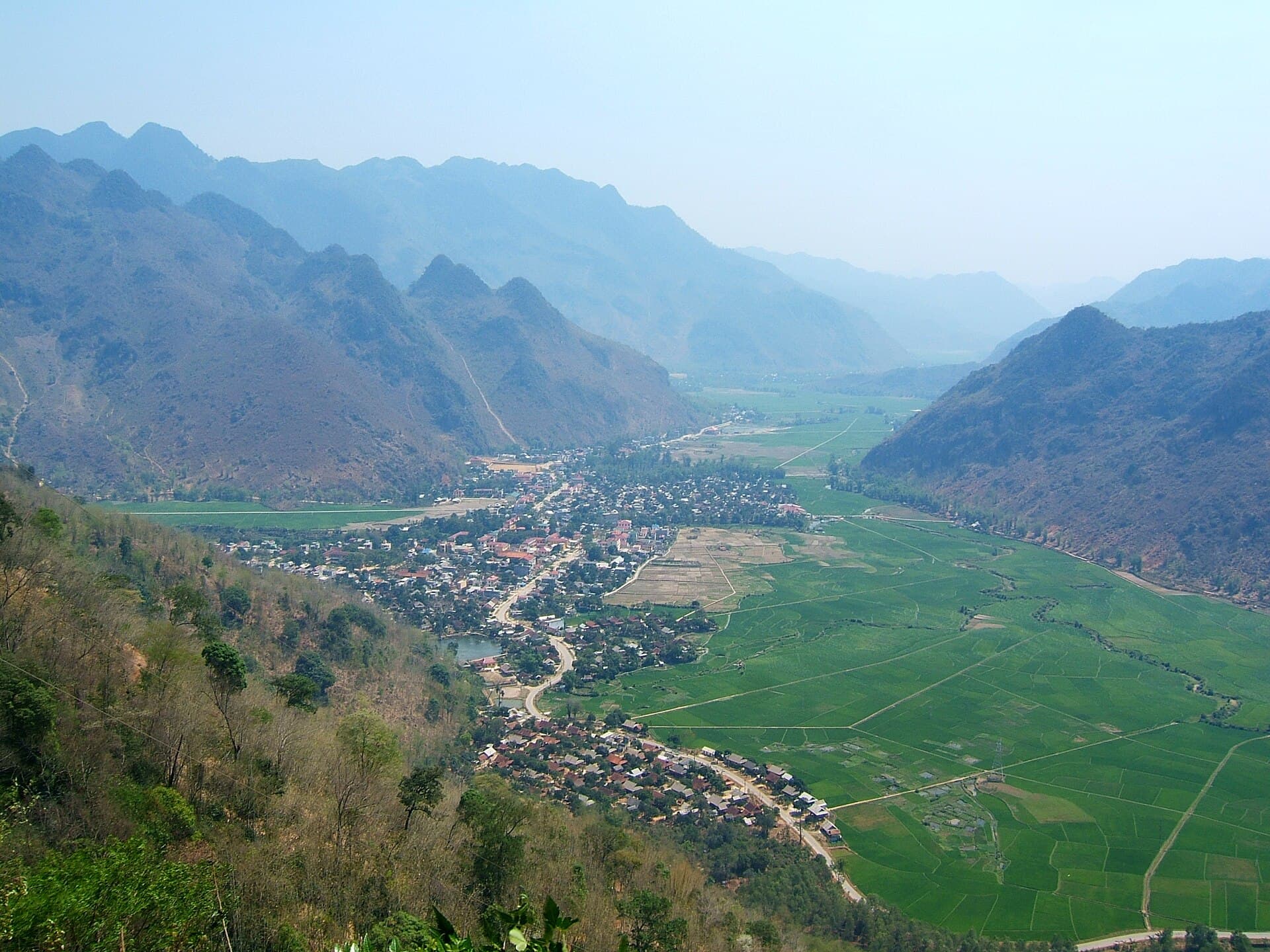
Het landschap van Mai Châu is een zachte verzameling glooiende groene heuvels rondom lappendeken rijstvelden, bezaaid met dorpen. Hoewel het misschien niet de dramatische kalkstenen karsts van Ninh Bình of de torenhoge pieken van Sapa heeft, ligt de aantrekkingskracht in zijn serene, langzame en agrarische charme. Mai Châu is de thuisbasis van verschillende etnische minderheidsgroepen, met de Witte Thai, Muong en Hmong als de meest prominente. Deze gemeenschappen hebben hun traditionele gebruiken, kleding, architectuur en handwerk behouden, waardoor Mai Châu een levend museum van de Vietnamese minderheidscultuur is.
Voor de 7e eeuw was het gebied dat nu bekend staat als Mai Châu grotendeels wildernis, bedekt met ongerepte bossen met minimale menselijke aanwezigheid. Het was een naamloze regio op de kaart van Vietnam. In het midden van de 7e tot het begin van de 8e eeuw migreerde een Thai-stam, afkomstig uit Zuid-China en op zoek naar ontsnapping aan de invloed van de Chinese Han-dynastie, naar Mai Châu. Deze migratie markeerde de eerste significante menselijke nederzetting in de regio, waarbij de Thai-bevolking gemeenschappen stichtte die zich uiteindelijk in verschillende richtingen over Noord-Vietnam zouden verspreiden.
Mai Châu werd officieel onderdeel van Vietnamees grondgebied onder de Nguyen-dynastie, na generaties lang een autonoom land te zijn geweest, bestuurd door Thai-landheren. De Nguyen-koningen verdeelden het noordwesten van Vietnam in administratieve eenheden genaamd 'Chau' (gelijk aan hedendaagse districten), en Mai Châu viel onder Phu Cho Bo van de provincie Muong. Tegen 1892 werd het erkend als een van de vijf 'Chau' van de provincie Hoa Binh. Desondanks bleef Mai Châu een afgelegen gebied, vaak over het hoofd gezien in het bredere verhaal van Vietnam.
Tijdens de Franse koloniale periode werd Mai Châu erkend door de Franse veroveraars, die het gebied vaak bezochten voor vakanties en de natuurlijke schoonheid ervan waardeerden. Deze periode zag de eerste erkenning van Mai Châu als een potentieel resortgebied.
Mai Châu speelde een rol tijdens de Vietnamoorlog en diende als een strategisch punt voor het Viet Minh-leger op hun reis naar de beslissende slag bij Dien Bien Phu. Lokale gemeenschappen steunden actief de Viet Minh, zorgden voor nachtelijk transport en gebruikten grotten in Mai Châu om troepen en voorraden te beschermen. Na de Franse nederlaag in 1954 verleende de Noord-Vietnamese regering hulp aan Mai Châu, waarbij enkele Kinh-gezinnen uit de Rode Rivierdelta naar het gebied verhuisden om nieuwe landbouwmethoden, onderwijs en technologie te introduceren.
In de jaren zeventig werd Mai Châu zelfs als proefproject voor een plattelandsresort gebruikt, met begeleiding van Sovjet- en Oost-Duitse experts. In oktober 1980 werd het district Mai Châu tijdelijk gecombineerd met het district Da Bac om het district Mai Da te vormen, een periode waarin grote boerderijen werden opgericht om lokale arbeid te collectiviseren. Later splitste Mai Da zich weer terug in zijn oorspronkelijke districten. In de afgelopen jaren is Mai Châu gestaag populairder geworden en heeft het zich getransformeerd tot een aantrekkelijke bestemming voor reizigers die op zoek zijn naar verkenning en avontuur. Het gebied is momenteel gericht op het worden van een belangrijk eco-toeristisch gebied in Vietnam en Zuidoost-Azië, met plannen voor verdere ontwikkeling tot een stedelijk district tegen 2025-2035.
Mai Châu biedt een reeks ervaringen, van het verkennen van lokale dorpen tot het aangaan van het natuurlijke landschap. Lac Village en Pom Coong Village zijn prominente Witte Thai-gemeenschappen waar bezoekers traditionele paalwoning-homestays kunnen ervaren en het lokale leven kunnen observeren. Fietsen door deze dorpen en de omliggende rijstvelden is een populaire activiteit, waardoor een ontspannen verkenning van het vlakke terrein van de vallei mogelijk is. Veel homestays en hotels bieden fietsverhuur aan.
Voor degenen die actievere bezigheden zoeken, biedt trektochten in Pu Luong Nature Reserve, op ongeveer 1,5 tot 2 uur rijden met de motor vanaf Mai Châu town, landschappen van kalkstenen karsts en terrasvormige rijstvelden. Andere natuurlijke attracties zijn de Go Lao-waterval en de panoramische uitzichten vanaf de Thung Khe Pass, vaak de 'Poort naar Mai Châu' genoemd. Mo Luong Cave, een groot grottensysteem van meer dan 500 meter, is ook toegankelijk voor verkenning.
Lokale markten bieden een kijkje in de cultuur van de regio. De Pa Co Fair Market, elke zondagochtend ongeveer 20 kilometer van Mai Châu town, is een levendige tentoonstelling van de Hmong-cultuur, met traditioneel handwerk, textiel en lokale delicatessen. De Mai Châu Sunday Market biedt ook verse producten en handgemaakte textiel. Overweeg voor een unieke culturele ervaring een traditionele dansvoorstelling bij te wonen, die vaak wordt aangeboden in homestays.
De beste tijd om Mai Châu te bezoeken is over het algemeen van december tot mei, wanneer het weer het meest comfortabel is voor buitenactiviteiten zoals trektochten en fietsen. Met name maart tot mei en september tot november zijn ideaal, waarbij oktober bijzonder wordt aanbevolen om de gouden gloed van de rijstvelden tijdens het oogstseizoen te zien. Tijdens januari en februari bloeien perzik- en pruimenbloesems, wat zorgt voor een schilderachtig landschap. Het regenseizoen, van mei tot oktober, brengt weelderig groen met zich mee, maar kan ook zware buien met zich meebrengen, wat de reis kan beïnvloeden. Het droge seizoen, van november tot april, wordt gekenmerkt door koelere, drogere lucht, met enkele mistige dagen.
Mai Châu ligt op ongeveer 140-160 kilometer van Hanoi, waarbij de reis meestal 3,5 tot 4,5 uur over de weg duurt. Vervoersmogelijkheden vanuit Hanoi zijn bussen (4-5 uur, 100.000-150.000 VND), limousinebusjes (3,5-4 uur, 200.000-350.000 VND), privéauto's (3,5-4 uur, 1.200.000-1.800.000 VND) of motoren (4-5 uur, 150.000-250.000 VND/dag huur). Binnen de vallei zijn fietsen het voorkeursvervoermiddel om dorpen en rijstvelden te verkennen vanwege het vlakke terrein. Elektrische karren zijn ook te huur, vooral in gebieden zoals Lac Village. Hoewel er geldautomaten aanwezig zijn in Mai Châu town, kunnen deze onbetrouwbaar zijn en op weekenden zonder contant geld komen te zitten, dus het is raadzaam om voldoende contant geld mee te nemen vanuit Hanoi. 4G-bereik is over het algemeen goed in de vallei, maar kan wegvallen op bergpassen en in grotten. Bij een bezoek aan dorpen wordt bescheiden kleding aanbevolen als teken van cultureel respect.
Mai Châu — Koreaans, Chinees, Hebreeuws en nog 29 talen, elke stop verteld door een moedertaalspreker. Het grootste taalaanbod van alle zelfgeleide audiotours.
Beschikbaar in: