Maximilianpark
The city's most recognizable landmark, a colossal glass elephant, holds a surprising past.
Full story unlocks in the tour
 Reckmann / CC BY-SA 3.0, via Wikimedia Commons
Self-guided audio walking tour of Hamm — GPS route, offline playback, story-driven narration in 32 languages.
“Where industrial innovation meets unexpected tranquility.”
Not the postcards. The stories even locals don't know — whispered in your ear, right where they happened.
The city's most recognizable landmark, a colossal glass elephant, holds a surprising past.
In an unassuming industrial area of Hamm, a lively piece of South India stands as a testament to a unique community.
Hamm once held a designation that might seem at odds with its industrial image.
Discover every secret of Hamm
Every address, every reveal in full — in your ear, right where it happened.
You pick your stops. You walk. The voice reveals what the others miss.


Your self-guided audio tour of Hamm is ready — pick your landmarks, choose your language, and start the moment you arrive.
BuyLume has a built-in augmented-reality guide. Hold your phone up and its camera shows the street ahead of you, with a glowing arrow laid over the real view that always points to your next stop — no map to puzzle over, no wrong turns. Like everything in Lume, it works fully offline.
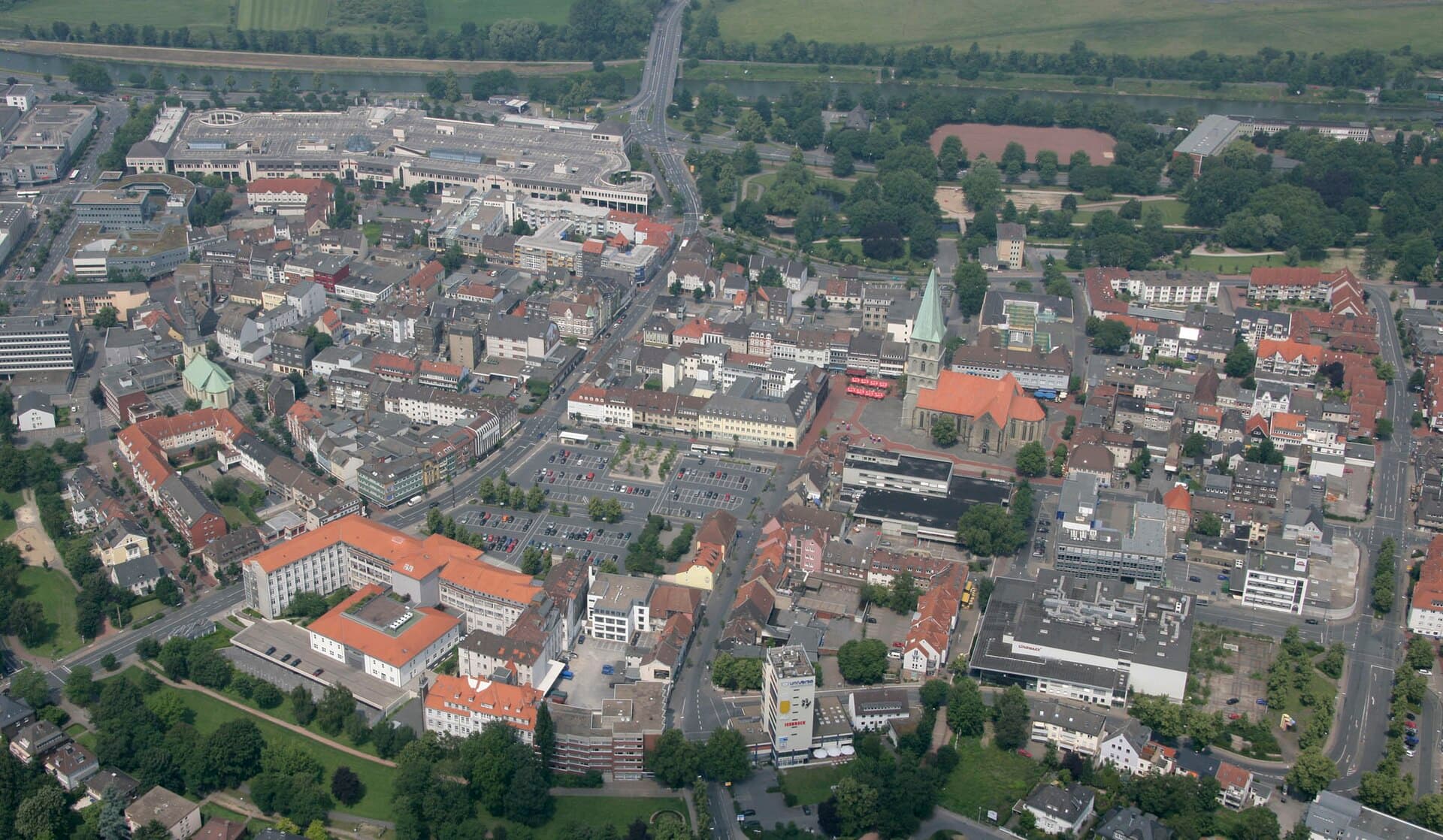
Hamm, a city in North Rhine-Westphalia, Germany, offers a blend of industrial heritage and green spaces, situated between the dynamic Ruhr region and the tranquil Münsterland. With a population of approximately 179,000, it maintains a measured atmosphere, where modern infrastructure coexists with historic buildings. The city's strategic location on the Lippe River and at the junction of major motorways (A1 and A2) has historically made it an important transport hub.
Beyond its industrial past, Hamm is a city of unexpected discoveries, from a monumental glass elephant to one of Europe's largest Hindu temples. It is a place that harmoniously blends its past with a forward-looking cultural future, offering a range of experiences for curious travelers. You will find a surprising amount of greenery, inviting parks, and a welcoming local atmosphere that encourages a peaceful and informative visit.
Hamm's commitment to transforming former industrial sites into recreational areas is evident, providing residents and visitors with ample opportunities for relaxation and engagement with nature. The city's unique attractions and historical depth invite exploration beyond the typical tourist routes.
Hamm's origins trace back to 1226, when Count Adolf I of the Mark founded the city on Ash Wednesday. The name "Hamm" itself derives from an old field name meaning "angle," referring to its location at the bend of the Lippe and Ahse rivers. The city quickly developed, granted rights to its own currency and measures, and benefited from its strategic position at the crossroads of ancient trade routes.
Hamm became the residence of the Earls of Mark and a significant member of the Hanseatic League, a powerful medieval trading organization, from 1469 to 1651. During this period, it was one of the most influential towns in the region, while many of the larger cities in the modern-day Ruhr area were still small villages.
The 17th century brought a period of decline for Hamm, marked by plague, fires, and wars, alongside the waning influence of the Hanseatic League. However, the city experienced a revitalization with the Industrial Revolution in the 19th century. The construction of the Cologne-Minden railway in 1847 and the intersecting Paderborn-Münster line in 1850 laid the groundwork for Hamm's emergence as an industrial and mining city, particularly known for its wire and machine-building industries.
Hamm's industrial prowess made it a primary target during World War II, with nearly 60% of its historic city center destroyed by air raids. Despite the devastation, the city embarked on a significant reconstruction effort. Today, Hamm continues to evolve, transforming its industrial legacy into new cultural and recreational spaces, such as the Maximilianpark, built on the site of a former coal mine.
The Maximilianpark is a prominent attraction, built on the site of a former coal mine. Its most famous feature is the Glass Elephant, a 35-meter-high (115 feet) walk-in sculpture created from the old coal-washing plant. Visitors can take an elevator in its trunk to a palm garden and a viewing platform offering panoramic views of the park and surrounding area. The park also features themed gardens, a butterfly house, and various play areas.
Another unique site is the Sri Kamadchi Ampal Temple, one of the largest Dravidian-style Hindu temples in mainland Europe. Its colorful entrance tower, adorned with numerous deity sculptures, is a striking architectural presence in an industrial setting. Visitors are welcome to experience the temple's spiritual energy and attend daily puja ceremonies.
The Kurpark offers a tranquil escape, with mature trees and the historic Art Nouveau Kurhaus, a remnant of Hamm's past as a spa town. For those interested in the city's past, the Gustav Lübcke Museum showcases archaeology, art, and cultural history collections. The Pauluskirche, a 13th-century church with an 80-meter-high (262 feet) pyramid-shaped tower, is another significant historical landmark.
The best times to visit Hamm are during the late spring (May to June) and early autumn (September to October). During these shoulder seasons, the weather is generally pleasant, and you can experience local festivals without the peak summer crowds and prices. For warm-weather activities, late June to early September offers comfortable temperatures. While summer is the busiest and most expensive, winter provides a quieter and often cheaper experience, if you do not mind cooler weather.
Hamm is well-connected by train, with direct services from major German cities like Dortmund, Düsseldorf, and Cologne. The Hamm railway station is an important hub. For air travel, Dortmund Airport (DTM) is the nearest, approximately 22 km (14 miles) away, with taxi or transfer services available. The city also has a local bus system with 14 routes.
While German is the primary language, many people in Hamm, especially in hotels, restaurants, and tourist attractions, speak English. Learning a few basic German phrases can enhance your experience. Hamm offers a range of accommodation, from budget hotels to more luxurious options. The city is generally safe, but standard travel precautions are advised.
Hamm in Korean, in Chinese or in Hebrew — and 29 more languages, every stop narrated by a native voice. The widest language range of any self-guided audio tour.
Available in: