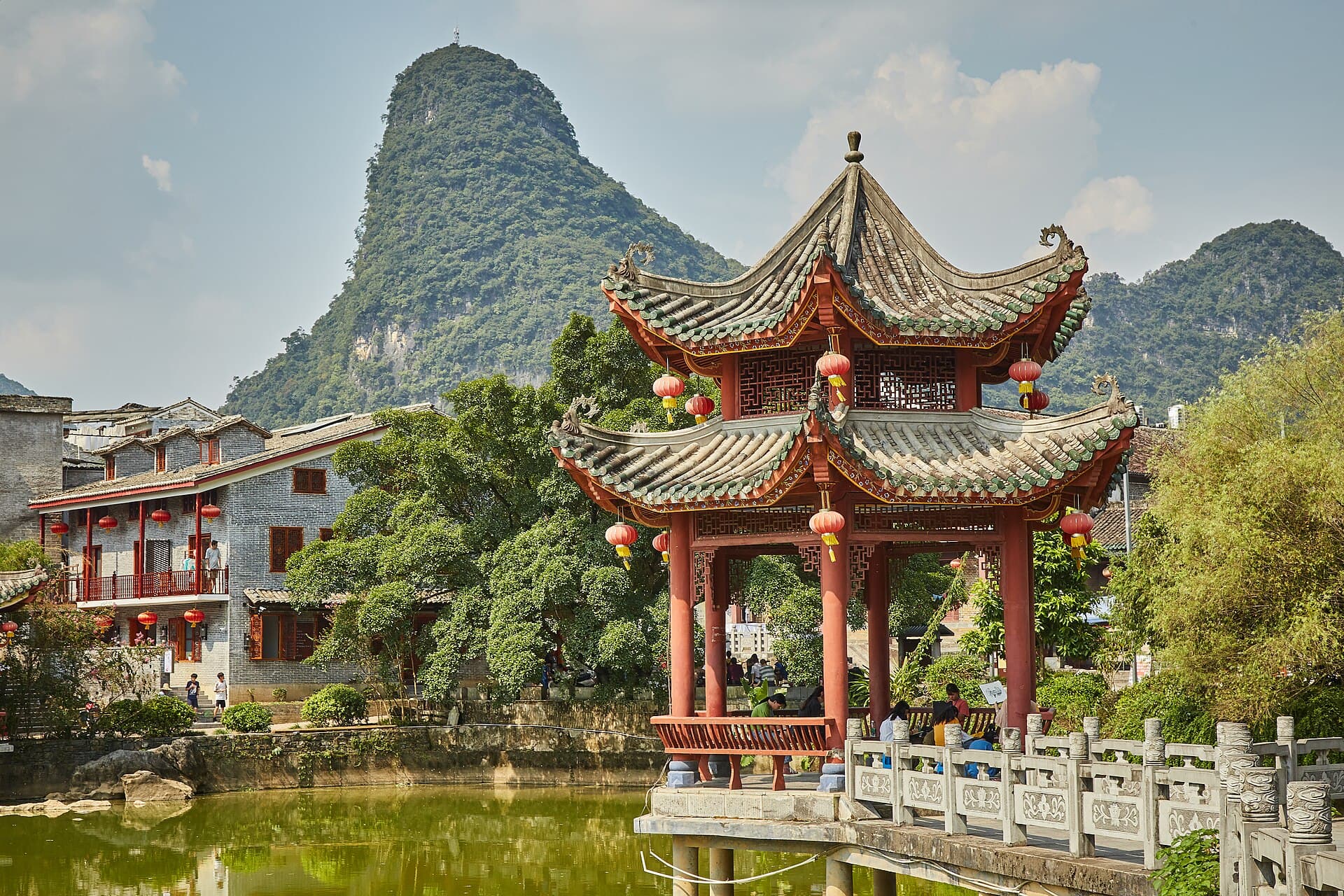
Immortal Ancient Well
The water from Huangyao's Immortal Ancient Well is fabled to bestow extraordinary longevity, yet locals cherish it for a reason beyond mere legend.
Full story unlocks in the tour
 Diego Robayo / CC BY-SA 2.0, via Wikimedia Commons
Self-guided audio walking tour of Huangyao — GPS route, offline playback, story-driven narration in 32 languages.
“Where ancient stones hum with enduring tales and rivers mirror a timeless grace.”
Not the postcards. The stories even locals don't know — whispered in your ear, right where they happened.
The water from Huangyao's Immortal Ancient Well is fabled to bestow extraordinary longevity, yet locals cherish it for a reason beyond mere legend.
Among Huangyao's venerable trees, one banyan possesses a distinctive form and a name that evokes a mythical creature.
Strolling Huangyao's ancient bluestone thoroughfares can feel like a journey through time, but these paths hold a subtle insight into their lasting smoothness.
Discover every secret of Huangyao
Every address, every reveal in full — in your ear, right where it happened.
You pick your stops. You walk. The voice reveals what the others miss.


Your self-guided audio tour of Huangyao is ready — pick your landmarks, choose your language, and start the moment you arrive.
BuyLume has a built-in augmented-reality guide. Hold your phone up and its camera shows the street ahead of you, with a glowing arrow laid over the real view that always points to your next stop — no map to puzzle over, no wrong turns. Like everything in Lume, it works fully offline.
Huangyao Ancient Town, situated in the northeast of Zhaoping County within Hezhou City, Guangxi Zhuang Autonomous Region, is a place where the clock's hands seem to slow. With a lineage stretching back over a thousand years to the Song Dynasty, this venerable settlement offers a compelling fusion of natural grandeur and preserved heritage. Encircled by dramatic karst formations and crisscrossed by three winding rivers—the Yaojiang, Small Pearl, and Xingning—Huangyao presents a landscape often likened to a 'mini-Guilin' or 'Dreamland Hometown.' Its meticulously maintained architecture, traditional way of life, and serene atmosphere make it a compelling destination for those seeking an authentic glimpse into China's past.
The town's design, shaped by Fengshui principles and conceived with defensive considerations, reveals a unique accord between human habitation and the surrounding environment. From its ancient banyan trees casting long shadows across bluestone paths to the intricate carvings adorning Ming and Qing Dynasty buildings, Huangyao invites unhurried exploration. It is a place where the murmur of flowing water and the sight of crimson lanterns at dusk conjure a poetic ambiance, providing a refreshing counterpoint to more bustling tourist locales.
Huangyao's narrative commences in the early Song Dynasty (960-1279), with settlements thought to have begun during the Kaibao era (968-977). The town's name, 'Huangyao,' was first documented during Emperor Renzong's Huangyou era (1049-1053) and originates from the two most prevalent family names of its initial inhabitants: Huang and Yao.
The town truly began to materialize and expand during the Ming Dynasty (1368-1644), particularly in the Wanli Period (1572-1620). This era saw the construction of many of the distinctive Ming-style buildings that continue to stand. Huangyao then experienced its most significant flourishing during the Qing Dynasty (1644-1911), especially under the rule of Emperor Qianlong (1735-1796). This period left an indelible mark on the town's architecture, with hundreds of well-preserved Qing Dynasty structures contributing to its antique character.
Historically, Huangyao served as a vital trade nexus due to its strategic position at the convergence of three provincial borders: Guangdong, Guangxi, and Hunan. The town's layout reflects a strong influence of Han Chinese culture and Fengshui principles, incorporating nine hills and three rivers. The arrangement of its residential complexes, linked by bridges, village gates, and gate towers, also served a protective function against adversaries and brigands. This seclusion, a consequence of its mountainous surroundings and less convenient transportation in earlier times, inadvertently fostered the remarkable preservation of its historical artifacts, including ancient writings, paintings, and the former homes of notable figures.
In more recent times, Huangyao offered sanctuary to patriots during the Anti-Japanese War (1937-1945). The town's authentic character and evocative scenery have also captured the attention of filmmakers, serving as a backdrop for the 2006 film The Painted Veil and the 2001 television drama Country Spirit. In 2022, Huangyao Ancient Town earned recognition as a state-level 5A-rated tourist attraction, acknowledging its significant cultural and natural value.
Huangyao's allure resides in its intricate details and the sensation of entering a living past. Begin your exploration on the bluestone streets, eight of which traverse the town, some dating back to the Shunzhi Period (1643-1661) of the Qing Dynasty. These smooth, worn paths connect over 300 Ming and Qing Dynasty folk houses, many adorned with exquisite carvings on their windows and doors.
Do not overlook the Dailong Bridge, the largest stone bridge in town, from the late Qing Dynasty. Its design, without banisters, harmonizes with the surrounding landscape. Nearby, the Immortal Ancient Well is a compelling five-section well system where locals continue to draw water for various purposes, illustrating sustainable living.
The town also contains numerous ancestral halls, temples, and pavilions, totaling over 30 structures. The Ancient Opera Stage, constructed in 1524 during the Ming Dynasty, stands as a notable example, with its brick and tile construction and eight pillars. Seek out the Dragon Claw Banyan, an ancient tree growing directly from a rock, its branches forming a distinctive, claw-like shape. For an encompassing view of the town, consider finding an elevated point, such as from the sixth floor of the Shichang Lvshe (Market Hotel).
Huangyao Ancient Town welcomes visitors throughout the year, but certain periods offer more agreeable weather and distinct experiences. The most pleasant weather, with comfortable temperatures ranging from 17°C to 31°C, occurs during February, September, October, November, and December. These months provide a good balance of sunny and rainy days. For photography, especially capturing the ethereal morning mist or the warm glow of lanterns at night, spending a night and exploring at sunrise or after dusk is highly recommended. Spring (March-April) brings gentle rain, creating an ink-wash painting effect, while autumn (September-November) offers crisp weather and the availability of fresh fruits. The town experiences a distinct rainy season from March to August, with June being the wettest month. Traditional festivals, such as dragon and lion dances on the second day of the Chinese lunar calendar, or the lantern-lit Hungry Ghost Festival on July 14th and 15th of the lunar calendar, provide deep cultural immersion.
Huangyao Ancient Town is situated in Zhaoping County, Hezhou City, Guangxi Province, approximately 200 kilometers southeast of Guilin and 150 kilometers southeast of Yangshuo. The admission fee is typically 100 CNY, with reductions for students, seniors, and complimentary entry for children under 1.2 meters and seniors over 70. Tickets are generally valid for three days, allowing multiple entries. One can also access the outer streets without charge before 7:30 AM or after 6:00 PM on weekdays (10:00 PM on weekends), though inner courtyards may still require a ticket.
To arrive in Huangyao, take a high-speed train to Hezhou Station and then transfer to a tourist shuttle bus (around 30 CNY, 1 hour). Long-distance buses are also available from Guilin (approximately 2.5-3 hours) and Yangshuo (around 1.5 hours) directly to Huangyao. Self-driving is an option, with parking available for about 20 CNY per day. Once within the town, wear comfortable, non-slip footwear, particularly on rainy days, as the bluestone paths can be slick. Consider an overnight stay in an old courtyard guesthouse within the town for a more profound experience, with rooms often ranging from 150-300 CNY during the off-season.
Huangyao in Korean, in Chinese or in Hebrew — and 29 more languages, every stop narrated by a native voice. The widest language range of any self-guided audio tour.
Available in: