Kargil War Memorial
The Kargil War Memorial stands as a solemn tribute, yet few realize the powerful symbolism woven into its very construction.
Full story unlocks in the tour
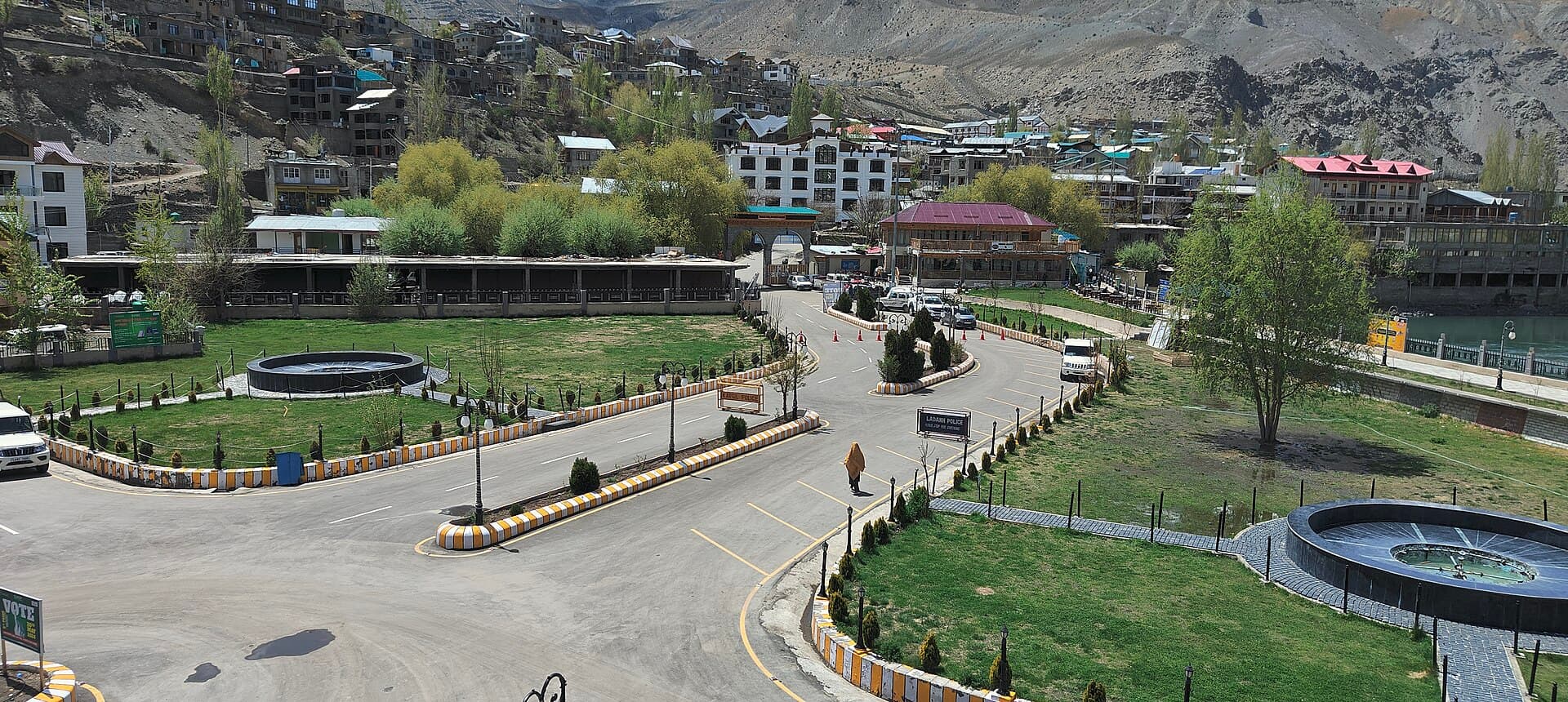 FAYAZ SHUJA / CC BY-SA 4.0, via Wikimedia Commons
Self-guided audio walking tour of Kargil — GPS route, offline playback, story-driven narration in 32 languages.
“Where mountains bear witness to enduring spirit and ancient trade routes converge.”
Not the postcards. The stories even locals don't know — whispered in your ear, right where they happened.
The Kargil War Memorial stands as a solemn tribute, yet few realize the powerful symbolism woven into its very construction.
This village, just a few kilometers from Kargil town, holds a unique and poignant secret about the human cost of borders.
Kargil's food tells a story not just of sustenance, but of deep cultural exchange and adaptation in a challenging environment.
Discover every secret of Kargil
Every address, every reveal in full — in your ear, right where it happened.
You pick your stops. You walk. The voice reveals what the others miss.


Your self-guided audio tour of Kargil is ready — pick your landmarks, choose your language, and start the moment you arrive.
BuyLume has a built-in augmented-reality guide. Hold your phone up and its camera shows the street ahead of you, with a glowing arrow laid over the real view that always points to your next stop — no map to puzzle over, no wrong turns. Like everything in Lume, it works fully offline.
Kargil, a significant town in the Ladakh region, serves as a crossroads where diverse cultures and dramatic landscapes meet. Situated at an average elevation of 2,676 meters (8,780 ft) along the banks of the Suru River, it is roughly equidistant from Srinagar and Leh. Once a vital hub on the ancient Silk Route, Kargil historically served as a meeting point for traders dealing in tea, wool, carpets, silk, and precious stones. This legacy of exchange has shaped a unique cultural tapestry, evident in its multi-ethnic population of Brogpas, Baltis, Purik, Shinas, and Ladakhis, who speak a variety of regional dialects including Shina, Balti, Purig, and Ladakhi.
Beyond its historical trade connections, Kargil holds a poignant place in modern Indian history due to the 1999 Kargil War. Today, it draws visitors not only for its natural beauty and adventure opportunities but also as a place to reflect on the sacrifices made during the conflict. The region offers a blend of serene valleys, towering peaks, and ancient monasteries, providing a distinctive experience that combines cultural immersion with patriotic remembrance.
Kargil's history is deeply intertwined with its strategic location as a former trade center on the Silk Route. The name "Kargil" itself is believed to be derived from "Khar rKil," meaning "a place between castles," or from "Gar Khil," referring to a central dwelling place. In the early 8th century, Tha Tha Khan, a scion of the Gilgit royal family, captured Kargil and established a dynasty that continues to exist in the Shakar Chiktan area. The Kacho's of Kargil are thought to be descendants of Tha Tha Khan. Another notable figure, Purik Sulatan, is credited with establishing his domain in the Suru area, ruling from Karchay Khar near Sankoo.
Islam arrived in Kargil in the 15th century with the visit of Mir Shams-ud-Din Iraqi, a Shia scholar from Central Asia, whose missionary efforts led to the conversion of local chiefs and subsequently much of the population. This has resulted in Kargil being predominantly inhabited by Shia Muslims, with religious heads and preachers known as Agas. The region was historically part of the Baltistan district of Ladakh before India's independence in 1947. After the Indo-Pakistani War of 1947-1948, the Line of Control (LoC) bisected the Ladakh district, with Kargil and Leh remaining on the Indian side.
Kargil regained international attention during the Kargil War in May-July 1999, a conflict between India and Pakistan. Pakistani forces, disguised as Kashmiri militants, infiltrated Indian territory, occupying strategic military outposts. India responded with "Operation Vijay," a military operation that involved the Indian Army and Air Force to reclaim the occupied positions. The war, fought at extreme altitudes, presented significant logistical challenges. After intense fighting and international diplomatic pressure, Pakistani forces withdrew. Kargil Vijay Diwas is celebrated annually on July 26 to commemorate India's victory and honor the sacrifices of its soldiers.
Begin your exploration at the Kargil War Memorial, also known as the Dras War Memorial, a poignant site built by the Indian Army to honor soldiers who died in the 1999 Kargil War. The memorial features a pink sandstone wall inscribed with the names of fallen heroes, and from here, you can see the Tololing Heights, Tiger Hill, and Point 4875 (Batra Top), which were key battlegrounds. A museum at the memorial showcases photographs, weapons, and artifacts from the war, including a gallery named after Captain Manoj Pandey, a recipient of India's highest military award.
Beyond the memorial, the Suru Valley offers profound natural beauty with lush green meadows, gushing rivers, and views of the majestic Nun Kun peaks, making it ideal for nature lovers and adventure seekers. The Nun Kun Massif, with peaks like Nun (7,135 m) and Kun (7,077 m), draws mountaineers. Visit ancient monasteries like Mulbekh Monastery, known for its 9-meter-tall rock-carved Maitreya Buddha statue, reflecting the region's Buddhist heritage. Other significant monasteries include Sani, Rangdum, and Zongkhul. For a glimpse into local culture and history, explore the bustling Kargil Market for traditional Ladakhi handicrafts and local delicacies, or visit the Munshi Aziz Bhat Museum, which showcases artifacts from the Silk Route era.
The best time to visit Kargil is during the summer months, from May to September. During this period, the weather is pleasant, with daytime temperatures ranging from 15°C to 30°C, making it ideal for sightseeing, trekking, and outdoor activities. The Srinagar-Leh highway, which connects Kargil, is also open during these months, ensuring easier access. While July and August offer lush green landscapes, September brings autumn colors. Winters, from October to February, are long and extremely cold, with temperatures dropping significantly, and many roads become inaccessible due to heavy snowfall.
Kargil is accessible by road, with regular buses and taxis operating from Srinagar and Leh. The journey often involves traversing the scenic Zoji La Pass, so it's essential to check road conditions, especially during winter closures. The nearest airport is Leh Kushok Bakula Rimpochee Airport, approximately 220 km away, from where you can hire a taxi or take a bus. Srinagar International Airport is another option, about 220 km from Kargil.
Accommodation in Kargil includes hotels categorized into A, B, and C, along with tourist bungalows. It is advisable to carry sufficient cash as ATMs and credit card facilities can be limited. Given the unpredictable mountain weather, even in summer, pack warm clothing for cool nights. Respect local customs and traditions, which blend Buddhist and Muslim influences, and seek permission before photographing people or religious sites. Special permits may be required for certain areas close to the Line of Control.
Kargil in Korean, in Chinese or in Hebrew — and 29 more languages, every stop narrated by a native voice. The widest language range of any self-guided audio tour.
Available in: