Jami Mosque Minaret
The elegant minaret of the Jami Mosque carries a darker, legendary past than its graceful form suggests.
Full story unlocks in the tour
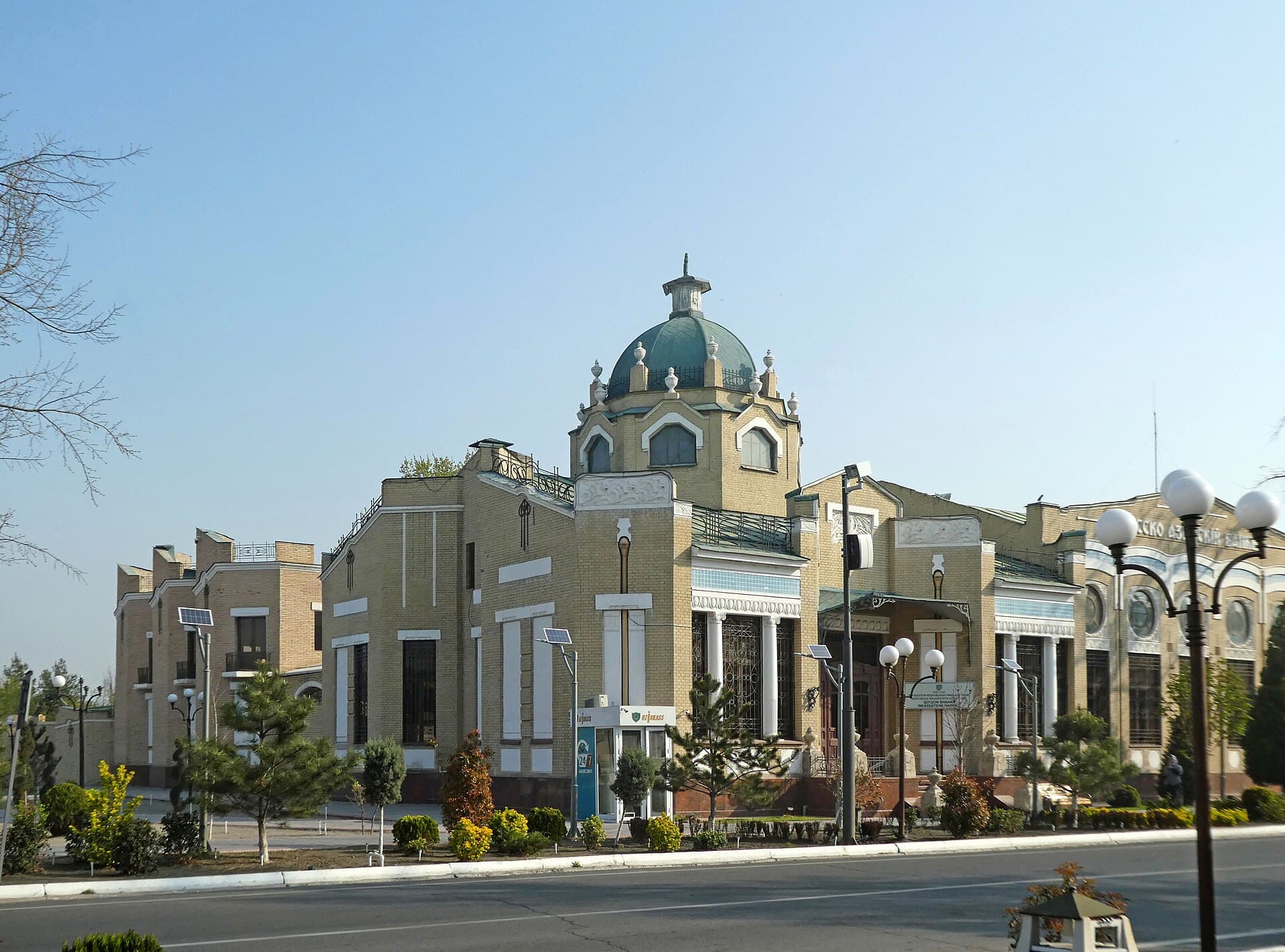 Екатерина Борисова / CC BY-SA 4.0, via Wikimedia Commons
Self-guided audio walking tour of Kokand — GPS route, offline playback, story-driven narration in 32 languages.
“Kokand: Where the Khan's legacy resonates in carved wood and intricate tiles.”
Not the postcards. The stories even locals don't know — whispered in your ear, right where they happened.
The elegant minaret of the Jami Mosque carries a darker, legendary past than its graceful form suggests.
The grand palace of Khudayar Khan, once an expansive complex, included a section dedicated to his many consorts.
This historic madrasah, a center of learning for the nobility, underwent a surprising modern relocation.
Discover every secret of Kokand
Every address, every reveal in full — in your ear, right where it happened.
You pick your stops. You walk. The voice reveals what the others miss.


Your self-guided audio tour of Kokand is ready — pick your landmarks, choose your language, and start the moment you arrive.
BuyLume has a built-in augmented-reality guide. Hold your phone up and its camera shows the street ahead of you, with a glowing arrow laid over the real view that always points to your next stop — no map to puzzle over, no wrong turns. Like everything in Lume, it works fully offline.
Kokand, a city home to approximately 250,000 residents, occupies the eastern expanse of Uzbekistan's fertile Fergana Valley. It stands at the intersection of ancient trade routes, historically linking Tashkent to the northwest and Khujand to the west. Unlike the more frequently visited Silk Road cities of Samarkand and Bukhara, Kokand offers a window into khanate-era life within a bustling urban setting, drawing fewer crowds.
The city's essence is found in its enduring architecture and lively markets, where the aroma of spices and fresh bread commingles in the air. Travelers are drawn to its khanate-era palaces and mosques, particularly the Khudayar Khan Palace, which anchors the city's historic core. Kokand rewards those who seek heritage and neighborhood strolls over luxury or expansive museums, providing a deeper understanding of the Fergana Valley's unique cultural legacy.
## From Ancient Crossroads to Khanate Capital Kokand's story reaches back to at least the 10th century, when it was recognized as Khavakand and served as a vital trading post along the caravan route connecting South and East Asia. The city, like many in Central Asia, endured destruction during the Mongol invasions of the 13th century.
The current city began to take shape as a fort in 1732. Its true ascent commenced in 1709 when Shahrukh Biy, of the Ming Tribe of Uzbeks, declared independence from the Khanate of Bukhara, establishing the Khanate of Kokand in the eastern Fergana Valley. By 1740, Kokand became the capital of this new Uzbek kingdom, which expanded significantly, eventually reaching as far as Kyzylorda in the west and Bishkek in the northeast. The khanate was a formidable state, a thriving trading center, and a major religious hub, at one point containing over 300 mosques and 25 madrasahs.
Under rulers such as Muhammad Umar Khan (1810-1822) and Muhammad Ali Khan (1821-1842), the Khanate of Kokand achieved its greatest territorial reach and cultural flourishing. Many of the city's mosques and madrasahs were constructed during this period. However, internal conflicts and external pressures led to its decline in the late 19th century. In 1868, Kokand became a Russian vassal state, and following uprisings against Russian rule and oppressive taxes, the final khan, Khudayar Khan, was compelled into exile in 1875. The Khanate of Kokand was formally absorbed by the Russian Empire in March 1876, becoming the Fergana Oblast. After national delimitation in the Soviet Union in the 1920s, Kokand was included in the Uzbek Soviet Socialist Republic. Today, it continues to evolve as a significant historical, cultural, and economic center in independent Uzbekistan.
The most prominent architectural marvel in Kokand is the Palace of Khudayar Khan, often referred to as the 'Pearl of Kokand'. Constructed between 1860 and 1872 for the last ruler of the Kokand Khanate, Khudayar Khan, this grand residence once comprised seven courtyards and 113 rooms. Today, two courtyards and 19 rooms remain, displaying intricate tilework, geometric patterns, and Arabic inscriptions. It now functions as a museum, offering guided tours.
The Jami Mosque, situated on Chorsu Square, is another significant location. Built by Muhammad Umar Khan between 1812 and 1818, it features a large courtyard, a 22-meter minaret, and a 100-meter-long iwan (portico) supported by 98 ornately carved redwood columns, reportedly sourced from India. Though closed for much of the 20th century, it reopened in 1989 after restoration and now houses a small museum of applied arts.
Other notable locations include the Kamol-Kazi Madrasah, built between 1830 and 1832, recognized for its classical Kokand architectural style and intricate ganch (plaster) work and hand-painted designs. The Modari Khan Mausoleum is part of the Dakhma-i Shakhon necropolis, a royal cemetery. For a deeper understanding of the region's heritage, consider visiting the Kokand Regional Museum on Navoi Street, which exhibits archaeological finds, traditional costumes, and khanate-era artifacts.
The most pleasant times to experience Kokand are during spring (April to June) and autumn (September to early December). During these periods, temperatures are mild, ranging from the mid-60s to low 80s°F (15-25°C), perfect for exploring the city's outdoor sites. Spring brings forth blooming poppies and apricot blossoms, while autumn is harvest season, with markets abundant with fresh produce. Summers (July and August) can be intensely hot, with temperatures frequently surpassing 100°F (37°C), making outdoor activities uncomfortable. Winters are cold, with temperatures dropping to around 30°F (-1°C).
Cash is preferred in Kokand, particularly at local markets and smaller shops, though larger establishments like hotels may accept cards. ATMs are available, but expect foreign transaction fees. Tipping is appreciated but not mandatory; rounding up the bill is a common practice.
Kokand is generally considered secure for travelers, but it's advisable to be aware in crowded areas due to potential petty theft. Exercise caution regarding overcharging for taxi rides and inflated prices from unofficial tour guides. Modest dress is recommended for both men and women, especially when visiting religious sites, meaning long pants or skirts that cover the knees and avoiding sleeveless tops.
The city center is walkable, though pavements can be uneven. Shared minivans (marschrutkas) offer an inexpensive way to travel, and taxis are readily available. Agree on a price before entering a taxi. Mobile coverage is good, and bottled water is recommended over tap water.
Kokand in Korean, in Chinese or in Hebrew — and 29 more languages, every stop narrated by a native voice. The widest language range of any self-guided audio tour.
Available in: