Kara Tepe Buddhist Complex
Imagine a Buddhist monastery where monks practiced their faith, but with an unexpected twist in its architecture and rituals.
Full story unlocks in the tour
 Zenwort / CC BY-SA 4.0, via Wikimedia Commons
Self-guided audio walking tour of Termez — GPS route, offline playback, story-driven narration in 32 languages.
“Where empires converged and Buddhism bloomed, Termez is a testament to the Silk Road's enduring spirit.”
Not the postcards. The stories even locals don't know — whispered in your ear, right where they happened.
Imagine a Buddhist monastery where monks practiced their faith, but with an unexpected twist in its architecture and rituals.
Among the thousands of artifacts, one particular discovery from the region tells a surprising tale about ancient leisure.
This ancient city, once a bustling port, was founded by a legendary conqueror, yet its exact location was lost to time for centuries.
Discover every secret of Termez
Every address, every reveal in full — in your ear, right where it happened.
You pick your stops. You walk. The voice reveals what the others miss.


Your self-guided audio tour of Termez is ready — pick your landmarks, choose your language, and start the moment you arrive.
BuyLume has a built-in augmented-reality guide. Hold your phone up and its camera shows the street ahead of you, with a glowing arrow laid over the real view that always points to your next stop — no map to puzzle over, no wrong turns. Like everything in Lume, it works fully offline.
Termez, Uzbekistan's southernmost city, rests on the northern bank of the Amu Darya river, historically known as the Oxus, marking a significant border with Afghanistan. With a history spanning over 2,500 years, Termez has been a vital crossroads on the Silk Road, acting as a bridge between diverse civilizations. This ancient oasis city has absorbed Hellenistic, Buddhist, Islamic, and Russian influences, shaping its distinct cultural landscape. Today, Termez invites travelers to explore its layered past, where the echoes of bustling trade routes and profound spiritual exchanges still resonate.
The modern city of Termez, a 19th-century creation that developed from a Russian garrison town, often serves as a base for exploring the surrounding archaeological wonders. While the contemporary urban area has a more Soviet-era feel with its wide boulevards, the true treasures lie in the ancient sites scattered across the region. Termez's strategic location ensured its role as a political, military, and cultural chameleon, shifting allegiances and even its physical location over millennia.
The origins of Termez trace back to fortified settlements in the mid-1st millennium BCE, during the era of Ancient Bactria. The city's strategic position on the Amu Darya (Oxus) River, controlling a vital crossing point, was a key factor in its development. In 329 BCE, Alexander the Great conquered the region, and Termez is widely believed to be the site of Alexandria on the Oxus, a city that flourished as part of the Greco-Bactrian kingdom.
During the Kushan Empire (1st–3rd centuries CE), Termez, then known as Termit or Ta-li-mi, became a major administrative, religious, and ideological center of Northern Bactria. It played a crucial role in the dissemination of Buddhism to China and East Asia, with monumental Buddhist monasteries like Fayaz Tepe and Kara Tepe, where Hellenistic art and Indian philosophy intertwined. Evidence of Zoroastrian-Buddhist syncretism, including Buddhist monasteries with fire altars, has been found from this period.
The city was conquered by the Umayyad Caliphate in 676 CE, and later gained religious significance during the Abbasid and Samanid empires, producing notable Islamic scholars such as al-Tirmidhi and al-Hakim al-Tirmidhi. In the 13th century, Old Termez was razed by Genghis Khan's Mongol forces after a two-day siege. A new city emerged in the 14th century as part of the Timurid empire, a few kilometers southeast of the old location. The current city of Termez originated in the 19th century as a Russian garrison town on the southernmost border of the Russian Empire, serving as a significant frontier outpost for decades.
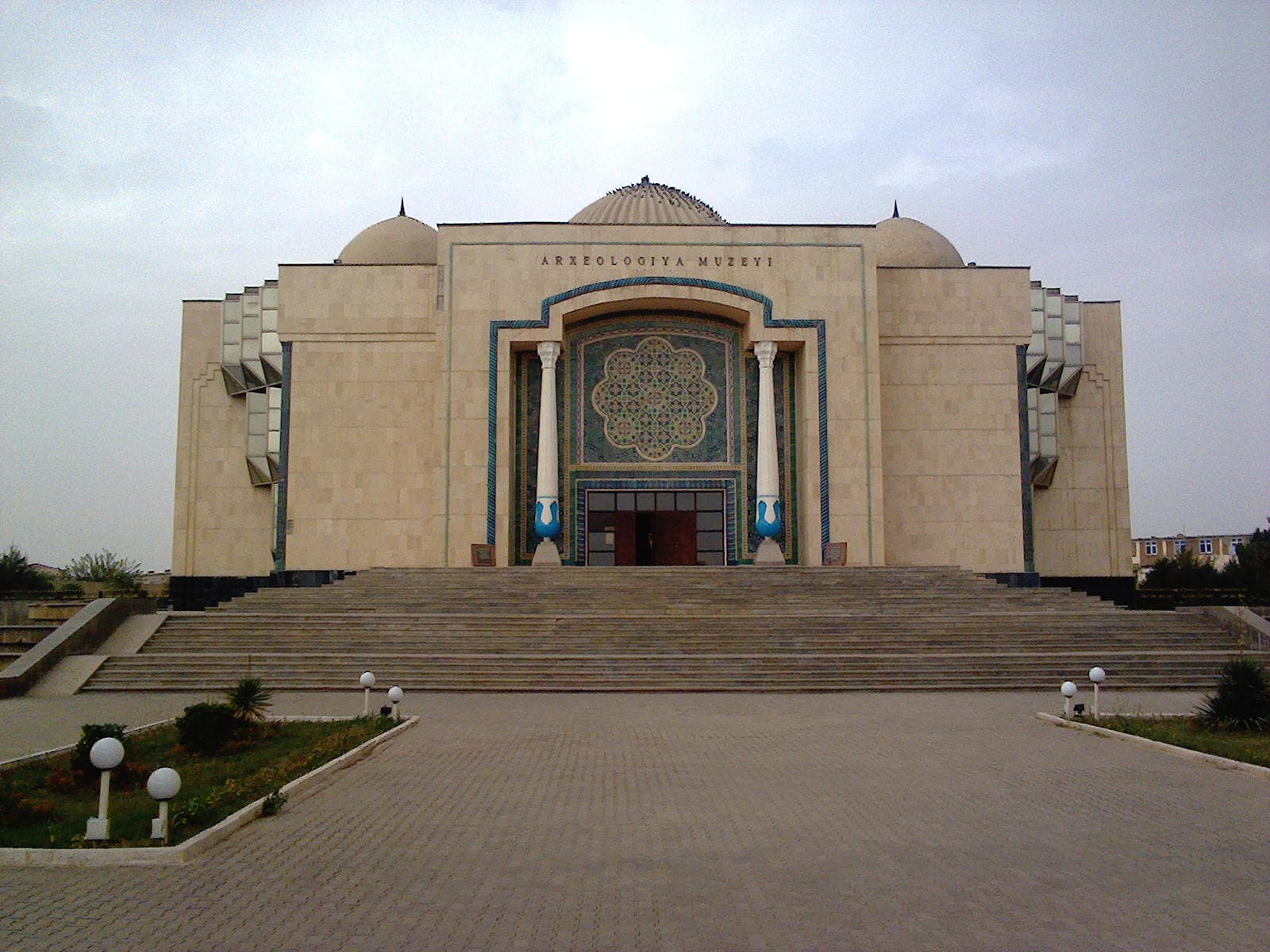
Termez offers a captivating journey through ancient history, with its most compelling sites located outside the modern city center. Begin at the Termez Archaeological Museum, which houses an extensive collection of artifacts from the Greco-Bactrian, Kushan, and Islamic periods, providing essential context for the region's deep past. Key exhibits include Buddhist artifacts from the 3rd-4th centuries and Bronze Age ceramics.
Just a few kilometers northwest of modern Termez lie the ruins of Old Termez, a sprawling archaeological site that was once divided into a city and a suburb. Here, you can explore the remnants of various civilizations. The Fayaz Tepe Buddhist Monastery, dating from the 1st to 3rd centuries CE, showcases the flourishing of Buddhism with its complex architecture and relics, including a well-preserved Buddha statue. Nearby, the Kara Tepe Buddhist Complex is a rock-cut temple complex founded in the 2nd century CE, offering insights into early Buddhist practices. The Zurmala Tower, a solitary remnant of an ancient Buddhist stupa, stands as one of Uzbekistan's oldest structures.
Further afield, Kampyr Tepe, believed to be Alexander the Great's Alexandria on the Oxus, reveals a fortified city with a harbor, citadel, and temples. For Islamic heritage, visit the Sultan Saodat Complex, an ensemble of mausoleums from the 11th to 17th centuries, and the Al-Hakim al-Tirmidhi Mausoleum, a revered pilgrimage site dedicated to a 9th-century Sufi scholar.
The best time to visit Termez is during the spring (April to June) and autumn (September to October) months. During these periods, the weather is mild and comfortable, with temperatures ranging from 20°C to 30°C (68°F to 86°F), making outdoor exploration enjoyable. Summers (July to August) can be extremely hot, often exceeding 35°C (95°F), with historical highs reaching 50°C (122°F). Winters (November to March) are mild but can be cold for outdoor activities, with temperatures between 5°C and 15°C (41°F to 59°F). March should be avoided due to heavy rainfall.
The official currency in Termez is the Uzbek Sum (UZS). It is advisable to carry cash, especially smaller denominations, as bank cards may only be accepted in larger hotels and some restaurants. For getting around the city, taxis are the most convenient option. It's recommended to agree on the fare before starting your journey, as meters might not always be used. Public transport, consisting of buses and minibuses, can be challenging for newcomers to navigate. For exploring sites outside the city, arranging a car with a driver through your hotel or a tour service is highly recommended to save time and avoid the heat.
Termez is generally considered safe for travelers, including solo female travelers, but it's always wise to be vigilant about your belongings and avoid walking alone late at night. Due to the hot climate, especially during warmer months, bring sunscreen, a hat, sunglasses, and lightweight, long-sleeved clothing. The land border with Afghanistan is heavily guarded and has been closed for passengers since 2021; avoid travel within 5 km of this border due to security concerns.
Termez in Korean, in Chinese or in Hebrew — and 29 more languages, every stop narrated by a native voice. The widest language range of any self-guided audio tour.
Available in: