The Savitsky Museum
This distant museum safeguards a collection of art, rescued from Soviet destruction.
Full story unlocks in the tour
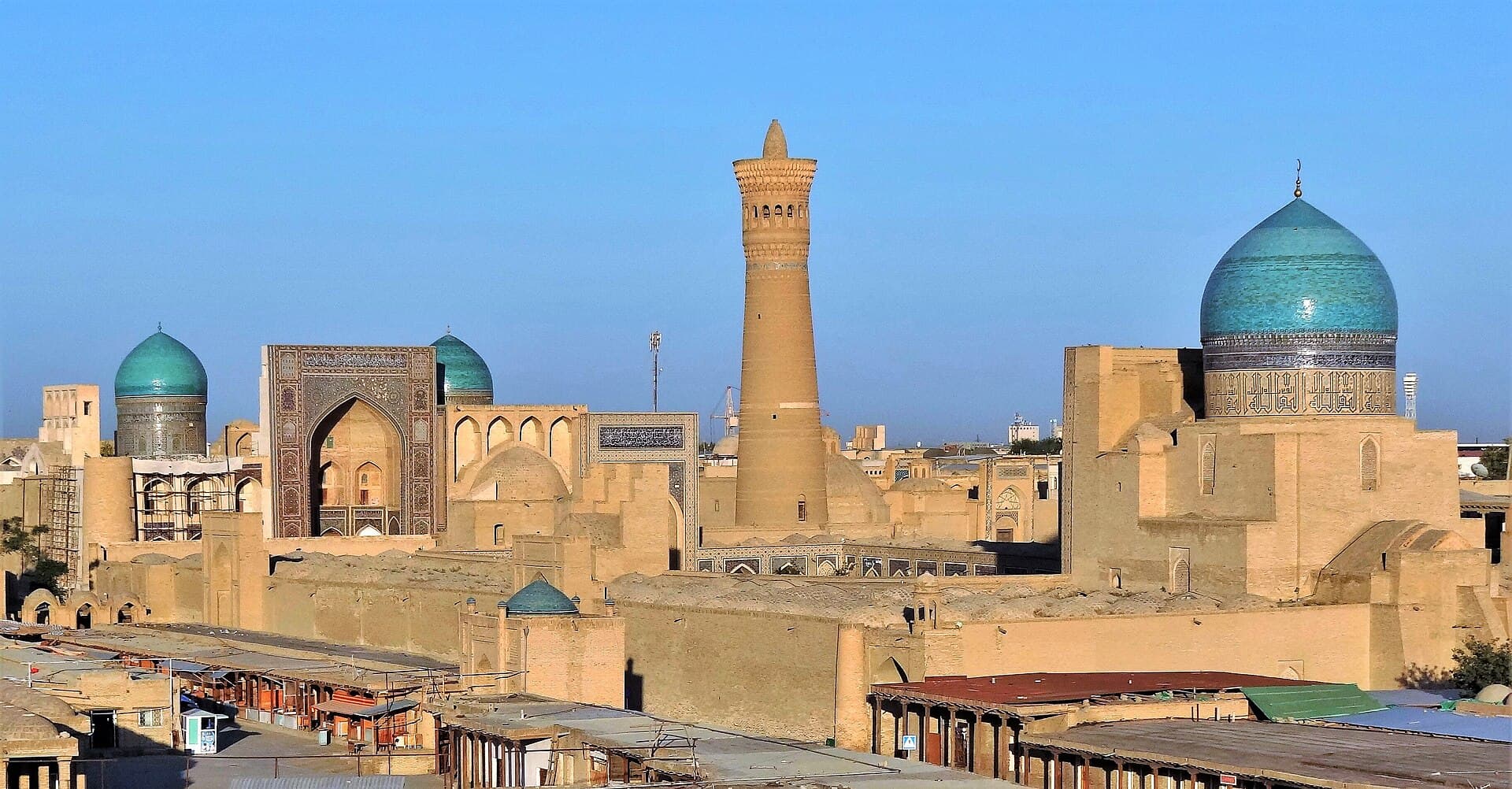 Photo of Bukhara, via Wikimedia Commons
Self-guided audio walking tour of Nukus — GPS route, offline playback, story-driven narration in 32 languages.
“Where art, once forbidden, thrives amidst the desert's expanse, marking where a sea once spread.”
Not the postcards. The stories even locals don't know — whispered in your ear, right where they happened.
This distant museum safeguards a collection of art, rescued from Soviet destruction.
A specific tomb here is said to function as a cosmic clock, counting down to the world's conclusion.
This ancient location holds a love story as sorrowful as any epic romance.
Discover every secret of Nukus
Every address, every reveal in full — in your ear, right where it happened.
You pick your stops. You walk. The voice reveals what the others miss.


Your self-guided audio tour of Nukus is ready — pick your landmarks, choose your language, and start the moment you arrive.
BuyNukus, the capital of the autonomous Republic of Karakalpakstan, offers a singular journey into a less-traveled corner of Uzbekistan. Enveloped by the expansive Kyzylkum, Karakum, and Ustyurt deserts, this city may not immediately evoke visions of Silk Road grandeur, yet it possesses a distinct charm. It is a place where ancient narratives, a lively indigenous culture, and the stark realities of environmental transformation converge, providing an authentic experience away from more frequented tourist routes.
While often regarded as a passage to the receding Aral Sea, Nukus itself is a city in flux, with new constructions appearing alongside echoes of its Soviet past. It is a destination to immerse oneself in the distinctive heritage of the Karakalpak people, a Turkic-speaking ethnic group with deep nomadic origins, whose language and customs bear more resemblance to Kazakhs than Uzbeks. From internationally recognized art collections to ancient necropolises veiled in legend, Nukus promises an enriching and reflective adventure.
The land where Nukus now stands holds a history stretching back millennia. Archaeological findings indicate a fortified settlement called Shurcha thrived here between the 4th century BC and the 4th century AD. This ancient outpost served as a crucial defensive position within the Khorezm state, overseeing vital waterways along the Amu Darya River.
The name "Nukus" itself is thought to be linked to one of the Karakalpak tribes, with early references to a military fortress bearing this name appearing in 12th-century chronicles. However, a permanent settlement did not truly emerge until the mid-19th century, initially as a small village (aul) and later as a Cossack frontier station.
Nukus officially attained city status in 1932, a pivotal moment marking its transformation from a rural area to an urban center. Just seven years later, in 1939, it superseded Turtkul as the capital of the Kara-Kalpak Autonomous Soviet Socialist Republic. This relocation was partly due to Turtkul's susceptibility to flooding from the Amu Darya, and it provided significant momentum for Nukus's administrative and cultural growth. Throughout the Soviet era, particularly in the 1950s and 60s, Nukus rapidly developed into a modern Soviet city, characterized by broad avenues and substantial public edifices. Its strategic yet isolated position also contributed to its role as a notable center for chemical weapons research during this period.
Following Uzbekistan's independence in 1991, Nukus was affirmed as the capital of the Republic of Karakalpakstan, an autonomous republic within Uzbekistan. Today, the city continues to evolve, balancing its Soviet-era infrastructure with new developments, all while serving as a vital hub for preserving and displaying Karakalpak culture and addressing the ongoing environmental challenges of the Aral Sea region.
The primary attraction in Nukus is the Savitsky Museum, formally known as the State Museum of Arts of the Republic of Karakalpakstan. Frequently referred to as the "Louvre in the Desert," it contains the world's second-largest collection of Russian avant-garde paintings, many of which were proscribed during the Soviet era and discreetly preserved by its founder, Igor Savitsky. Beyond the avant-garde, the museum also displays an impressive collection of Karakalpak applied arts, including textiles, jewelry, and ceramics, as well as archaeological artifacts from the area.
Approximately 20 kilometers beyond the city, the Mizdakhan Necropolis is a significant archaeological location dating back to the 4th century BC. This expansive complex encompasses a citadel, fortress, and numerous tombs, with the 12th-14th century Mazlumkhan Sulu mausoleum being particularly notable for its glazed turquoise tiles. Nearby, the Mausoleum of Shamun Nabi is enveloped in local legends.
For a deeper understanding of local history and culture, explore the State Museum of the History and Culture of Karakalpakstan (also known as the Regional History Museum). It provides essential context for the region's ancient civilizations and exhibits traditional Karakalpak crafts. The Amet and Ayimkhan Shamuratovs House Museum offers a glimpse into Karakalpak music and oral culture through personal belongings, photographs, and manuscripts.
Nukus also serves as the main departure point for excursions to the Aral Sea Ship Cemetery in Moynaq, a poignant reminder of the sea's dramatic retreat. This journey often includes traversing eerie remnants of once-flourishing fishing towns.
The most agreeable times to visit Nukus are during the spring (April-May) and autumn (September-October) months. In these periods, daytime temperatures are mild and comfortable, ranging from 15°C to 25°C (59°F to 77°F), making it ideal for exploring the city and its surroundings. Spring brings blossoming flora and cultural observances, while autumn offers clear, dry weather and beautiful seasonal colors. Summers (June-August) are exceedingly hot, with temperatures often surpassing 38°C (100°F), intensified by the surrounding desert. Winters (December-February) are severe and cold, with temperatures falling below freezing and strong winds.
Nukus is well-connected by air, with Nukus International Airport (NCU) offering direct flights from Tashkent, Istanbul, Moscow, and other regional cities. The airport is conveniently situated just a few kilometers north of the city center, with public buses and taxis providing straightforward access. For those preferring rail, sleeper trains from Tashkent operate several times a week, and connections are available from other Uzbek cities like Samarkand and Bukhara (though a transfer in Urgench is often necessary for Khiva). Shared taxis and buses also present options for regional travel.
Within Nukus, taxis are abundant and economical for navigating the city. The local currency is the Uzbekistani Som (UZS). While Uzbek is an official language, Karakalpak is also widely spoken, and learning a few Karakalpak phrases can be warmly received by local residents. It is advisable to carry ample water, especially when venturing into desert areas or to the Aral Sea, and to wear sturdy, closed-toe footwear due to the terrain.
Nukus in Korean, in Chinese or in Hebrew — and 29 more languages, every stop narrated by a native voice. The widest language range of any self-guided audio tour.
Available in: