Molhes da Barra
In Laguna, a singular alliance between humans and bottlenose dolphins has endured across generations.
Full story unlocks in the tour
 Wilson Schuelter / CC BY-SA 4.0, via Wikimedia Commons
Self-guided audio walking tour of Laguna — GPS route, offline playback, story-driven narration in 32 languages.
“Where history's tides meet nature's rhythm.”
Not the postcards. The stories even locals don't know — whispered in your ear, right where they happened.
In Laguna, a singular alliance between humans and bottlenose dolphins has endured across generations.
Beyond the artifacts honoring a revolutionary heroine, a rare botanical specimen flourishes here.
Along a secluded shoreline, a towering rock formation stands, its origins veiled in local lore.
Discover every secret of Laguna
Every address, every reveal in full — in your ear, right where it happened.
You pick your stops. You walk. The voice reveals what the others miss.


Your self-guided audio tour of Laguna is ready — pick your landmarks, choose your language, and start the moment you arrive.
BuyLume has a built-in augmented-reality guide. Hold your phone up and its camera shows the street ahead of you, with a glowing arrow laid over the real view that always points to your next stop — no map to puzzle over, no wrong turns. Like everything in Lume, it works fully offline.
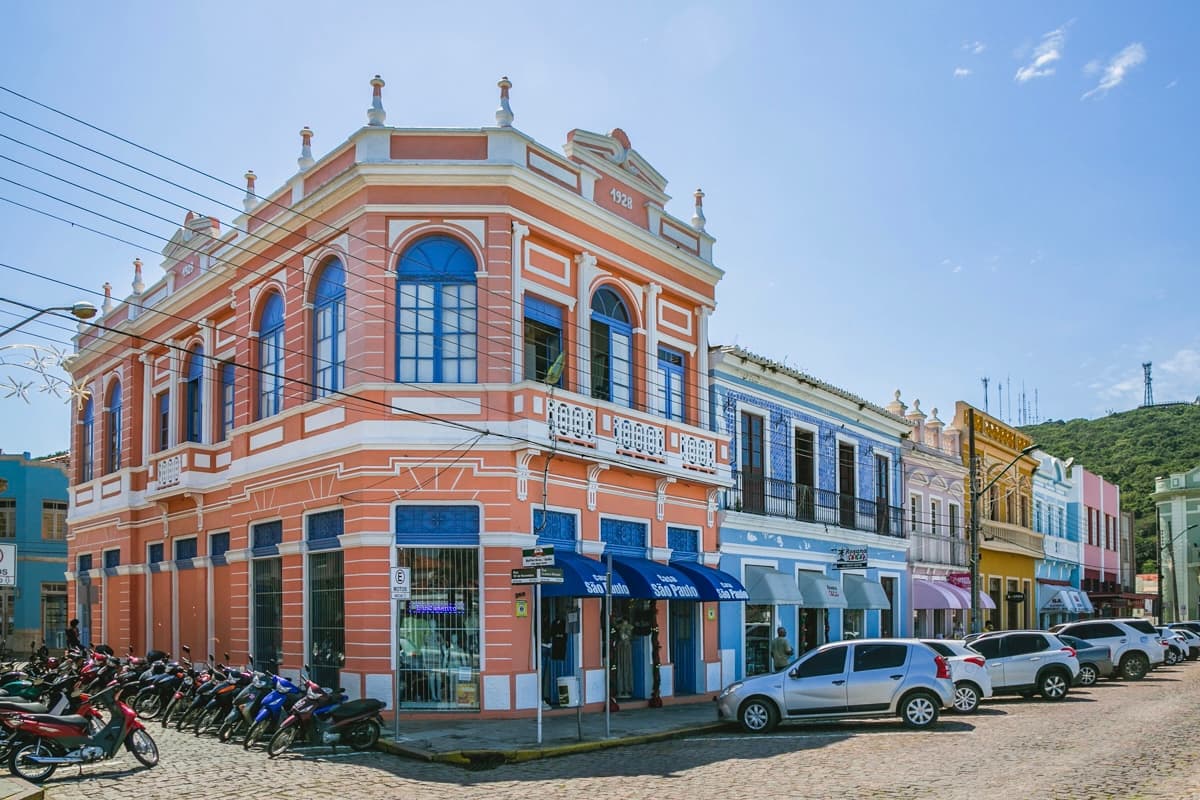
Laguna, a coastal city in the southern Brazilian state of Santa Catarina, presents a compelling fusion of natural splendor and historical depth. With a population exceeding 50,000, it is known for its expansive beaches, tranquil lagoons, and a distinctive cultural identity. The city's allure stems from its meticulously preserved colonial architecture and a relaxed, welcoming atmosphere.
Positioned on the Atlantic coast, Laguna offers access to both sandy expanses and serene lagoons, making it an excellent location for various water activities and nature exploration. Beyond its scenic landscapes, Laguna occupies a significant place in Brazilian history, particularly for its involvement in 19th-century revolutionary movements. It is a destination that promises a unique Brazilian encounter, blending seaside recreation with cultural insights.
## Early Settlement and Colonial Era Laguna's origins can be traced to 1676, when rural settlers from the capitania of São Vicente established the community. In 1684, Domingos de Brito Peixoto formally founded the seaport. The Portuguese Crown encouraged settlement in Laguna to counteract the advancing Spanish Jesuits, who were establishing missions in the region. By 1694, the community had transitioned from a farming and fishing settlement to one centered on grazing. The locality achieved recognition as a municipality in 1714 and was granted city status in 1847.
## The Juliana Republic and Revolutionary Spirit Laguna played a central role in 19th-century regional uprisings, most notably serving as the capital of the short-lived Juliana Republic in 1839. This republican movement was allied with broader rebellions in southern Brazil, reflecting a period of considerable political unrest. The city's historical identity is also interwoven with the figures of Italian revolutionary Giuseppe Garibaldi and his Brazilian companion, Anita Garibaldi. Anita Garibaldi, often referred to as the "Heroine of the Worlds," gained renown for her participation in these struggles alongside her husband. Her narrative and local memorials contribute substantially to Laguna's profound historical account.
## Economic and Cultural Development Throughout its existence, Laguna's economy has been shaped by its coastal location. Early on, it developed into an out-migration area as its residents moved south to the plains of Rio Grande do Sul. In the 18th century, a newly opened road facilitated the livestock trade, connecting Laguna to São Paulo and the mines of Minas Gerais. Today, the city's economy relies on artisanal fishing, coastal tourism, and services supporting visitors. This combination of historical importance, natural attractions, and ongoing traditions, such as the unique dolphin-fishermen cooperation, continues to define Laguna's character.
Laguna's historic center serves as an excellent starting point, with colonial buildings and museums that recount the region's past. The Church of Santo Antônio dos Anjos, an example of Baroque architecture, is a notable edifice. The Anita Garibaldi Museum is dedicated to the life of the Brazilian heroine. Visitors can also view the Anita Garibaldi Monument.
For coastal panoramas, the Farol de Santa Marta, a lighthouse, offers expansive views of the Atlantic Ocean. Praia do Mar Grosso is Laguna's primary beach, suitable for sunbathing and surfing. Molhes da Barra is a location for fishing and observing dolphins. The Lagoon District features lagoons ideal for kayaking, bird watching, and nature strolls. Praia do Gi is another beach celebrated for its dunes. A drive across the sand can lead to Pedra do Frade, a rocky elevation providing views.
The most favored time to visit Laguna for warm-weather activities is from December to March, when the climate is mild and suitable for beach recreation. For fewer crowds and more temperate conditions, consider a visit during the shoulder seasons in spring (mid-March to early June) or autumn (mid-August to mid-December). The dry season in southern Brazil generally extends from March to November. Rainfall is highest in February and lowest in April.
Laguna is located on the Atlantic coast of southern Brazil, within the state of Santa Catarina. It lies approximately 120 kilometers south of Florianópolis, the state capital. The BR-101 coastal highway traverses the municipality, ensuring accessibility by road. While in Laguna, you can explore the historic center on foot, where charming streets lead to colonial architecture. For travel to beaches and other attractions further afield, local transportation or a rental car would be advantageous. Parking in the historic center can be challenging, often requiring a 'card'. Many local beaches offer gentle waves and soft sand, making them suitable for families, with lifeguards present at popular locations.
Laguna in Korean, in Chinese or in Hebrew — and 29 more languages, every stop narrated by a native voice. The widest language range of any self-guided audio tour.
Available in: