Hexenbürgermeisterhaus
The Hexenbürgermeisterhaus, or 'Witch Mayor's House,' bears a name that hints at a dark chapter. The mayor it refers to wasn't accused of witchcraft himself.
Full story unlocks in the tour
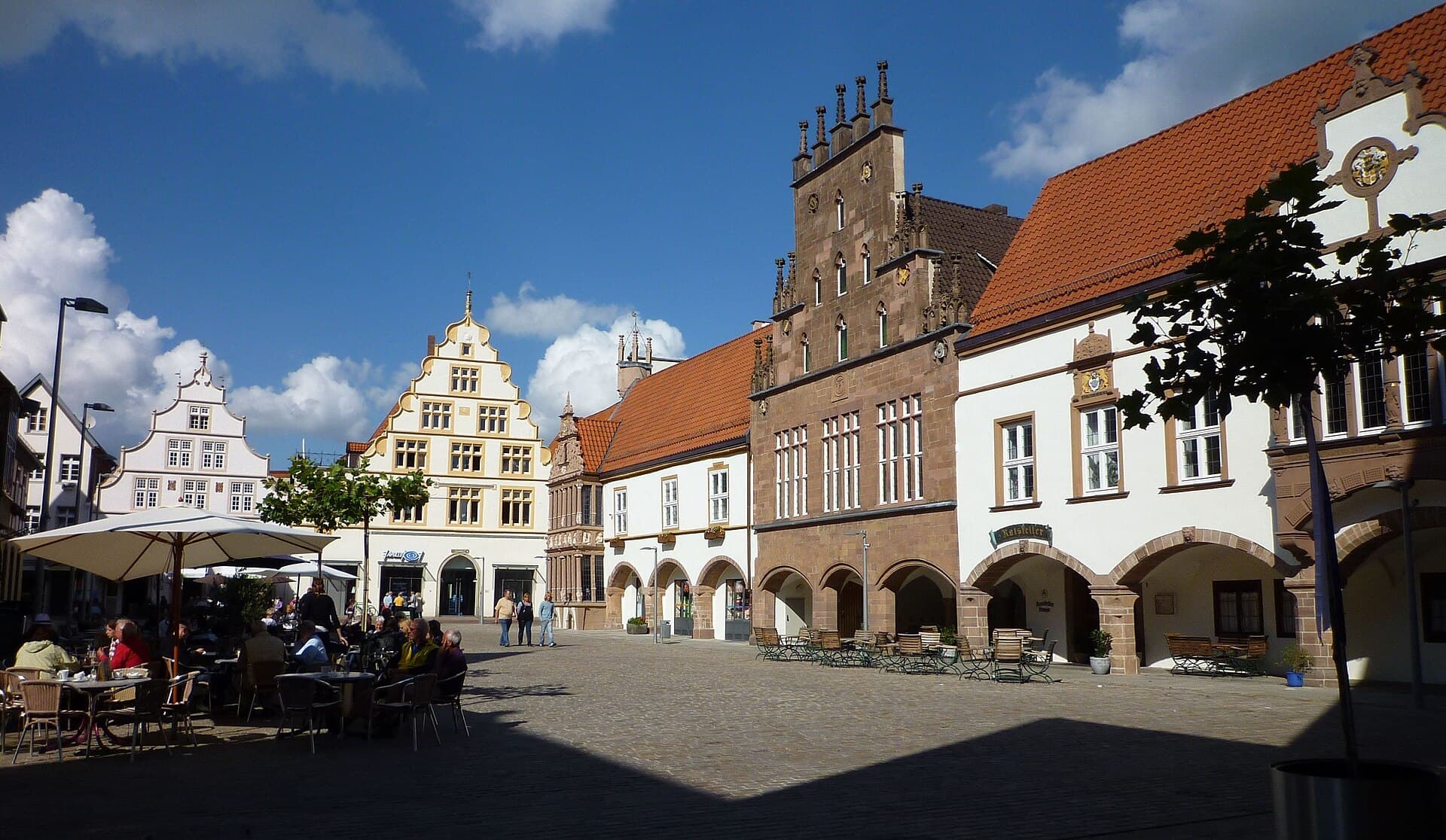 Franzfoto / CC BY-SA 3.0, via Wikimedia Commons
Self-guided audio walking tour of Lemgo — GPS route, offline playback, story-driven narration in 32 languages.
“Where Weser Renaissance architecture meets tales of resilience and artistic obsession.”
Not the postcards. The stories even locals don't know — whispered in your ear, right where they happened.
The Hexenbürgermeisterhaus, or 'Witch Mayor's House,' bears a name that hints at a dark chapter. The mayor it refers to wasn't accused of witchcraft himself.
The Junkerhaus is a two-story half-timbered house that looks like a fantastical carving. Its creator, Karl Junker, lived a life as intricate and solitary as his art.
The 13th-century St. Nicolai Church is a prominent landmark with two towers that locals affectionately call 'the unalike brothers.'
Discover every secret of Lemgo
Every address, every reveal in full — in your ear, right where it happened.
You pick your stops. You walk. The voice reveals what the others miss.


Your self-guided audio tour of Lemgo is ready — pick your landmarks, choose your language, and start the moment you arrive.
BuyLume has a built-in augmented-reality guide. Hold your phone up and its camera shows the street ahead of you, with a glowing arrow laid over the real view that always points to your next stop — no map to puzzle over, no wrong turns. Like everything in Lume, it works fully offline.
Lemgo, a historic town in the Lippe district of North Rhine-Westphalia, Germany, offers a journey through centuries of European unfolding. Founded around 1190 by Bernard II, Lord of Lippe, at the crossroads of two significant trade routes, it quickly became the oldest town in the Lippe district and a prominent member of the Hanseatic League. Today, with a population of approximately 45,000, Lemgo is recognized for its remarkably preserved medieval town center, which survived World War II largely undamaged.
The town's architectural landscape is a testament to its past prosperity, featuring impressive stone-gabled houses and half-timbered buildings in late-Gothic and Weser Renaissance styles. Beyond its historical character, Lemgo is also a university town and a hub for research and innovation, particularly in mechanical engineering and industrial electronics. This blend of ancient heritage and modern dynamism creates a distinctive atmosphere, inviting visitors to explore its storied streets and contemporary life.
Lemgo's origins trace back to approximately 1190, established by Bernard II, Lord of Lippe, at a strategic intersection of medieval trade routes. This advantageous location propelled its growth into a significant trading center, leading to its membership in the Hanseatic League, a powerful medieval trading association. This affiliation brought considerable wealth, evident in the town's enduring architecture.
The 16th century marked a pivotal period for Lemgo with the advent of the Protestant Reformation. In 1522, Lemgo embraced Lutheranism, a decision that created tension with the then-Catholic ruling Counts of Lippe. The town's citizens actively demonstrated their Protestant faith, challenging Count Simon V of Lippe, who opposed the Reformation. After a period of dispute and mediation, Lemgo formally adopted the Lutheran Reformation in 1533.
However, religious tensions resurfaced in 1605 when Count Simon VI of Lippe converted to Calvinism and attempted to impose this faith on Lemgo's citizens. This led to the 'Revolt of Lemgo,' a significant disagreement that was eventually resolved by the Peace of Röhrentrup in 1617. This agreement granted Lemgo the right to determine its own faith, a confessional divide that persists to some extent today. The town also endured a siege during the Thirty Years' War in 1638.
A darker chapter in Lemgo's history unfolded during the 17th century, when it became a focal point for some of Germany's most severe witch trials. Between 1665 and 1681, an estimated 250 people, predominantly women, fell victim to these persecutions. The infamous 'Hexenbürgermeister' (Witch Mayor) Hermann Cothmann, who resided in the Hexenbürgermeisterhaus, played a central role, using the trials to consolidate his power and eliminate perceived opponents.
Remarkably, Lemgo's historic town center remained largely undestroyed during World War II, preserving its Renaissance-era character. In the post-war era, from 1947 to 1993, Lemgo hosted soldiers from the British Army at Stornoway Barracks. Today, Lemgo is not only a guardian of its past but also a forward-looking university town. It is home to the University of Applied Sciences and Arts Ostwestfalen-Lippe (TH OWL) and a Fraunhofer Institute research facility, contributing to its role as an important center for mechanical engineering and industrial electronics in Germany.
Begin your exploration in the Marktplatz, Lemgo's central square, surrounded by ancient buildings that reflect various historical periods. Here, you'll find the Town Hall, a building of European significance constructed between 1325 and 1612, showcasing Gothic and Weser Renaissance styles. The ground floor of the Town Hall even houses a historic pharmacy, the first in the principality, opened in the mid-17th century.
A short walk will lead you to the Hexenbürgermeisterhaus (Witch Mayor's House), an ornate Weser Renaissance building from 1568-1571. This house, now a museum, delves into Lemgo's past, including the dark history of the witch trials. Don't miss the Junkerhaus, a unique half-timbered house built by artist Karl Junker between 1891 and 1912. Its exterior is covered in intricate carvings, and the ornamentation continues inside, making it a Gesamtkunstwerk.
The St. Nicolai Church, a 13th-century Gothic structure with its distinctive 'unalike brothers' twin towers, is Lemgo's most famous landmark. Another significant site is Brake Castle, a moated Renaissance castle built on the foundations of one of Northern Germany's largest medieval fortresses. It houses the Weser Renaissance Museum, showcasing art and culture from that period. For a peaceful retreat, explore the former ramparts, which now form a green belt around the town.
The best time to visit Lemgo for pleasant weather and outdoor activities is from late June to late August. During these summer months, temperatures are warm, with average highs around 24°C (75°F) in July. The skies are also clearest in July, offering more opportunities for sightseeing. While there is a possibility of rain during summer, it's generally a comfortable time to explore the town's historic center and enjoy local festivals. For those who prefer to avoid peak tourist crowds, late spring (May-June) or early autumn (September-October) also offer good weather with fewer visitors.
Lemgo is located in North Rhine-Westphalia, approximately 25 kilometers (15 miles) east of Bielefeld and 70 kilometers (43 miles) west of Hannover. The closest international airports are Paderborn Lippstadt Airport (50 km south), Hannover Airport (70 km northeast), Münster/Osnabrück Airport (85 km west), and Dortmund Airport (105 km southwest). The town is accessible by train via the RB 73 'The Lipperländer' line, which runs hourly to Bielefeld main station, and the Innovation Campus Lemgo even has its own train station, Lemgo-Lüttfeld. The nearest major highway, Bundesautobahn 2 (A2), is just 9 kilometers (5.6 miles) west of Lemgo.
Within Lemgo, the historic city center is compact and walkable, allowing easy access to most attractions. The town offers a variety of shops, from branch stores to owner-operated boutiques. For local news and events, you can check sources like Lemgo Radio or local news websites.
Lemgo in Korean, in Chinese or in Hebrew — and 29 more languages, every stop narrated by a native voice. The widest language range of any self-guided audio tour.
Available in: