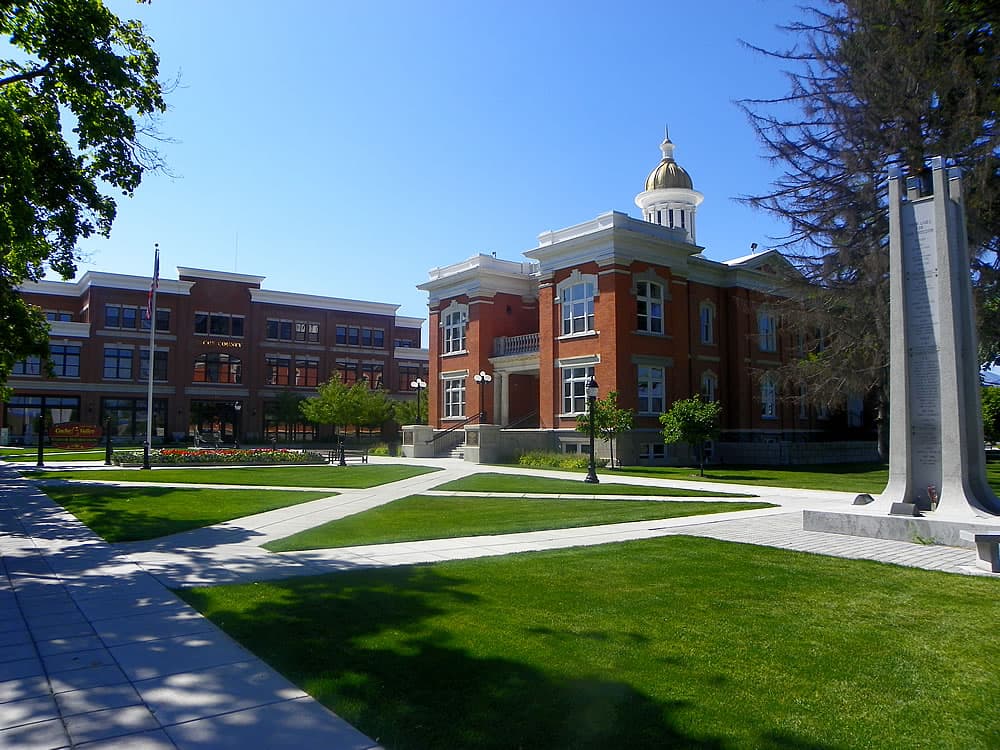
Logan Utah Temple
The grand Logan Utah Temple, a monument crafted by early settlers, once presented a different face to the world.
Full story unlocks in the tour
 UtahStizzle / Public domain, via Wikimedia Commons
Self-guided audio walking tour of Logan — GPS route, offline playback, story-driven narration in 32 languages.
“Where canyon adventures meet academic distinction and pioneer resolve.”
Not the postcards. The stories even locals don't know — whispered in your ear, right where they happened.
The grand Logan Utah Temple, a monument crafted by early settlers, once presented a different face to the world.
The prominent 'A' adorning Utah State University's Old Main tower carries a tale of its beginnings.
The Logan Tabernacle, a foundational structure for the community, experienced considerable delays during its construction, for reasons that might surprise you.
Discover every secret of Logan
Every address, every reveal in full — in your ear, right where it happened.
You pick your stops. You walk. The voice reveals what the others miss.


Your self-guided audio tour of Logan is ready — pick your landmarks, choose your language, and start the moment you arrive.
BuyLume has a built-in augmented-reality guide. Hold your phone up and its camera shows the street ahead of you, with a glowing arrow laid over the real view that always points to your next stop — no map to puzzle over, no wrong turns. Like everything in Lume, it works fully offline.
Logan, Utah, unfolds in the heart of Cache Valley, embraced by the dramatic crests of the Wasatch Range. Established in 1859 by Latter-day Saint settlers, the city weaves together a profound pioneer legacy with the dynamic energy of a university town. Logan serves as the administrative center of Cache County and stands as the primary city of the Logan metropolitan area, which extends into southeastern Idaho.
The city's identity is deeply intertwined with Utah State University (USU), a public land-grant research institution founded in 1888. USU's presence infuses Logan with a lively atmosphere, offering a convergence of academic pursuits, cultural events, and a youthful spirit. Beyond the university, Logan provides access to extensive outdoor recreation, with Logan Canyon presenting opportunities for hiking, fishing, and scenic drives.
The story of Logan begins in the spring of 1859, when Brigham Young dispatched groups of Latter-day Saint settlers to Cache Valley to establish a fort near the Logan River. The community received its name from Ephraim Logan, an early fur trapper who frequented the area. By March 1860, the settlement had expanded to 100 houses, arranged with wide streets in a grid pattern, echoing Salt Lake City's design. Logan swiftly became the largest settlement in Cache Valley due to its central location and abundant water, vital for both mills and irrigation.
Early enterprises included a sawmill, lime kiln, and tannery, with one of the first public buildings being a theater. In 1864, construction commenced on the Logan Tabernacle, a significant community gathering place, though its completion was delayed until 1891 due to various factors, including the reassignment of workers to the Logan Temple project. The Logan Utah Temple itself was announced in 1876, with groundbreaking in 1877, and was completed seven years later in 1884, built entirely by volunteer labor. These two structures remain prominent landmarks within the city.
A pivotal moment in Logan's evolution was the establishment of the Agricultural College of Utah in 1888, which later became Utah State University. The first building on campus, Old Main, began construction in 1889, with its south wing completed in 1890. The university's founding solidified Logan's role as a hub for education and research, drawing students and faculty and contributing to its sustained expansion. The city was incorporated on January 17, 1866.
Logan presents a blend of historical locations, natural splendor, and cultural attractions. A visit to Utah State University is recommended; explore the campus, including the historic Old Main building with its distinctive 'A' on the tower. The campus also hosts the Nora Eccles Harrison Museum of Art, showcasing world-class art, and a complimentary Sculpture Walking Tour.
Downtown, the Logan Utah Temple stands as a testament to pioneer artistry, and the nearby Logan Tabernacle is a historic gathering place recognized for its architecture and a pipe organ from the early 1900s. For those seeking outdoor excursions, the Logan Canyon Scenic Byway (US-89) offers a picturesque drive through towering limestone cliffs and forests alongside the Logan River. Within Logan Canyon, you will discover popular spots like First Dam and Second Dam for picnics and water activities, and paths leading to the Wind Caves or Tony Grove Lake. The American West Heritage Center in nearby Wellsville provides an immersive look into the region's pioneer past.
Logan experiences four distinct seasons, with warm, dry summers and cold, snowy winters. The ideal time to visit for warm-weather activities extends from late June to late August, when temperatures average around 89°F. For comfortable weather, late spring (mid-May to June) and early fall (September) are perfect, offering mild temperatures for outdoor pursuits and brilliant fall foliage in Logan Canyon. May is typically the wettest month, while July is the driest.
Logan is approximately 85 miles north of Salt Lake City. While Logan itself does not have a major international airport, the closest large airport is Salt Lake City International Airport (SLC). For navigating Logan, public transportation is available through Logan Public Transit, which provides door-to-door service throughout Cache County. It is advisable to call 24 hours in advance to schedule a ride. Fares vary by zone, with discounted rates for seniors and people with disabilities. Cash or tickets can be used for payment. Having a car provides the most flexibility for exploring Logan Canyon and surrounding natural areas.
Logan in Korean, in Chinese or in Hebrew — and 29 more languages, every stop narrated by a native voice. The widest language range of any self-guided audio tour.
Available in: