Provo's Name Origin
The city's name honors an early explorer, yet the river it sits upon once bore a different, more somber designation.
Full story unlocks in the tour
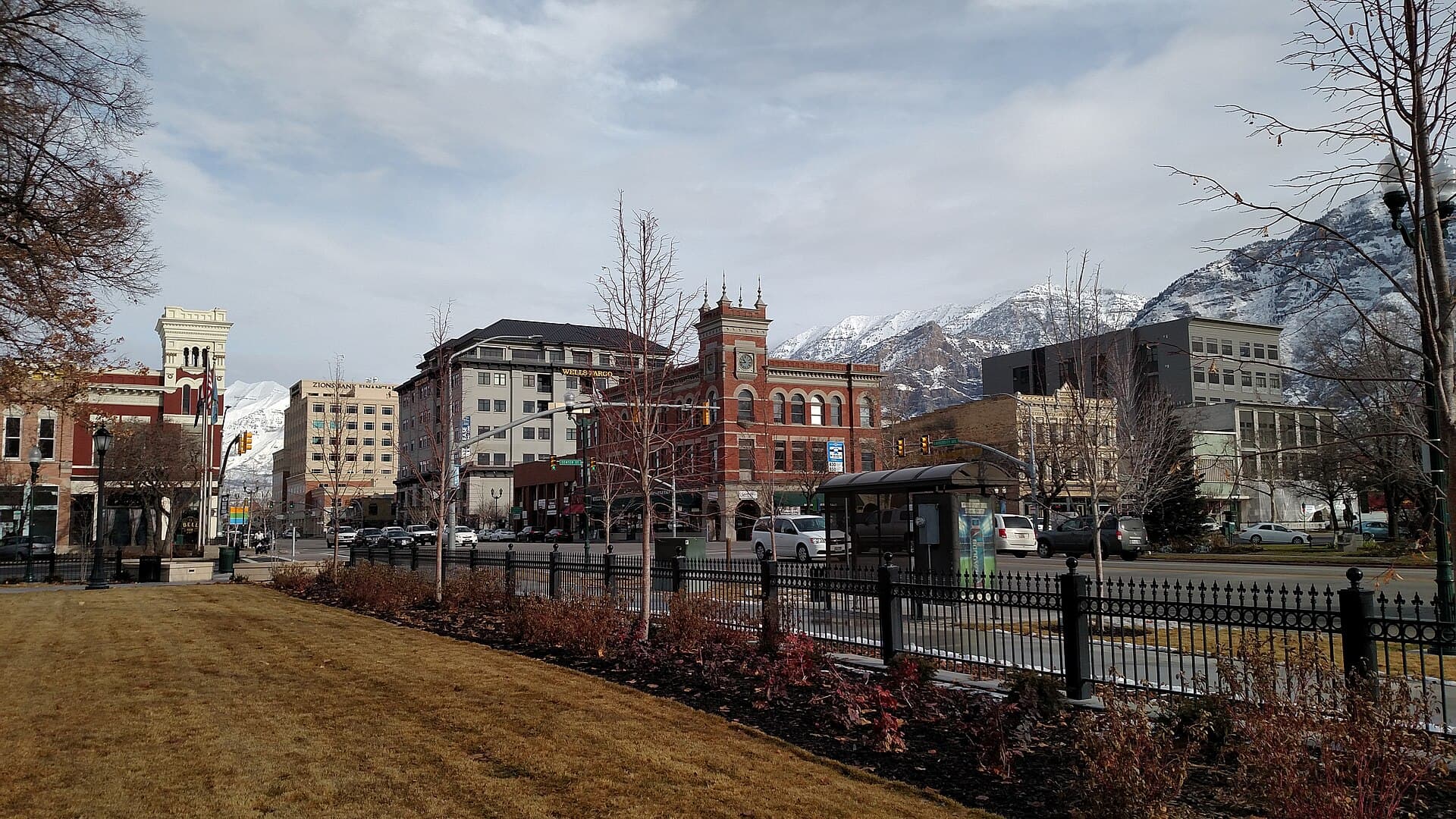 Creator: Javin Weaver / CC BY-SA 3.0, via Wikimedia Commons
Self-guided audio walking tour of Provo — GPS route, offline playback, story-driven narration in 32 languages.
“Provo, Utah: where mountain grandeur meets a pioneering heart and youthful energy.”
Not the postcards. The stories even locals don't know — whispered in your ear, right where they happened.
The city's name honors an early explorer, yet the river it sits upon once bore a different, more somber designation.
For many years, a beloved summer concert series in Provo carried a name that no longer reflected its physical setting.
Beneath the surface of Brigham Young University's campus, an unexpected network extends.
Discover every secret of Provo
Every address, every reveal in full — in your ear, right where it happened.
You pick your stops. You walk. The voice reveals what the others miss.


Your self-guided audio tour of Provo is ready — pick your landmarks, choose your language, and start the moment you arrive.
BuyLume has a built-in augmented-reality guide. Hold your phone up and its camera shows the street ahead of you, with a glowing arrow laid over the real view that always points to your next stop — no map to puzzle over, no wrong turns. Like everything in Lume, it works fully offline.
Provo, Utah, is a city where the profound silence of towering mountains converges with the hum of a flourishing urban landscape. It offers a singular fusion of outdoor exploration and cultural encounters. Situated within Utah Valley, bordered by Utah Lake to the west and the Wasatch Front mountains to the east, Provo stands as Utah's fourth-largest city. It serves as the primary urban center in the Provo-Orem-Lehi metropolitan area.
Originally inhabited by the Timpanogos Ute people, who called the area 'Timpanogas'—a term meaning 'rock river'—Provo first welcomed European explorers in 1776, with the arrival of Spanish Franciscan missionary Silvestre Vélez de Escalante. Later, in 1849, Mormon pioneers established Fort Utah. Today, Provo is recognized for its natural splendor and as the academic home of Brigham Young University (BYU).
The land now known as Provo was originally the domain of the Timpanogos, a band of the Ute people. They prospered from the abundant resources of the Provo River and Utah Lake, referring to the area as 'Timpanogas,' a Numic word possibly signifying 'rock river.' In 1776, Spanish Franciscan missionary-explorer Silvestre Vélez de Escalante became the first European to set foot in the region.
Decades later, in 1825, French-Canadian trapper Étienne Provost explored the area. Yet, it was in 1849 that 33 Mormon families from Salt Lake City, under the guidance of Brigham Young, established the first enduring non-Native settlement, initially named Fort Utah. Tensions between the new settlers and the Ute Indians intensified, culminating in conflicts such as the Provo War in 1850. That same year, Fort Utah was renamed Provo in honor of Étienne Provost.
Provo expanded swiftly as more members of The Church of Jesus Christ of Latter-day Saints arrived, cultivating farms and establishing industrial centers. It earned the moniker 'Garden City' due to its extensive fruit orchards, trees, and gardens. Industrialization commenced in the late 1860s with the Provo Woolen Mills, followed by the Ironton Steel Mill in the 1920s and later the Geneva Steel Plant. Brigham Young Academy, established in 1875 by Brigham Young, eventually became Brigham Young University in 1903, cementing Provo's role as an educational nucleus.
Provo presents a varied array of attractions, from natural wonders to cultural touchstones. Bridal Veil Falls, a 607-foot waterfall at the southern reach of Provo Canyon, is readily accessible via a paved trail and a designated picnic area. Visitors can appreciate the views from the base or ascend to the summit. For those seeking scenic drives, the Alpine Loop and Nebo Loop unveil striking autumn foliage displays in October.
On the cultural front, the Provo City Center Temple, formerly the Provo LDS Tabernacle, stands as an architectural marvel. Its exterior was meticulously restored following a fire in 2010; while interior tours are generally not available to the public, the surrounding grounds offer a peaceful experience. The Utah County Courthouse, dedicated in 1926, features symbolic sculptural groups representing justice and local industries. Brigham Young University's campus is also a notable point of interest, with its well-kept grounds and the BYU Museum of Paleontology, which houses dinosaur fossils including a Camarasaurus skeleton. For art enthusiasts, the Covey Center for the Arts hosts rotating exhibitions by local and regional artists.
The most agreeable times to visit Provo for pleasant weather extend from mid-April to May and again from mid-September to mid-October. During these periods, temperatures remain mild, ranging from the 50s to 70s in spring and 38–61°F (3–16°C) in October, accompanied by less precipitation and abundant sunshine. Summers are warm and dry, with average daily highs between 80-90°F, ideal for outdoor pursuits, though July and August can bring occasional afternoon thunderstorms. Winters are cold with substantial snowfall, transforming the area into a destination for skiing and snowmobiling.
Provo lies approximately 45 miles south of Salt Lake City, reachable via I-15 S. The city is served by the Utah Transit Authority (UTA), which operates an extensive public transportation network encompassing buses, light rail, and commuter trains throughout Utah County and beyond. The UVX bus rapid transit provides frequent service to key destinations such as downtown Provo, BYU, and local shopping centers. For longer journeys, the Frontrunner commuter rail connects to Salt Lake City. Amtrak's California Zephyr also makes a stop in Provo, offering cross-country rail travel. Provo Airport provides flights through Allegiant and Breeze Airlines, with Salt Lake International Airport offering broader travel options. Car rentals and rideshares are also readily available.
Provo in Korean, in Chinese or in Hebrew — and 29 more languages, every stop narrated by a native voice. The widest language range of any self-guided audio tour.
Available in: