St. George Tabernacle
Beneath the Tabernacle's grand facade rests a peculiar secret regarding its original construction.
Full story unlocks in the tour
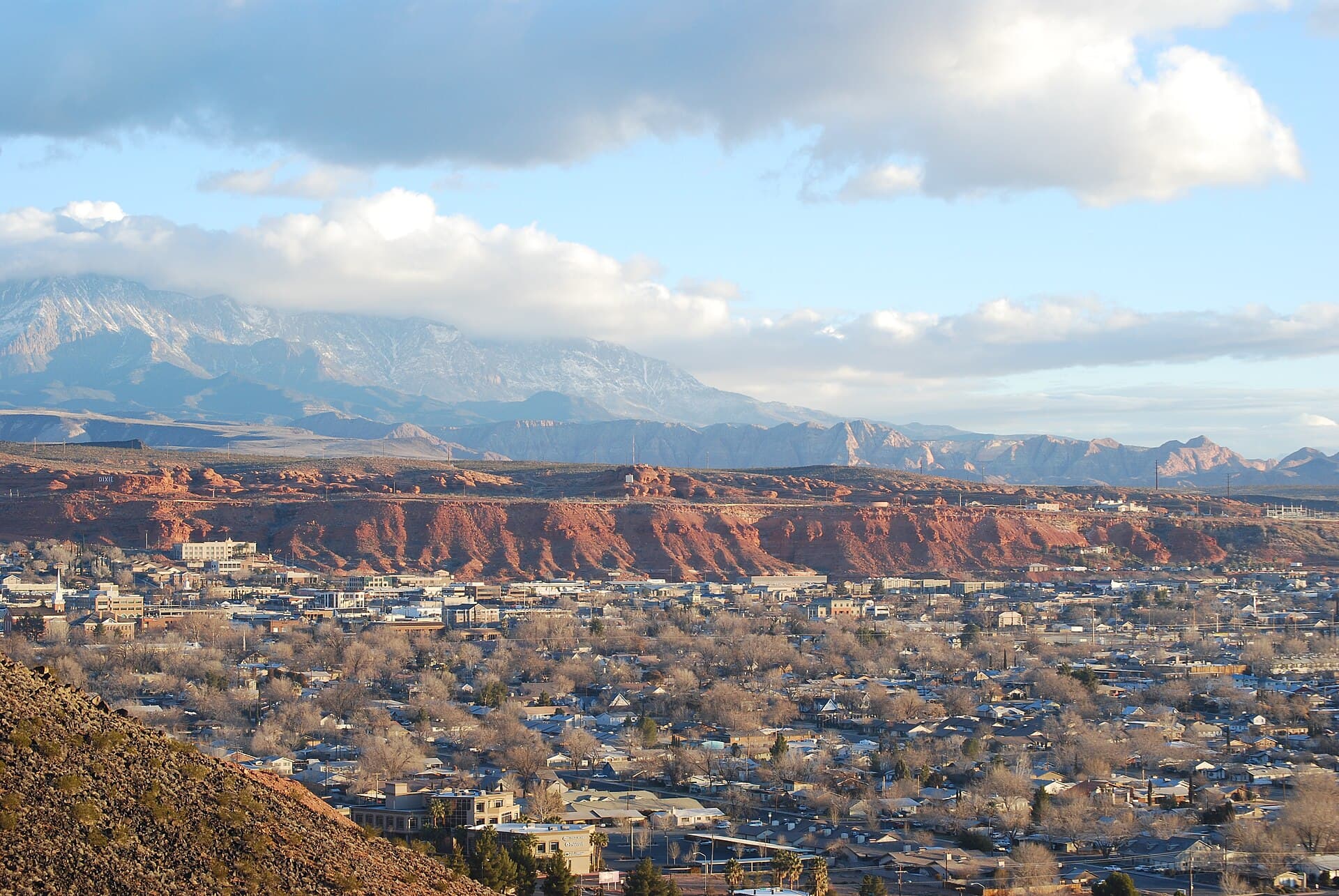 Eddie Maloney from North Las Vegas, USA / CC BY-SA 2.0, via Wikimedia Commons
Self-guided audio walking tour of St. George — GPS route, offline playback, story-driven narration in 32 languages.
“Where crimson rock meets the sun, and the desert tells its ancient story.”
Not the postcards. The stories even locals don't know — whispered in your ear, right where they happened.
Beneath the Tabernacle's grand facade rests a peculiar secret regarding its original construction.
The sweet aspirations of St. George once depended on a crop that struggled in the arid lands.
The prominent red rock formation overlooking St. George holds a surprisingly simple, yet enduring, local custom.
Discover every secret of St. George
Every address, every reveal in full — in your ear, right where it happened.
You pick your stops. You walk. The voice reveals what the others miss.


Your self-guided audio tour of St. George is ready — pick your landmarks, choose your language, and start the moment you arrive.
BuyLume has a built-in augmented-reality guide. Hold your phone up and its camera shows the street ahead of you, with a glowing arrow laid over the real view that always points to your next stop — no map to puzzle over, no wrong turns. Like everything in Lume, it works fully offline.
St. George, Utah, is a city sculpted by the elements, where the vivid red rock landscape of Southern Utah converges with a surprising abundance of green. Situated in the Mojave Desert, yet bordering the Pine Valley Mountains, it’s a place of striking contrasts: arid beauty alongside verdant golf courses, and a pioneering spirit that shaped its early development. This sun-drenched city serves as a portal to some of the American Southwest's most enduring natural wonders, yet it maintains its own distinct character, inviting exploration beyond the well-traveled routes.
The city's identity is deeply interwoven with its geology and climate. Warm temperatures prevail for much of the year, drawing outdoor enthusiasts to its extensive trail systems, golf courses, and nearby state and national parks. Beyond the adventure, St. George offers a developing cultural scene, a relaxed pace, and a palpable sense of community, making it a destination that caters to both the active traveler and those seeking a tranquil retreat.
## Early Settlement and the Cotton Mission St. George's origins trace back to the mid-19th century when Brigham Young, leader of The Church of Jesus Christ of Latter-day Saints, called upon settlers to establish a 'Cotton Mission' in the Virgin River basin. The objective was to create a self-sufficient community capable of producing cotton, grapes, and other semi-tropical crops, lessening dependence on goods from the eastern United States. In 1861, 300 families arrived in the area, confronting the harsh realities of the desert environment. They dug irrigation canals, cultivated the land, and built homes from the readily available red sandstone and volcanic rock. The city was named in honor of George A. Smith, a cousin of Joseph Smith and a prominent leader in the Church.
## Overcoming Adversity and Growth The early years were marked by immense challenges, including floods, droughts, and the sheer difficulty of farming in the arid climate. Despite these hardships, the settlers persevered, establishing farms, building essential infrastructure, and constructing the impressive St. George Tabernacle, a testament to their dedication and craftsmanship. The completion of the St. George Temple in 1877, the first operating temple of The Church of Jesus Christ of Latter-day Saints in Utah, further solidified the city's importance to the early pioneers.
## The 20th Century and Beyond Throughout the 20th century, St. George gradually transformed from a primarily agricultural community to a more diversified economy. The construction of major highways brought increased accessibility, and the city's warm climate began to attract retirees and visitors. The establishment of Dixie State College (now Utah Tech University) in the early 1900s also contributed to its growth and development. In recent decades, St. George has experienced rapid expansion, becoming one of the fastest-growing metropolitan areas in the United States. This growth has brought new businesses, amenities, and a lively cultural scene, while still retaining its unique character and connection to its pioneering past. The city continues to embrace its outdoor recreation opportunities, serving as a center for exploring the striking natural landscapes of Southern Utah.
Begin your exploration at the St. George Tabernacle, an architectural marvel from the 1870s, notable for its striking white exterior and historical significance. Nearby, the St. George Temple stands as a serene and iconic landmark; while interior access is generally restricted to members of The Church of Jesus Christ of Latter-day Saints, its grounds offer a peaceful experience. For a glimpse into pioneer life, visit the Jacob Hamblin Home, a well-preserved adobe house offering tours that evoke the early settlement period.
Outdoor enthusiasts will find abundant opportunities. Snow Canyon State Park, just a short drive north, presents dramatic volcanic cones, lava flows, and sandstone cliffs, with numerous trails for hiking and biking. Consider the Jenny's Canyon Trail for an easy slot canyon experience or the Lava Flow Trail for a unique geological perspective. For expansive views of the city and surrounding red rock country, journey to Pioneer Park and ascend 'Dixie Rock' (Sugarloaf), a local favorite for sunset viewing. The Red Hills Desert Garden provides a surprising oasis, exhibiting native desert plants, a replica slot canyon, and even a dinosaur track site.
The ideal time to visit St. George is during the spring (March to May) and fall (September to November). During these seasons, temperatures are pleasant, ranging from the 60s to 80s Fahrenheit (15-30°C), perfect for outdoor activities like hiking and biking. Summers (June to August) can be intensely hot, often exceeding 100°F (38°C), making outdoor exploration challenging. Winters (December to February) are mild, with daytime temperatures typically in the 50s (10-15°C), offering a comfortable escape from colder climates.
St. George is easily accessible by car, positioned just off Interstate 15. The St. George Regional Airport (SGU) offers regional flights, with connections to larger hubs. While a car is highly recommended for exploring the surrounding areas and national parks, the city itself has a public transit system, SunTran, offering bus services on several routes. Accommodation options range from budget-friendly motels to upscale resorts, with a concentration of hotels along Bluff Street and near the I-15 exits. Dining options are varied, from casual eateries to fine dining, with a good selection of local and chain restaurants. Remember to remain hydrated, especially during warmer months, and carry ample water when venturing outdoors. Sunscreen and a hat are also essential year-round.
St. George in Korean, in Chinese or in Hebrew — and 29 more languages, every stop narrated by a native voice. The widest language range of any self-guided audio tour.
Available in: