Mattsee Lake
A faint line may appear beneath the surface of Lake Mattsee, particularly in its northern bay. It is not an illusion, but a submerged path with a surprising origin.
Full story unlocks in the tour
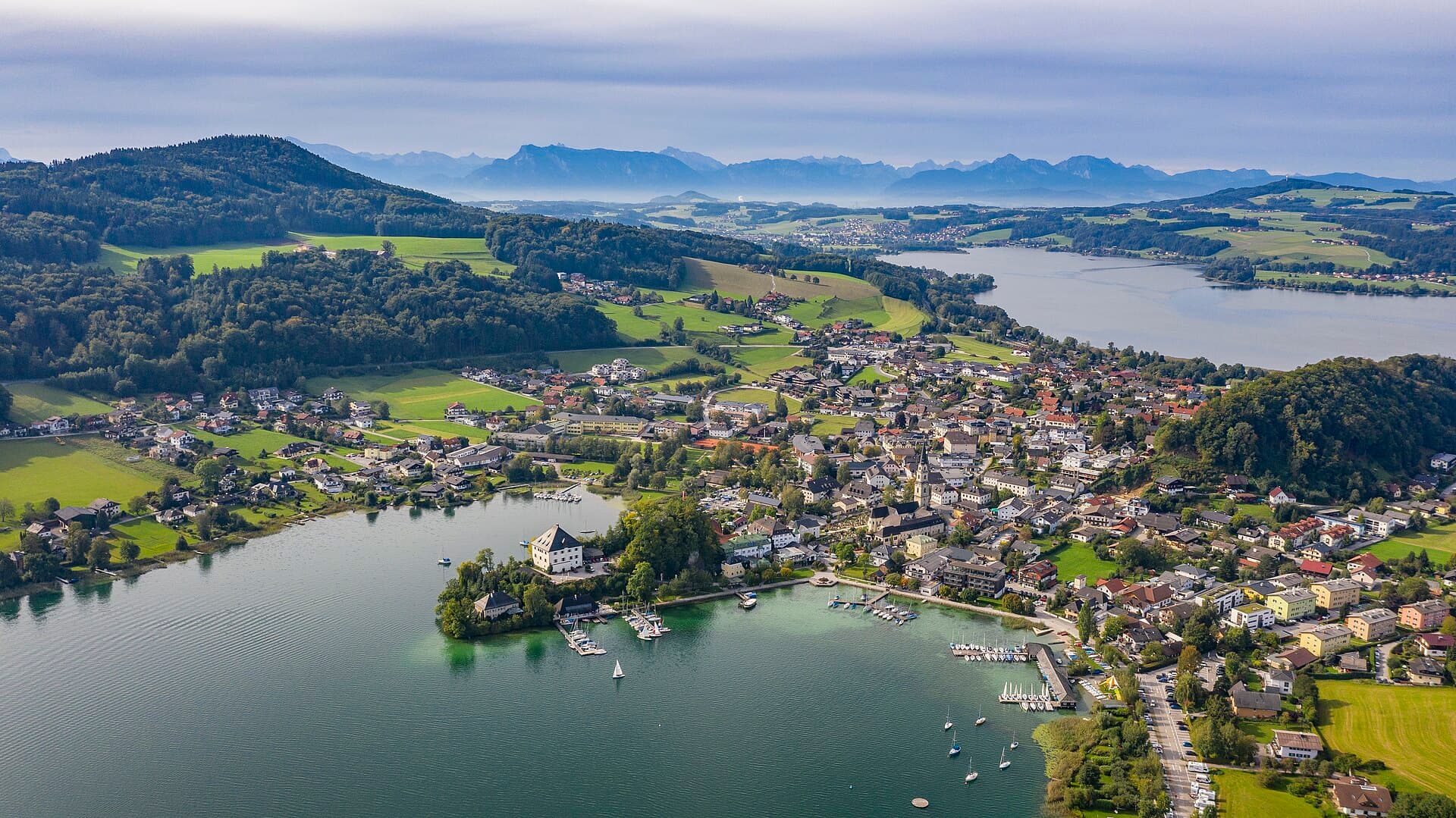 Arne Müseler / CC BY-SA 3.0 de, via Wikimedia Commons
Self-guided audio walking tour of Mattsee — GPS route, offline playback, story-driven narration in 32 languages.
“Where ancient stories drift on the alpine air, and the lake's surface mirrors centuries of quiet grace.”
Not the postcards. The stories even locals don't know — whispered in your ear, right where they happened.
A faint line may appear beneath the surface of Lake Mattsee, particularly in its northern bay. It is not an illusion, but a submerged path with a surprising origin.
The soaring 60-meter steeple of Mattsee's Collegiate Church of St. Michael, sometimes called the 'Goliath of Mattiggau,' is a prominent landmark. This impressive structure, however, is not the church's first, or even second, iteration.
Mattsee's public lido, with its Art Deco character, feels like a journey through time. It was constructed during a period of great optimism and burgeoning tourism, but its initial purpose extended beyond simple recreation.
Discover every secret of Mattsee
Every address, every reveal in full — in your ear, right where it happened.
You pick your stops. You walk. The voice reveals what the others miss.
Your self-guided audio tour of Mattsee is ready — pick your landmarks, choose your language, and start the moment you arrive.
BuyLume has a built-in augmented-reality guide. Hold your phone up and its camera shows the street ahead of you, with a glowing arrow laid over the real view that always points to your next stop — no map to puzzle over, no wrong turns. Like everything in Lume, it works fully offline.
Mattsee, a market town in the Salzburg Lake District, offers a serene escape where the past gracefully intertwines with the present. Surrounded by the eponymous Mattsee, Obertrumer See, and Grabensee, this picturesque locale is often referred to as the 'Venice of Salzburg' due to its intimate relationship with the water. With a population of around 3,000, Mattsee maintains a charming village atmosphere, characterized by idyllic architecture, a central cemetery, and inviting streets perfect for exploration on foot.
Beyond its natural beauty, Mattsee is a place of considerable historical and cultural depth. The town is dominated by its ancient monastery and the impressive Collegiate Church of St. Michael, alongside the historic Mattsee Castle. The area also holds a unique connection to mobility history through the Ferdinand Porsche Experience World. Whether you are drawn to water sports, cultural events, or simply the tranquility of lakeside living, Mattsee provides a diverse array of activities throughout the year.
The origins of Mattsee stretch back to the 8th century, with its foundation attributed to Duke Tassilo III of Bavaria around 760 or 765 AD. He established the Mattsee Benedictine Abbey, a significant religious center that would shape the region for centuries. Initially, the monastery and its associated church were likely constructed from wood, with archaeological findings suggesting a pre-Carolingian wooden church on the site of the current Collegiate Church of St. Michael.
Following the Battle of Lechfeld in 955, a stone church was likely built, succeeded by a Romanesque basilica in the 12th century. This Romanesque structure, roughly the size of today's church, was tragically consumed by fire in 1276. The immediate rebuilding in early Gothic style laid the foundation for the Collegiate Church we see today, though its prominent 60-meter Baroque steeple was a later addition in 1766, designed by Wolfgang Hagenauer. The monastery itself became a college of canons in 993, falling under the Diocese of Passau, and later, from 1807, under the Archdiocese of Salzburg.
Mattsee Castle, standing adjacent to the monastery, has its own venerable history, with foundations dating back to around 1100 AD, built by bishops from Passau. In 1398, it was sold to the Archbishopric of Salzburg. The castle played a role in times of crisis, serving as a refuge for Archbishop Wolf-Dietrich during a Salzburg epidemic in 1597. Over the centuries, the castle changed hands multiple times before being acquired by the municipality of Mattsee in 1949. Extensive renovations in 1996, based on original plans, restored its Baroque appearance.
The 20th century saw Mattsee evolve into a popular holiday destination. The historic Mattsee Lido, built around 1930, stands as a testament to this era, reflecting a period of booming tourism and the influence of the Salzburg Festival. Today, Mattsee continues to balance its substantial historical legacy with its role as a spirited lakeside community.
Begin your exploration at the Collegiate Church of St. Michael, a Gothic structure with a Baroque interior, notable for its 60-meter steeple, often called the 'Goliath of Mattiggau.' Adjacent to the church is the Mattsee Monastery Museum (Propsteimuseum), showcasing sacred art, historical exhibits, and a significant 860 grant deed by King Louis the German.
Overlooking the lake, Mattsee Castle (Schloss Mattsee), with its Baroque facade, offers sweeping views and houses a restaurant and outdoor cafe. Wander along the Schlossbergweg, a path tracing the base of the castle and the lake, providing insights into local natural and cultural history through display boards.
For a refreshing dip, visit the historic Mattsee Lido (Strandbad Mattsee), an Art Deco architectural example from the 1930s, offering a long beach area, sunbathing lawns, and water activities. Alternatively, the natural bathing beach at Gebertsham provides a quieter option.
Delve into the world of automotive innovation at the Ferdinand Porsche Experience World (fahr(T)raum), a museum displaying historic racing cars, tractors, airplanes, and interactive simulators. Nature enthusiasts can explore the Buchberg Nature Park, which features six signposted themed trails, including a 'Legends Trail,' offering insights into nature, regional history, and myths.
Consider a boat trip on the electric ship 'Seenland,' connecting Mattsee with Seeham and Obertrum am See, offering a tranquil way to experience the three Trumer Lakes. Do not overlook the Weyerbucht, home to a reconstructed early medieval settlement, an adventure playground, and mini-golf.
Mattsee is a year-round destination, but the best time to visit largely depends on your interests. For swimming, water sports, and outdoor activities on the lakes, the warmer months from late spring to early autumn (May to September) are ideal. During this period, the lidos are fully operational, and boat trips are readily available.
Cultural events like the Diabelli Summer Festival and Schlossbergspiele also take place during the summer. For those interested in a quieter, more atmospheric experience, the Advent market 'Mattsee Advent by the Lake' transforms the town in winter, offering regional specialties and music. Cross-country skiing is also possible with sufficient snow.
Mattsee is conveniently located just a 20-minute drive from Salzburg. While there is no train station in Mattsee, buses (lines 120 and 121) connect Salzburg to Mattsee in under 40 minutes. The town itself is small and easily explored on foot.
Parking is available, with free options at the north car park and paid spaces directly at the lido or in Weyerbucht during the summer season. For dining, Mattsee offers a variety of options, including the Stiftskeller Mattsee for local cuisine and cafes at Schloss Mattsee. For self-catering, the Speis Mattsee is a 24-hour self-service farmer's market offering locally sourced products.
Many accommodations are available, including apartments within the historic Schloss Saalhof. The local currency is the Euro, and while many places accept card payments, having some cash for smaller purchases is always a good idea.
Mattsee in Korean, in Chinese or in Hebrew — and 29 more languages, every stop narrated by a native voice. The widest language range of any self-guided audio tour.
Available in: