Mielec Market Square
Before Mielec officially became a city, it nearly bore an entirely different name.
Full story unlocks in the tour
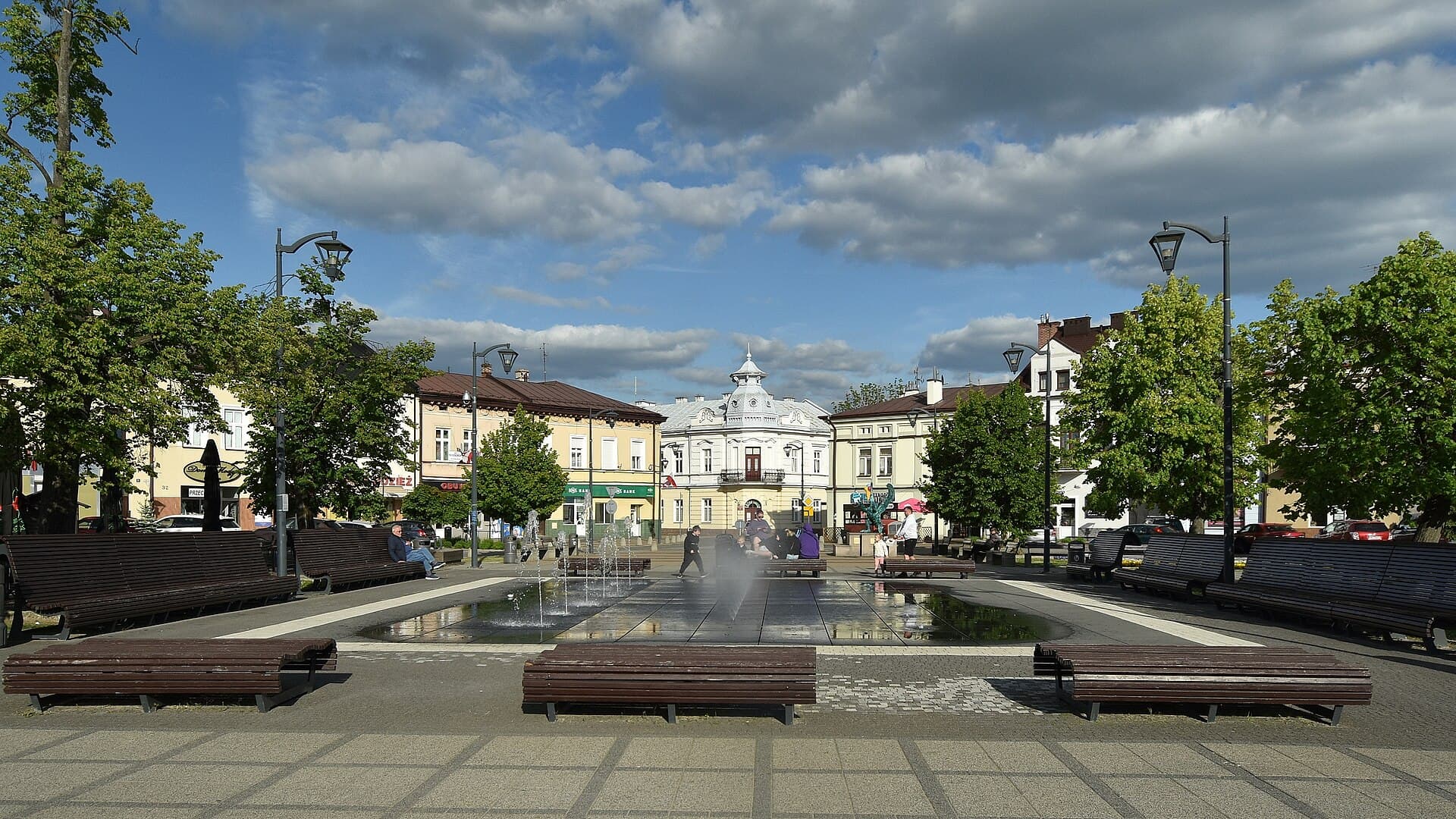 Henryk Bielamowicz / CC BY-SA 4.0, via Wikimedia Commons
Self-guided audio walking tour of Mielec — GPS route, offline playback, story-driven narration in 32 languages.
“Mielec: Where innovation takes flight amidst the echoes of a complex past.”
Not the postcards. The stories even locals don't know — whispered in your ear, right where they happened.
Before Mielec officially became a city, it nearly bore an entirely different name.
Mielec was home to Poland's first aircraft manufacturing facility, though its role during WWII veered into a dark chapter.
The thriving Jewish community of Mielec met a uniquely swift and brutal end during the Holocaust, a process not replicated elsewhere.
Discover every secret of Mielec
Every address, every reveal in full — in your ear, right where it happened.
You pick your stops. You walk. The voice reveals what the others miss.

Your self-guided audio tour of Mielec is ready — pick your landmarks, choose your language, and start the moment you arrive.
BuyLume has a built-in augmented-reality guide. Hold your phone up and its camera shows the street ahead of you, with a glowing arrow laid over the real view that always points to your next stop — no map to puzzle over, no wrong turns. Like everything in Lume, it works fully offline.
Mielec, a city in southeastern Poland within the Subcarpathian Voivodeship, offers a compelling narrative of endurance and transformation. Situated in the Wisłoka Valley, it is a place where echoes of a medieval past converge with the hum of modern industry. While perhaps recognized today as a significant industrial and aviation center, Mielec's story extends back to the 13th century, evolving from a small settlement into a dynamic urban core with a population of approximately 59,509 as of December 2021.
The city's motto, 'Here wings spread!', aptly reflects its deep connection to aviation, an industry that has profoundly shaped its identity and growth over the last century. Yet, beyond its industrial capacity, Mielec reveals layers of history through its historic sites, cultural institutions, and green spaces. It is a city that balances its forward-looking economic drive with a profound respect for its heritage, making it a distinctive destination in southeastern Poland.
The first documented mention of Mielec appears in a 1229 bull issued by Pope Gregory IX, hinting at its early existence. By the latter half of the 14th century, 'Mielecka' was recognized as a parish. The official city charter was granted by King Casimir IV in 1457, though the actual establishment of the city by Jan Mielecki's sons, Jan and Bernardyn, did not occur until 1470.
The Mielecki family maintained ownership of the town until 1771, a period marked by the flourishing of craft industries. The first guild, for blacksmiths, was established in 1522, followed by those for tailors, cobblers, potters, spinners, and weavers. After the Mieleckis, the town passed through the hands of the Ossolinski, Morsztyn, and eventually the Oborski families.
The early 20th century saw Mielec experience considerable growth, with the construction of brick houses around the market square, a courthouse in 1902, and a gymnasium and County Council office in 1912. However, this progress was severely disrupted by the devastation of World War I.
The interwar period brought renewed development, including paved streets, a private power station, and new businesses. A major flood in 1934 was followed by a pivotal moment in 1936: the establishment of a state-owned airplane chassis factory. This factory, part of Poland's Central Industrial Region (COP, Centralny Okręg Przemysłowy), would fundamentally transform Mielec, leading to a sixfold increase in its population and solidifying its identity as an aviation center.
The German occupation from 1939 to 1944 brought immense suffering, particularly to Mielec's Jewish community, which had a presence in the city dating back to at least 1573. On March 9, 1942, the Nazis carried out a unique and brutal liquidation of the Jewish population, deporting most to death camps and utilizing others for forced labor in the aviation factory, which was then producing German aircraft. The factory itself, known as Flugzeugwerk Mielec under German control, became a site of forced labor.
After liberation in 1944, the factory, renamed WSK-Mielec, became Poland's largest aviation plant. It produced Soviet-designed planes under license, including the An-2 transport plane and Polish versions of MiG fighters, as well as Polish-designed aircraft like the TS-11 Iskra trainer. In 1995, Mielec became home to the first Special Economic Zone in Poland, Euro-Park Mielec, further diversifying its economy beyond aviation to include other manufacturing and service sectors.
Mielec offers a variety of attractions that reflect its layered history and modern character. Begin your exploration in the Market Square, surrounded by historic architecture, and imagine the centuries of commerce and community that have unfolded here. The Minor Basilica of St. Matthew the Evangelist, dating back to 1526, is a prominent religious landmark with significant historical and architectural value.
For a glimpse into the city's aristocratic past, visit the Oborski Manor House, a 17th-century building that now functions as a museum. Another notable historical residence is the Suchorzewski Manor House, a classicistic building. The Jadernys' House, now a museum, provides further insight into local heritage.
Mielec's strong aviation heritage is evident throughout the city. While the main factory is an active industrial site, the Mielec Aeronautical Center highlights the city's role in aircraft production. For those interested in local culture, the Culture Centre houses the Culture House, the Regional Museum, and the Public Library, offering exhibitions and performances. The city also features a Historic Jewish Cemetery, a poignant reminder of its pre-war Jewish community. Beyond the city center, the nearby Puszcza Sandomierska (Sandomierz Forest) offers opportunities for outdoor activities and a refreshing contrast to Mielec's industrial landscape.
The most pleasant time to visit Mielec for general outdoor activities spans from mid-June to early September, with a peak in the second week of August, when temperatures generally range between 65°F and 80°F. Summers are comfortable, though they can bring some rainy days. Late spring (May) and early autumn (September and October) also offer agreeable weather with fewer crowds and mild temperatures. Winters are cold and snowy, with temperatures often dropping below freezing, but the city can be charming under a blanket of snow, and nearby ski resorts are operational.
Mielec is located in the Subcarpathian Voivodeship in southeastern Poland. It is the seat of Mielec County. The city has its own airport, offering passenger and charter flights, and is served by a railway siding connected to the Euro-Park Mielec Special Economic Zone. While Mielec is the largest town in Poland without direct access to national roads, the A4 motorway and national road number 9 are relatively close. Within the city, public bus transport is well-developed.
Accommodation options in Mielec include various hotels. For dining, you will find a range of restaurants, and it is worth seeking out a 'Milk Bar' for an authentic taste of traditional Polish cuisine. The local currency is the Polish Złoty (PLN). The area code for Mielec is +48 17, and postal codes range from 39-300 to 39-303, and 39-323.
Mielec in Korean, in Chinese or in Hebrew — and 29 more languages, every stop narrated by a native voice. The widest language range of any self-guided audio tour.
Available in: