Rue des Arceaux
Let your gaze drift upward as you wander along Rue des Arceaux, and you will discern an unusual architectural detail.
Full story unlocks in the tour
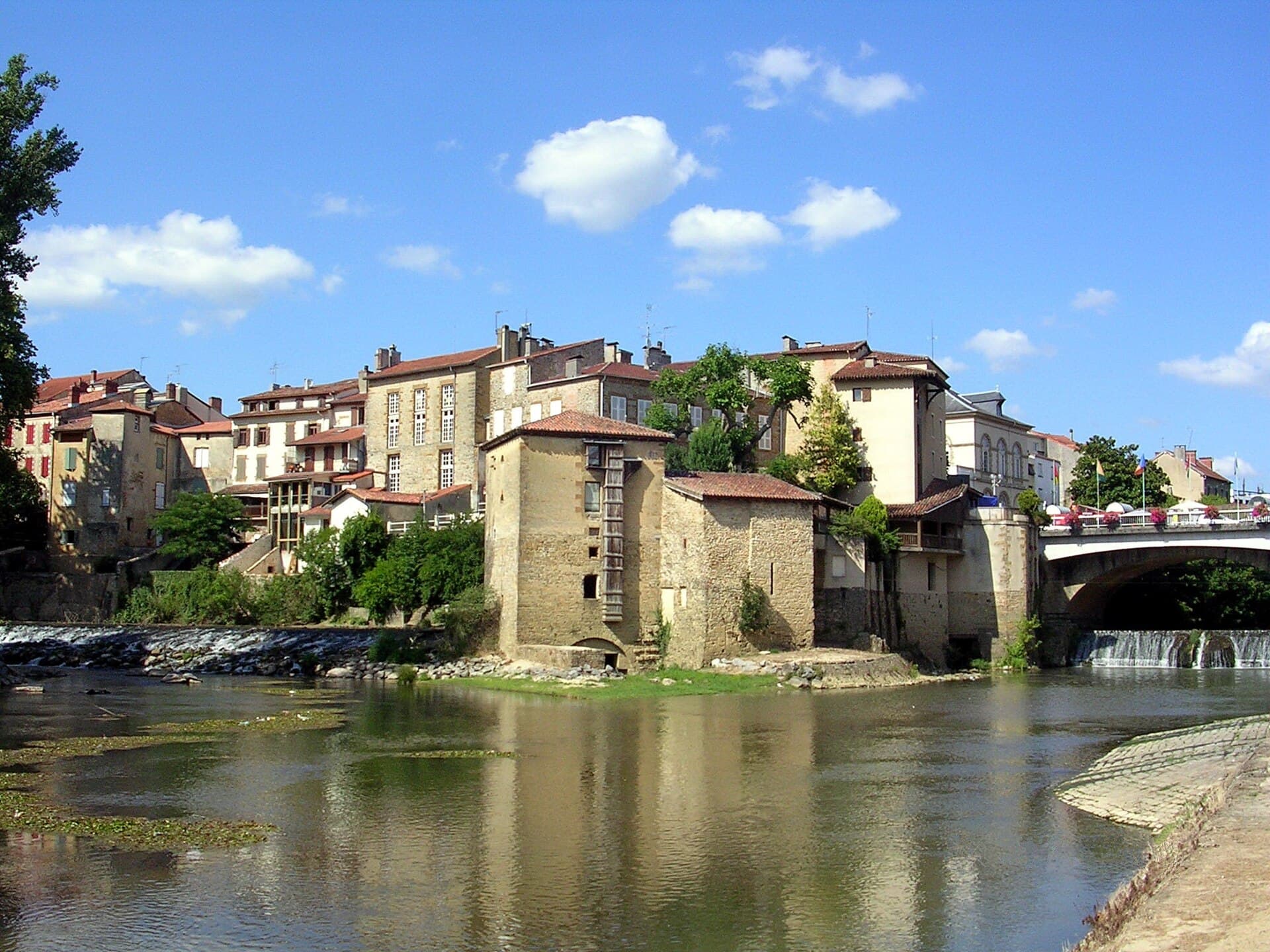 Jibi44 / CC BY-SA 3.0, via Wikimedia Commons
Self-guided audio walking tour of Mont-de-Marsan — GPS route, offline playback, story-driven narration in 32 languages.
“Where three rivers converge, art and history flow freely.”
Not the postcards. The stories even locals don't know — whispered in your ear, right where they happened.
Let your gaze drift upward as you wander along Rue des Arceaux, and you will discern an unusual architectural detail.
Along the banks of the Midouze river, an unexpected figure hangs suspended, caught in a moment of perpetual motion.
The city's very name transcends mere geographical description, hinting at an ancient, perhaps even Roman, lineage.
Discover every secret of Mont-de-Marsan
Every address, every reveal in full — in your ear, right where it happened.
You pick your stops. You walk. The voice reveals what the others miss.


Lume has a built-in augmented-reality guide. Hold your phone up and its camera shows the street ahead of you, with a glowing arrow laid over the real view that always points to your next stop — no map to puzzle over, no wrong turns. Like everything in Lume, it works fully offline.
Mont-de-Marsan, the capital of the Landes department in southwestern France, is a city sculpted by the embrace of water and art. Positioned at the convergence of the Douze and Midou rivers, which unite to form the Midouze, the city's distinct aquatic character is immediately apparent. Frequently referred to as the 'City of Three Rivers,' its carefully tended riverbanks beckon with the promise of unhurried walks, offering a tranquil counterpoint to its animated urban heart.
Beyond its natural setting, Mont-de-Marsan bears the distinction of being France's 'Capital of Figurative Sculpture.' More than 50 sculptures are woven into the urban landscape, transforming streets, squares, and parks into an expansive open-air gallery. This artistic identity, interwoven with a medieval heritage and a lively local culture, renders Mont-de-Marsan a destination where history, nature, and creativity intertwine.
Mont-de-Marsan was established in 1133 by Viscount Pierre de Marsan, who created a fortified settlement, or 'castelnau,' around his new castle. This act consolidated his power and created a defensive stronghold. Its strategic position at the confluence of the Douze and Midou rivers made it a pivotal center for trade and defense. The city prospered in the Middle Ages, largely due to its active river port on the Midouze, which linked the inland Gascony region to the Atlantic port of Bayonne. Goods such as grain, wine, spirits, honey, and wood moved through the city, nurturing a prosperous merchant class and influencing its early architecture.
Mont-de-Marsan came under English dominion as part of Aquitaine in 1154 and remained so until the mid-15th century. During this period, it largely avoided the Hundred Years' War but endured hardship during the Wars of Religion. In 1479, it rejoined the Kingdom of France, and by 1589, with Henry IV's ascent to the throne, it was firmly secured for the French crown. The 18th century witnessed the city's transformation, as its castle, towers, and walls were dismantled to create broader squares and green avenues. In 1790, during the French Revolution, Mont-de-Marsan became the prefecture (capital) of the newly formed Landes department. Napoleon I visited in 1808, signing a decree for the improvement of the region's forestry and the construction of administrative buildings.
The 19th century marked a significant administrative and architectural rise for Mont-de-Marsan, with the construction of emblematic structures like the town hall, the theater, and the Plumaçon bullring. The city also solidified its artistic identity, becoming recognized as the birthplace of sculptor Robert Wlérick and influenced by Charles Despiau. Today, the Despiau-Wlérick Museum, housed in the 14th-century Lacataye Keep, displays a significant collection of figurative sculpture.
Begin your exploration at the convergence of the Douze and Midou rivers, where they unite to form the Midouze. The carefully tended banks offer pleasant walks and views of the river. Seek out the striking 'Diver' sculpture suspended over the river, a highlight of the city's open-air art trail.
The Lacataye Keep (Donjon Lacataye), a 14th-century fortified tower, stands as a symbol of the city's medieval past and houses the Despiau-Wlérick Museum, dedicated to figurative sculpture. Nearby, explore the Romanesque fortified houses on streets like Maubec and Lacataye, constructed with shell stone in the 12th century. Do not overlook Rue des Arceaux, with its distinctive medieval covered passages connecting buildings.
For a moment in nature, visit the Jean Rameau Park, a six-hectare botanical garden featuring a Japanese garden, fragrant gardens, and ancient trees. The Parc Animalier de Nahuques offers a free-access green space with wallabies, emus, llamas, and other animals, ideal for families. The Church of La Madeleine, with its neoclassical style and impressive marble high altar, is another significant landmark. If you are interested in local life, the Saint-Roch Covered Market is active on Tuesday and Saturday mornings, offering regional specialties and crafts.
The ideal time to experience Mont-de-Marsan is from May to October, when the Aquitaine oceanic climate offers pleasant days. Summer temperatures average around 28°C, perfect for riverside strolls. July is particularly celebratory, with the Fêtes de la Madeleine, a significant local fair. September brings mild weather, ideal for exploring the Landes forest and savoring regional cuisine. While winters are mild, ranging from 2°C to 11°C, the warmer months offer the most favorable conditions for outdoor activities and cultural events.
Mont-de-Marsan is accessible by train, with direct connections to Bordeaux in under two hours, and further connections to Paris and Toulouse. By car, the A65 motorway links the city to Pau and Bordeaux. The closest airport is in Pau, about an hour away, though Bordeaux-Mérignac offers more international flights. Once in Mont-de-Marsan, the compact city center is easily explored on foot. Public transport within the city is less extensive, and taxis may be difficult to hail spontaneously, so booking in advance is advisable for evening travel. French is the official language, and while English is spoken in hotels and major tourist spots, it is less common in smaller shops. Mont-de-Marsan is considered a safe city for visitors. Pharmacies are easily identified by a flashing green cross and operate on a rotation system for after-hours emergencies. For any serious medical or safety emergencies, dial 112, the universal European emergency number. If visiting in summer, consider mosquito repellent, especially near rivers and parks.
Mont-de-Marsan in Korean, in Chinese or in Hebrew — and 29 more languages, every stop narrated by a native voice. The widest language range of any self-guided audio tour.
Available in: