Château des Ducs
Mortemart's grand castle, once a symbol of authority, carries a subtle mark, a testament to defiance against a powerful cardinal.
Full story unlocks in the tour
 Nitot / CC BY-SA 3.0, via Wikimedia Commons
Self-guided audio walking tour of Mortemart — GPS route, offline playback, story-driven narration in 32 languages.
“Ancient stones and quiet lanes echo with history.”
Not the postcards. The stories even locals don't know — whispered in your ear, right where they happened.
Mortemart's grand castle, once a symbol of authority, carries a subtle mark, a testament to defiance against a powerful cardinal.
This former Augustinian convent, now the heart of the village's civic life, holds an architectural detail hinting at its more expansive past.
Within the village church's solemn confines, a closer look at the 15th-century wooden stalls uncovers a whimsical secret carved into their very structure.
Discover every secret of Mortemart
Every address, every reveal in full — in your ear, right where it happened.
You pick your stops. You walk. The voice reveals what the others miss.

Your self-guided audio tour of Mortemart is ready — pick your landmarks, choose your language, and start the moment you arrive.
BuyLume has a built-in augmented-reality guide. Hold your phone up and its camera shows the street ahead of you, with a glowing arrow laid over the real view that always points to your next stop — no map to puzzle over, no wrong turns. Like everything in Lume, it works fully offline.
Mortemart, the sole village in the Haute-Vienne department recognized among "The Most Beautiful Villages in France," invites visitors to step into a meticulously preserved medieval past. This small commune, home to approximately 120 residents, presents a remarkable architectural coherence, with many buildings and historical artifacts designated as Historic Monuments. Situated within the scenic Monts de Blond region, Mortemart is a place where granite houses, venerable convents, and a ducal château unfold a narrative spanning over a millennium.
The village's origins trace back to a castle erected in 995 AD by the Duc de Mortemart, around which the community steadily grew. Later, in the 14th century, Mortemart became a significant religious center with the establishment of three monasteries by Cardinal Pierre Gauvain, a native son. Despite its modest dimensions today, Mortemart's enduring heritage and serene atmosphere make it a compelling destination for those seeking an authentic glimpse into French history and rural character.
The story of Mortemart begins in 995 AD, with the construction of a castle by Abon Drut, Lord of Mortemart. He received permission to build this fortification after successfully defending the city of Bellac against Guillaume de Poitiers. This initial structure laid the foundation for the village that would gradually coalesce around it. The Mortemart family, originating from this site, grew into a prominent lineage, recognized for their military prowess and intellect.
In the 14th century, Mortemart's importance expanded as a religious hub. Cardinal Pierre Gauvain, born in Mortemart, established three convents in 1330: the Augustins, the Carmes, and the Chartreux. While the Chartreux convent eventually vanished, the Augustins and Carmes convents endure, displaying architectural styles from the 17th and 18th centuries. The Couvent des Augustins, in particular, was rebuilt in the late 17th or early 18th century, its facade later refreshed with granite by the distinguished Brousseau Brothers, architects from Limoges.
Mortemart's standing was further elevated in 1650 when Louis XIV designated it a duchy-peerage, granting the lords of Mortemart the title of dukes. However, this era also witnessed a demonstration of royal power: Cardinal Richelieu commanded the demolition of the second floor of the Château des Ducs' towers and main building, a measure intended to curb the influence of local nobility. Despite this, the château, which still belongs to the Mortemart family, underwent modernization in the late 15th century with the addition of residential wings flanked by towers. The village also thrived commercially, with monthly fairs established in 1681 and a weekly market in 1730, centered around the covered market hall. Today, Mortemart's protected status since 1965 ensures the careful preservation of its historic buildings and distinctive character.
Begin your exploration at the Château des Ducs, a structure whose origins date back to 995 AD. While portions were reduced by order of Cardinal Richelieu, you can still admire its imposing granite porch, a five-sided tower containing a stone spiral staircase, and monumental 15th-century chimneys. The château, still privately owned by the current Duc de Mortemart, occasionally hosts exhibitions and offers views of its moat and garden.
Next, visit the Couvent des Augustins, now serving as the village's town hall. This impressive building, rebuilt in the 17th and 18th centuries, displays a grander style with classical architectural elements. Adjacent to it stands the Église Saint-Hilaire, originally the convent's chapel. Dating from the 14th century, its interior is notable for its 15th-century carved wooden stalls and a beautifully adorned Baroque altarpiece from the 17th century. Observe the distinctive triple-bulb bell tower.
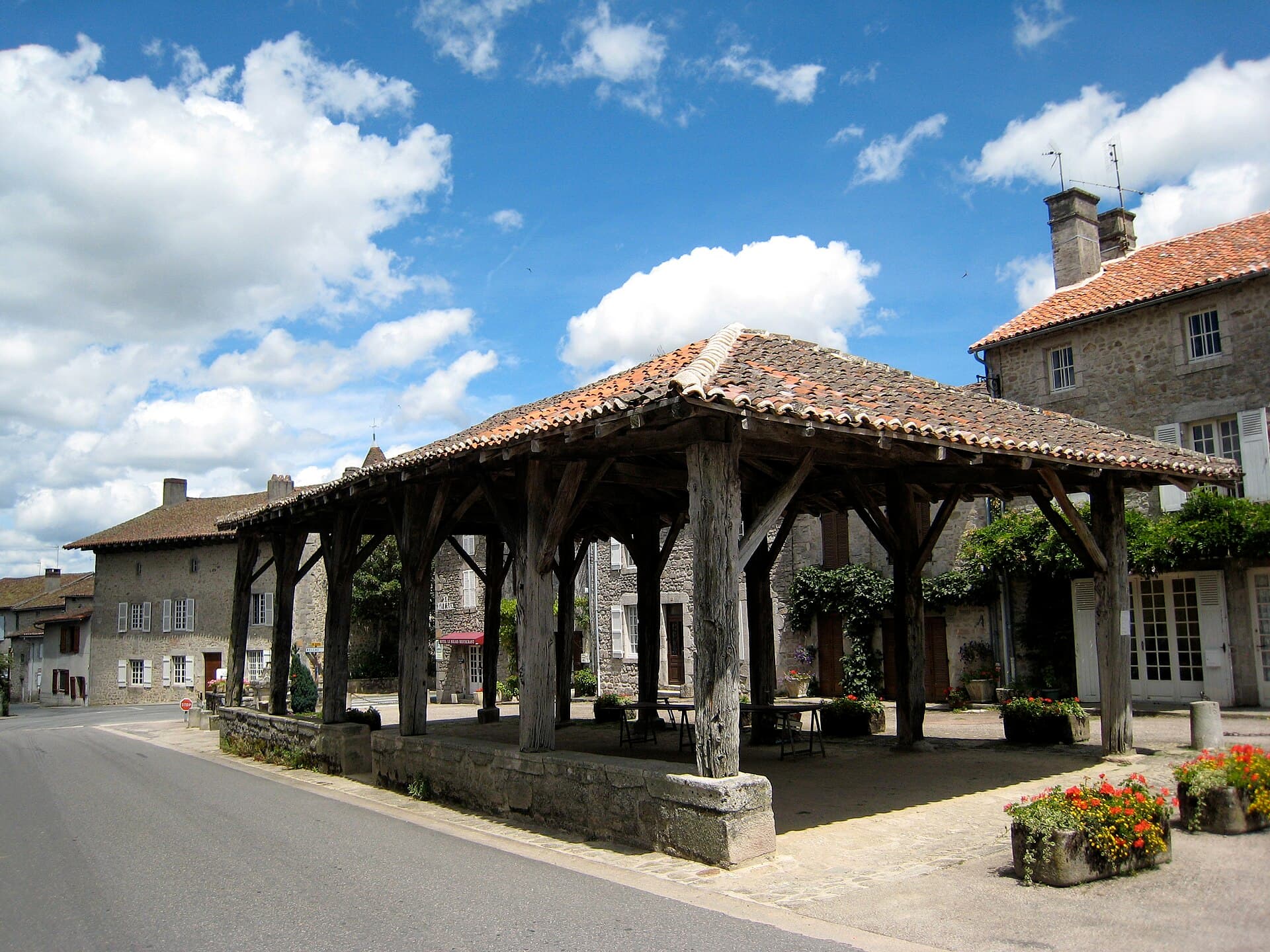
Stroll to the village center to see the Covered Market Hall, a rustic 17th or 18th-century structure with twelve oak pillars supporting a four-sided roof. This hall, restored in 2013, serves as a reminder of Mortemart's commercial past. As you wander, observe the lovely stone houses, some of which were once residences of notable figures, like the 'maison du Chevalier de Beon' and the 'Maison des Verdilhac-Villelonge,' displaying typical Limousin style. The Couvent des Carmes, another of Cardinal Gauvain's foundations, also remains, with its impressive 14th-century monumental gateway.
Mortemart is lovely in spring and fall, offering agreeable weather and fewer visitors. During these seasons, typically from March to May and September to November, the countryside is green, and temperatures are comfortable for walking. Summer, particularly July and August, brings more lively villages, festivals, and consistently warm weather, with temperatures ranging from 14-27°C (57-81°F). However, it can also be busier with vacationing Europeans. Winter travel is generally quieter, though some tourist activities may have reduced hours.
Mortemart is a small village, best explored on foot. While guided tours are available year-round, you can easily discover its key monuments independently. The village is situated in the north-west of Haute-Vienne, approximately 15 kilometers southwest of Bellac and 40 kilometers northwest of Limoges. For those arriving by car, parking is available. Public transport options to Mortemart may be limited, so checking local schedules in advance is advisable. There are a few dining options within the village, including a hotel restaurant and a snack bar at the local golf course. Local markets in nearby towns like Saint-Junien (Saturdays) and Limoges (daily) offer opportunities to experience regional produce. The village tourist office can provide information on guided tours and local activities.
Mortemart in Korean, in Chinese or in Hebrew — and 29 more languages, every stop narrated by a native voice. The widest language range of any self-guided audio tour.
Available in: