Gloucester Tree
Before the advent of modern aerial surveillance, a network of immense karri trees served as crucial fire lookouts.
Full story unlocks in the tour
 JAW at en.wikipedia / CC BY-SA 3.0, via Wikimedia Commons
Self-guided audio walking tour of Pemberton — GPS route, offline playback, story-driven narration in 32 languages.
“Where colossal karri forests embrace cool-climate wines.”
Not the postcards. The stories even locals don't know — whispered in your ear, right where they happened.
Before the advent of modern aerial surveillance, a network of immense karri trees served as crucial fire lookouts.
This serene swimming spot holds a surprising connection to the town's industrial origins.
The delightful tourist tram traverses tracks that once bore a vastly different kind of freight.
Discover every secret of Pemberton
Every address, every reveal in full — in your ear, right where it happened.
You pick your stops. You walk. The voice reveals what the others miss.


Your self-guided audio tour of Pemberton is ready — pick your landmarks, choose your language, and start the moment you arrive.
BuyLume has a built-in augmented-reality guide. Hold your phone up and its camera shows the street ahead of you, with a glowing arrow laid over the real view that always points to your next stop — no map to puzzle over, no wrong turns. Like everything in Lume, it works fully offline.
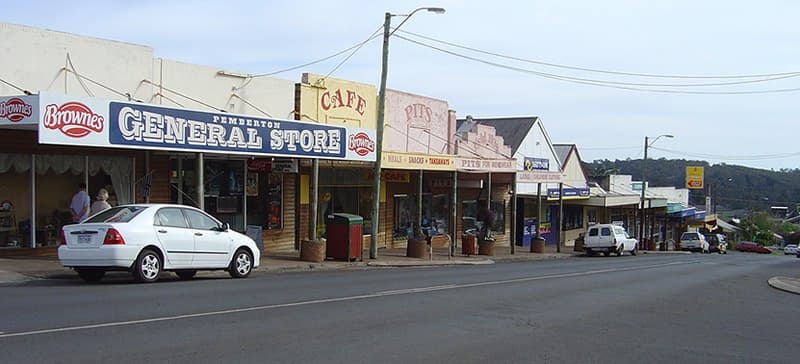
Pemberton, a town in Western Australia's South West region, is celebrated for its immense karri forests and cool-climate wines. Situated approximately 335 kilometers south of Perth, it functions as a central point for the surrounding rural and forestry communities. The town, at an elevation of 174 meters, encompasses an area of 17.2 square kilometers and recorded a population of 617 people in 2021.
Originally known as Wandergarup by the Indigenous Bibbulmun people, meaning 'plenty of water,' Pemberton's landscape is defined by its towering karri trees, flowing rivers, and rolling hills. The region's temperate climate, characterized by warm, dry summers and cool, rainy winters, fosters its verdant environment and renders it ideal for viticulture. Pemberton is now recognized as a leading cool-climate wine region in Australia, cultivating more grapevines than the nearby Margaret River region.
The Pemberton region was originally home to the Bibbulmun people, who referred to the area as Wandergarup, signifying 'plenty of water.' Their seasonal residency involved skillful navigation of the forest and water systems for sustenance and shelter, employing cultural fire practices to manage the forest, encourage wildflowers, and facilitate hunting.
European settlement in the area began in the 1860s. Following an expedition in 1861, Edward Reveley Brockman established Warren House homestead in 1862. His uncle, Pemberton Walcott, after whom the town would later be named, established Karri Dale farm. The arrival of settlers, however, introduced devastating diseases like measles and influenza to the Aboriginal population.
Pemberton was officially founded as a sawmill town in 1913, initially named Big Brook. The State Sawmills Department developed a private mill town to provide railway sleepers for the Trans-Australian Railway. By 1939, the Pemberton Mill had grown to become the largest in Australia. The town was officially gazetted as Pemberton in October 1925, though some sources cite 1930.
The 1920s witnessed significant growth in Pemberton, partly due to the Group Settlement Scheme, which attracted migrants from Britain. Essential buildings like the Mill Workers Hall, the School (now the Tourist Bureau), the Pemberton Hotel, and the Picture Theatre were constructed along Brockman Street, many of which endure today. The trout acclimatisation program also commenced in 1930, focusing on hatching, rearing, and distributing trout.
While the timber industry was central to Pemberton's early development, shifts in government policy in the early 2000s prompted the mill to transition to plantation pine and bluegum. The mill eventually closed in 2016 due to insufficient log supply. Today, Pemberton's economy has broadened, with tourism, farming (including vegetables, fruit, and wine), and aquaculture playing significant roles.
Pemberton offers a variety of attractions, many centered around its magnificent karri forests. A prominent feature is the Gloucester Tree, a 61-meter tall karri tree that served as a fire lookout until 1974. Visitors can ascend 153 metal pegs spiraling up the trunk to a lookout platform for expansive forest views.
Another iconic experience is the Pemberton Tramway, which provides scenic 75-minute journeys through karri and marri forests, crossing trestle bridges and pausing at The Cascades. The Pemberton Pool, a historic swimming hole constructed in the 1920s, offers a serene location for relaxation amidst the karri trees.
For those seeking more natural splendor, Beedelup Falls in Beedelup National Park is a compelling sight, particularly in winter and spring when the falls are at their fullest. A suspension bridge offers prime viewing. The Karri Forest Explorer Drive is an 85km circuit that connects many of Pemberton's natural attractions, allowing visitors to explore at their own pace. Additionally, the Dave Evans Bicentennial Tree, a 75-meter tall karri tree, is open for climbing to its first platform, offering a glimpse into its past as a fire lookout.
Pemberton is a year-round destination, with each season presenting distinct experiences. For warm-weather activities, the most favorable time to visit is from late December to mid-March, when average daily high temperatures exceed 24°C (76°F). Spring (September to November) is ideal for hiking and forest walks, as the weather is mild and wildflowers are in bloom. Autumn (March to May) brings crisp mornings, golden foliage, and excellent conditions for wine tasting and trail biking. Winter (June to August) offers cool, misty days, perfect for warming by a fireplace, exploring local wineries, and experiencing the truffle season.
Pemberton is located approximately 335 kilometers south of Perth, a drive that typically takes around four hours. Visitors can also take a bus operated by South West Coach Lines. The town's population was 617 in 2021, with a median age of 48 years. The median personal income in Pemberton is $671 per week, and the median rent is $280 per week.
For those planning to explore the surrounding national parks and attractions, sturdy footwear is recommended, especially for activities like climbing the fire lookout trees. It's also advisable to secure loose items, including phones, and to note that climbing is not recommended for young children. The Pemberton Visitor Centre can provide further information on local activities and tours.
Pemberton in Korean, in Chinese or in Hebrew — and 29 more languages, every stop narrated by a native voice. The widest language range of any self-guided audio tour.
Available in: