Peñafiel Castle
The castle's distinctive form isn't a mere accident; it's a deliberate design that recounts its strategic significance.
Full story unlocks in the tour
 Barcex / CC BY-SA 3.0, via Wikimedia Commons
Self-guided audio walking tour of Peñafiel — GPS route, offline playback, story-driven narration in 32 languages.
“Where ancient stones meet the spirited pour of Ribera del Duero.”
Not the postcards. The stories even locals don't know — whispered in your ear, right where they happened.
The castle's distinctive form isn't a mere accident; it's a deliberate design that recounts its strategic significance.
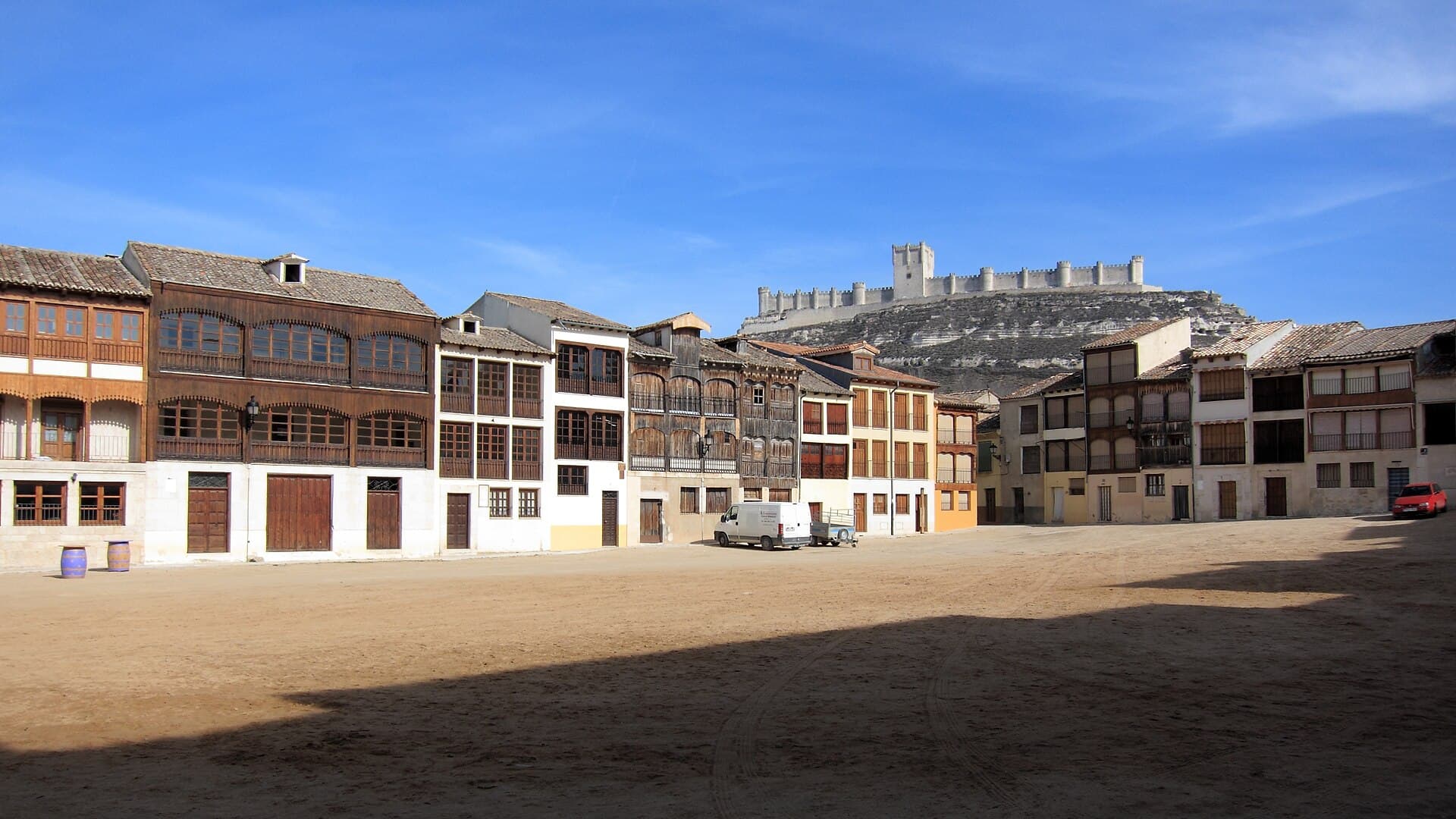
This medieval square, celebrated for its bullfights, safeguards an unexpected detail about its surrounding structures.
Beyond the visible vineyards and contemporary bodegas, an unseen realm beneath Peñafiel perpetuates the region's winemaking tradition with remarkable consistency.
Discover every secret of Peñafiel
Every address, every reveal in full — in your ear, right where it happened.
You pick your stops. You walk. The voice reveals what the others miss.

Your self-guided audio tour of Peñafiel is ready — pick your landmarks, choose your language, and start the moment you arrive.
BuyLume has a built-in augmented-reality guide. Hold your phone up and its camera shows the street ahead of you, with a glowing arrow laid over the real view that always points to your next stop — no map to puzzle over, no wrong turns. Like everything in Lume, it works fully offline.
Peñafiel, a town in Spain's Valladolid province, is a destination where the echoes of time and the art of viticulture are deeply entwined. Its iconic medieval castle commands the skyline, marking the town as a central point of the Ribera del Duero wine region. The town’s origins reach into antiquity, gaining considerable prominence during the Middle Ages as a crucial defensive position.
Stone-paved paths meander through the old quarter, revealing monuments and traditional architecture. The town’s identity is inextricably linked to its winemaking heritage, with vineyards blanketing the surrounding countryside. Peñafiel offers a blend of cultural exploration and gastronomic pleasures, making it a compelling stop for those seeking the essence of rural Castile.
Peñafiel's story is a testament to its strategic position, particularly along the Duero River, which served as a border between Christian and Muslim territories during the 9th and 10th centuries. The name "Peñafiel" itself, derived from the Latin Pinna Fidelis, meaning 'faithful rock,' mirrors its enduring role as a stronghold.
The first recorded mention of the town as Penna Fidele dates to 943. The castle, a focal point of the town, began construction in the 10th century and was a crucial defensive outpost against Arab forces. In 1013, Count Sancho García famously took the fortress from the Moorish leader Almanzor, reportedly planting his lance on the hill and declaring it "Castile's Faithful Rock," thus bestowing upon the town its enduring name.
Over the centuries, the castle underwent significant transformations. Alfonso X donated it to his brother, Infante Juan Manuel, a prominent medieval Spanish writer, who initiated rebuilding efforts from 1307 onwards. Further interventions in the 14th and 15th centuries, notably by Don Pedro Girón, Lord of Peñafiel, shaped its current appearance. Despite periods of abandonment and damage, including a fire in 1755, the castle was declared a National Monument in 1917 and has been meticulously restored.
Beyond the castle, Peñafiel thrived as an important medieval center, once home to as many as 19 churches. The town's expansion was further aided by the arrival of the Spanish rail system, facilitating the distribution of goods, especially wheat, and leading to the establishment of flour factories. Today, Peñafiel's deep past is evident in its well-preserved medieval structures and traditions, particularly its unique Plaza del Coso and its profound connection to the Ribera del Duero wine region.
Peñafiel offers a concentrated journey through time and wine. The most prominent landmark is Peñafiel Castle, a striking 10th-century fortress that rises like a ship anchored on its hilltop. Inside the castle's keep, you'll find the Provincial Wine Museum, an interactive space dedicated to the Ribera del Duero wine region's traditions and winemaking processes.
At the heart of the town lies the Plaza del Coso, a medieval square designated an Asset of Cultural Interest. This rectangular space, encircled by 48 buildings with ornate wooden balconies, transforms into a bullring during the August Fiestas of Nuestra Señora and San Roque. It also hosts the distinctive "Descent of the Angel" ceremony on Easter Sunday.
Explore the old quarter to discover the Clock Tower, the belfry of the former Saint Steven's Church, and the Convent of San Pablo, a Gothic-Mudejar complex housing the tomb of Infante Juan Manuel. For a deeper immersion into local life, visit the Casa Museo de la Ribera, displaying traditional Castilian architecture and early 20th-century living. Do not miss the opportunity to visit some of the numerous wineries that define the Ribera del Duero region; many offer tours and tastings.
The most agreeable times to visit Peñafiel are during spring and early autumn (May, June, September, and October). These months offer mild weather, fewer crowds, and the vineyards are at their most verdant. Summers (July and August) are very warm with average highs of 30-31°C (86-88°F), while winters (January and December) are cold, with daytime highs around 10°C (50°F). Peñafiel experiences a distinct dry season from June to September, with July being the sunniest month.
Peñafiel is located in the Valladolid province of Castile and León, Spain. It is accessible by bus from major cities like Madrid and Valladolid. The town itself is compact and easily explored on foot, allowing visitors to wander its stone-paved paths and discover its historical sites.
Many local restaurants specialize in traditional Castilian cuisine, with lechazo (roast suckling lamb) being a celebrated local delicacy, often paired with the region's exquisite Ribera del Duero wines. Guided tours of Peñafiel Castle are available, though they are often in Spanish only. For wine enthusiasts, numerous wineries in the surrounding area offer tours and tastings, which are a growing tourist activity. The local tourist office, located in the Plaza del Coso, can provide further information and assistance.
Peñafiel in Korean, in Chinese or in Hebrew — and 29 more languages, every stop narrated by a native voice. The widest language range of any self-guided audio tour.
Available in: