Convent of the Discalced Carmelites Museum
Behind its austere stone face, this convent guards an unexpected artistic trove.
Full story unlocks in the tour
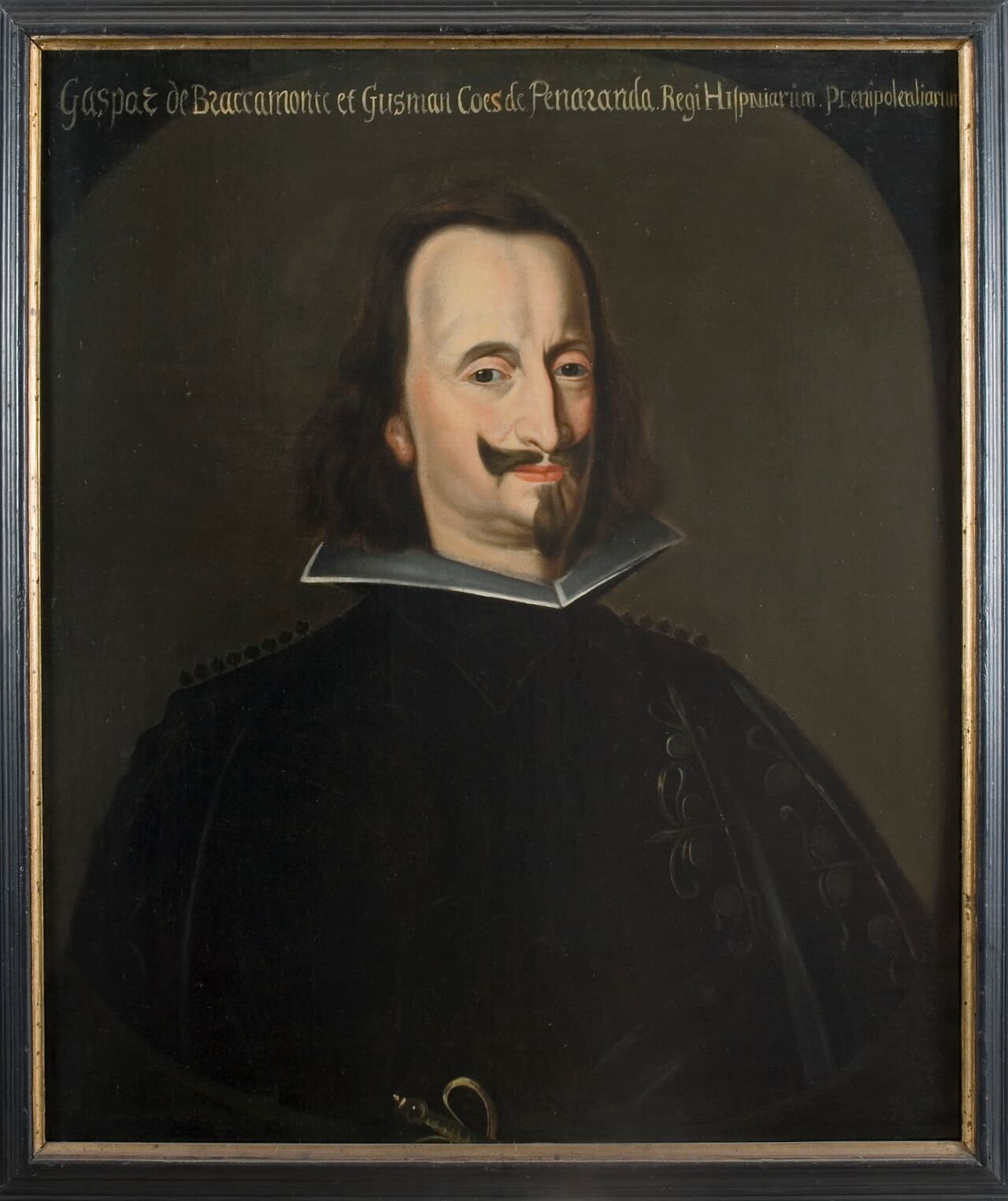 After Anselm van Hulle / public domain, via Wikimedia Commons
Self-guided audio walking tour of Peñaranda de Bracamonte — GPS route, offline playback, story-driven narration in 32 languages.
“Castilian grace and Baroque splendor unfold across three interwoven squares.”
Not the postcards. The stories even locals don't know — whispered in your ear, right where they happened.
Behind its austere stone face, this convent guards an unexpected artistic trove.
One of Peñaranda's three historic squares once served a starkly different purpose.
There is a local dish so emblematic, it serves as a declaration of regional identity.
Discover every secret of Peñaranda de Bracamonte
Every address, every reveal in full — in your ear, right where it happened.
You pick your stops. You walk. The voice reveals what the others miss.


Your self-guided audio tour of Peñaranda de Bracamonte is ready — pick your landmarks, choose your language, and start the moment you arrive.
BuyLume has a built-in augmented-reality guide. Hold your phone up and its camera shows the street ahead of you, with a glowing arrow laid over the real view that always points to your next stop — no map to puzzle over, no wrong turns. Like everything in Lume, it works fully offline.
Peñaranda de Bracamonte, a city in the province of Salamanca, Castilla y León, stands as a vital center in the northeastern part of the region. Situated approximately 40 kilometers from the capital city of Salamanca, it functions as the administrative and service hub for the Tierra de Peñaranda comarca. The town is celebrated for its distinctive Castilian architecture, particularly its three interconnected arcaded squares, which have earned its historic quarter the designation of a Property of Cultural Interest.
Surrounded by expansive cereal fields, Peñaranda de Bracamonte offers a serene, rural environment that invites exploration. The town's enduring role as a commercial center, dating back to a royal privilege granted in the 14th century for its market, continues to shape its identity and draw visitors. Beyond its architectural allure and commercial heritage, Peñaranda de Bracamonte is also recognized for its profound gastronomy, with traditional dishes that reflect the local produce and culinary traditions.
## Early Origins and the Bracamonte Influence Peñaranda de Bracamonte's origins trace back to the 12th century, when settlers from Peñaranda de Duero in Burgos established the town. Initially a small rural council, it saw modest growth until the arrival of the Bracamonte family. This noble family, of French descent, became linked to the village in the 15th century through the marriage of Juana de Bracamonte to Álvaro de Ávila, who was already the lord of Peñaranda. The town's name officially became Peñaranda de Bracamonte in 1602, when King Felipe III granted Alonso de Bracamonte the title of Count of Peñaranda.
## A Flourishing Market Town The town's prosperity was significantly bolstered by its weekly market, a tradition established by royal privilege in 1375. This market transformed Peñaranda into a vital commercial crossroads within the Cañada de las Merinas, a historic sheep drovers' route. The 17th century, under the influence of the Bracamonte family and the flourishing market, marked a period of significant prosperity for the town.
## Architectural Evolution and Cultural Recognition The town's unique urban plan, characterized by three successive arcaded squares—Plaza de Agustín Martínez Soler, Plaza de la Constitución, and Plaza de España—developed over centuries. The Plaza de la Constitución, for instance, was created in the 16th century to accommodate the expanding market, and the Town Hall was built there in 1647. In 1973, Peñaranda's historic quarter, encompassing these squares and prominent buildings like the Church of San Miguel and the former Bracamonte Palace, was declared a Historic-Artistic Site.
## Modern Developments and Enduring Legacy Peñaranda de Bracamonte continued to evolve into the 19th and 20th centuries, with notable milestones such as the creation of the province's first newspaper, La Voz de Peñaranda, in 1878, the inauguration of the Teatro Calderón in 1881, and the arrival of the railway in 1894. The town gained city status by Royal Decree on June 11, 1908. Despite a devastating gunpowder magazine explosion during the Civil War that destroyed parts of the city, Peñaranda was rebuilt, partly through the labor of political prisoners. Today, it maintains its identity as a welcoming city known for its cultural heritage and gastronomy.
Peñaranda de Bracamonte is distinguished by its three interconnected arcaded squares, each offering a glimpse into Castilian architecture. The Plaza de Agustín Martínez Soler is the oldest and most rural in character. The Plaza de la Constitución, expanded in the 16th century for market activities, features the Town Hall, constructed in 1647. The Plaza de España, with its more regular shape, houses the old prison and a bandstand.
Consider a visit to the Renaissance-style Church of San Miguel. Another significant site is the Baroque-style Convent of the Discalced Carmelites, founded in 1661 by Don Gaspar de Bracamonte y Guzmán, Viceroy of Naples. The convent's museum contains a valuable collection of Italian artwork. The Hermitage of El Humilladero, located opposite the Carmelite Convent, and the Hermitage of San Luis, dating from 1643, are also notable.
For those interested in local life, the weekly market on Thursdays, a tradition since 1375, offers fresh produce, clothing, flowers, and prepared foods across approximately 50 stalls.
The most pleasant time to visit Peñaranda de Bracamonte for general outdoor activities is from mid-June to mid-September, with peak conditions in the last week of July. For hot-weather activities, early July to mid-August is ideal. Summers are typically short, warm, and mostly clear, while winters are very cold and partly cloudy. The clearest month is July, with clear or partly cloudy skies 85% of the time on average.
Peñaranda de Bracamonte is easily accessible by road, particularly via the A-50, which connects Salamanca with Ávila, and the CL-605. The town is located approximately 40 kilometers from Salamanca.
Parking options include several spots for cars and even larger vehicles like camper vans. The Plaza de los Herreros offers a dirt parking area suitable for four or five large motorhomes, though it lacks shade. There are also private garages available for rent or purchase. For general parking, ViaMichelin can help locate available spaces.
The Tourist Office is open Tuesday to Saturday from 10 AM to 2 PM. The Town Hall operates Monday to Friday from 9 AM to 2 PM.
Peñaranda de Bracamonte in Korean, in Chinese or in Hebrew — and 29 more languages, every stop narrated by a native voice. The widest language range of any self-guided audio tour.
Available in: