Wielka Świątynia
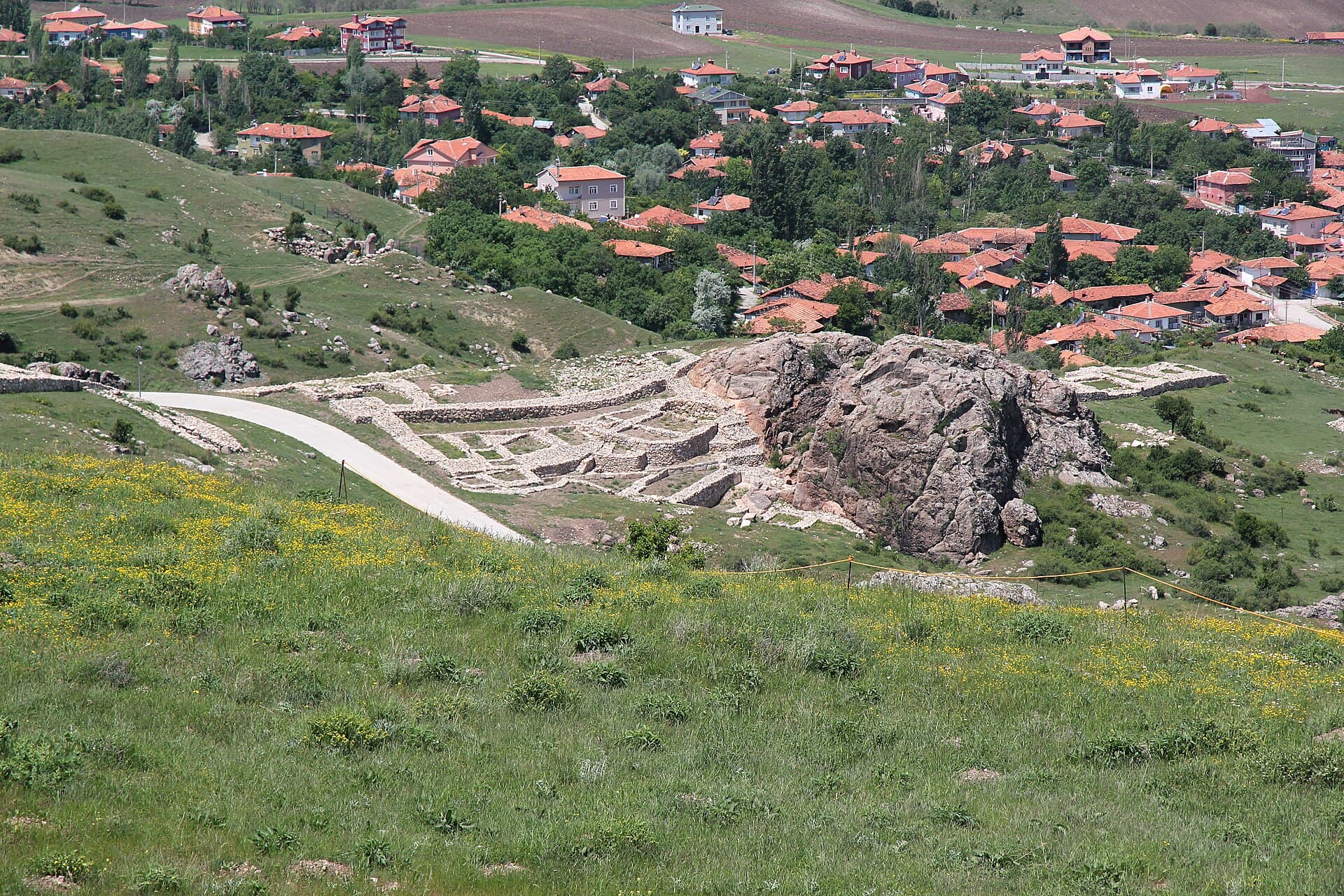
Tajemniczy zielony kamień spoczywa w Wielkiej Świątyni, inny niż wszystkie skały w okolicy.
Pełna historia odblokowuje się w wycieczce
 Ingeborg Simon / CC BY-SA 3.0, via Wikimedia Commons
Samodzielna audio-wycieczka po Boğazkale — trasa GPS pieszo, odtwarzanie offline, wciągająca narracja w 32 językach.
“Echoes of an empire, etched in stone and earth.”
Nie pocztówki. Historie, których nawet miejscowi nie znają — szeptane do ucha, dokładnie tam, gdzie się wydarzyły.
Tajemniczy zielony kamień spoczywa w Wielkiej Świątyni, inny niż wszystkie skały w okolicy.
Pod imponującą Bramą Sfinksów długi, podziemny tunel prowadzi do nieoczekiwanego odkrycia.
Koniec potężnej stolicy Imperium Hetytów, Hattusy, kryje osobliwą tajemnicę: nie została ona splądrowana w tradycyjnym tego słowa znaczeniu.
Odkryj każdy sekret Boğazkale
Każdy adres, każde pełne odkrycie — w Twoim uchu, dokładnie tam, gdzie się wydarzyło.
Ty wybierasz przystanki. Ty spacerujesz. Głos ujawnia to, co inni przegapiają.

Twój samodzielny audioprzewodnik po Boğazkale jest gotowy — wybierz swoje punkty orientacyjne, wybierz język i rozpocznij w momencie przybycia.
KupLume ma wbudowanego przewodnika w rozszerzonej rzeczywistości. Unieś telefon: kamera pokazuje ulicę przed tobą, a na rzeczywistym obrazie świeci strzałka, która zawsze wskazuje twój następny przystanek — bez rozszyfrowywania mapy, bez błędnych skrętów. Jak wszystko w Lume, działa całkowicie offline.
Boğazkale, a small town in Turkey's Çorum Province, serves as the entrance to Hattusa, the ancient capital of the Hittite Empire. This UNESCO World Heritage site, once a formidable power rivaling ancient Egypt, offers a tangible connection to a civilization that flourished in Anatolia from roughly 1600 BCE to 1200 BCE.
The area, formerly known as Boğazköy, has been a site of human settlement since the Chalcolithic age, around 5000 BCE, with significant historical places like Hattusa and the rock sanctuary of Yazılıkaya discovered in 1834. Today, Boğazkale itself is a quiet village, but its proximity to these monumental ruins makes it a vital destination for those seeking to explore the Bronze Age history of Anatolia.
Visitors to Boğazkale are drawn by the impressive foundations of Hattusa, its monumental gateways, and the intricately carved reliefs of Yazılıkaya. The site's dramatic setting and the sheer antiquity of its remains offer a profound sense of stepping back in time to an era of powerful empires and mysterious rituals.
## From Ancient Settlements to Imperial Capital The history of Boğazkale stretches back to approximately 5000 BCE, with early settlements in the Chalcolithic period. The area gained significant prominence with the rise of the Hattian people, who established a permanent settlement at the Hattusa site by at least 2000 BCE. By the 18th century BCE, Hattusa was already a notable trading center, even in its remote location, connected to the Assyrian empire through trade posts.
Around the mid-17th century BCE, a Hittite ruler, possibly named Labarna, made Hattusa the capital of his burgeoning empire, despite a legendary curse from an earlier king, Anitta of Kanesh, who had destroyed the city around 1700 BCE and sown weeds in its place. Under Hittite rule, Hattusa grew into a vast and sophisticated city, covering approximately one square kilometer with a peak population of 10,000. It was protected by stout walls, measuring 6.6 kilometers long, and featured an inner city on higher ground with palaces and temples, and an outer city with timber and mud-brick structures that have since vanished.
The Hittite Empire reached its zenith between 1350 and 1200 BCE under King Šuppiluliuma I, who expanded Hittite control across much of Anatolia and subjugated Syria, even warring with Egypt. Hattusa was the power center of this empire, home to temples dedicated to the Storm God and other deities. The royal archives unearthed at Hattusa yielded over 30,000 cuneiform clay tablets, providing invaluable insights into Hittite daily life, religion, administration, and politics. These tablets included official correspondence, legal codes, cultic procedures, oracular prophecies, and even the world-famous Treaty of Kadesh, a peace agreement between the Hittite king Hattusili III and the Egyptian pharaoh Ramesses II, signed in 1259 or 1258 BCE.
Despite its power, the Hittite Empire collapsed around 1200 BCE, a fate shared by other Bronze Age societies, for reasons that remain largely unknown. Hattusa was destroyed by fire around this time, though evidence suggests it was meticulously evacuated. The site was largely forgotten for millennia until its rediscovery in 1834 by French archaeologist Charles Texier. Systematic excavations began in 1907 by the German Oriental Society and the German Archaeological Institute, and have continued since 1939, revealing the grandeur of this ancient capital. In 1986, Hattusa and its sanctuary Yazılıkaya were officially recognized as a UNESCO World Heritage site.
The primary attractions in Boğazkale revolve around the ancient Hittite capital of Hattusa and its nearby rock sanctuary, Yazılıkaya. Hattusa itself is an expansive open-air museum, best explored by driving the loop road that connects its various sections. Key sights include the impressive city walls and monumental gateways, such as the Lion Gate, flanked by two large stone lions, and the King's Gate, featuring a relief of a warrior god.
Within Hattusa, explore the foundations of the Great Temple, the largest religious building in the city, dedicated to the storm god Teshub and the sun goddess Arinna. Here, you'll find the intriguing Green Stone, a polished block of nephrite or serpentinite whose purpose remains a mystery. The Yerkapı, an artificial embankment topped by the Sphinx Gate, conceals a 71-meter subterranean tunnel, believed to have been used for religious processions.
Just 2.6 km uphill from the Hattusa entrance is Yazılıkaya, an open-air rock sanctuary with two main chambers, A and B. Chamber A showcases a procession of 64 deities from the Hurrian pantheon carved into the rock walls, while the narrower Chamber B contains larger, better-preserved reliefs, including a procession of twelve underworld gods and a notable carving of King Tudhaliya IV embraced by a god.
The Boğazköy Museum, located in the village center, houses many artifacts excavated from Hattusa, including the twin sphinxes that once guarded the main gates and hieroglyphic inscriptions.
The most pleasant times to visit Boğazkale are during the spring (May, June) and fall (September, October). During these months, temperatures are comfortable, ranging from 21°C to 27°C, making it ideal for exploring the extensive outdoor archaeological sites without the extreme heat of summer or the chill of winter. Rainfall is moderate, offering a good balance of sunny and rainy days. July is the sunniest month, with an average of 10.6 hours of sunshine per day.
Boğazkale is a small town in Turkey's Çorum Province, with a population of about 1,200 people. The nearest major transport hub is Sungurlu, approximately 30 km northwest, which is on the Ankara-Samsun bus route. From Sungurlu, you can take a dolmuş (minibus) that runs three times a day (not on weekends) or hire a taxi for the 30-minute journey to Boğazkale. For those driving, Hattusa is about a 2.5-hour drive east of Ankara. The archaeological site of Hattusa has a loop road, making it convenient to drive between the different points of interest.
The entrance fee for Hattusa and Yazılıkaya is typically a combined ticket, and it's advisable to carry cash as credit cards may not be accepted at the ticket office. The Boğazköy Museum is often included with a MuseKart or has a separate, nominal fee. While there are accommodations in Boğazkale, many visitors opt for day trips from larger cities like Ankara or Cappadocia. Mobile phone signal can be patchy in the area, with Vodafone offering some 4G coverage, but Türk Telekom or Turkcell signals may be absent.
Boğazkale in koreański, in chiński or in hebrajski — and 29 more languages, every stop narrated by a native voice. The widest language range of any self-guided audio tour.
Available in: