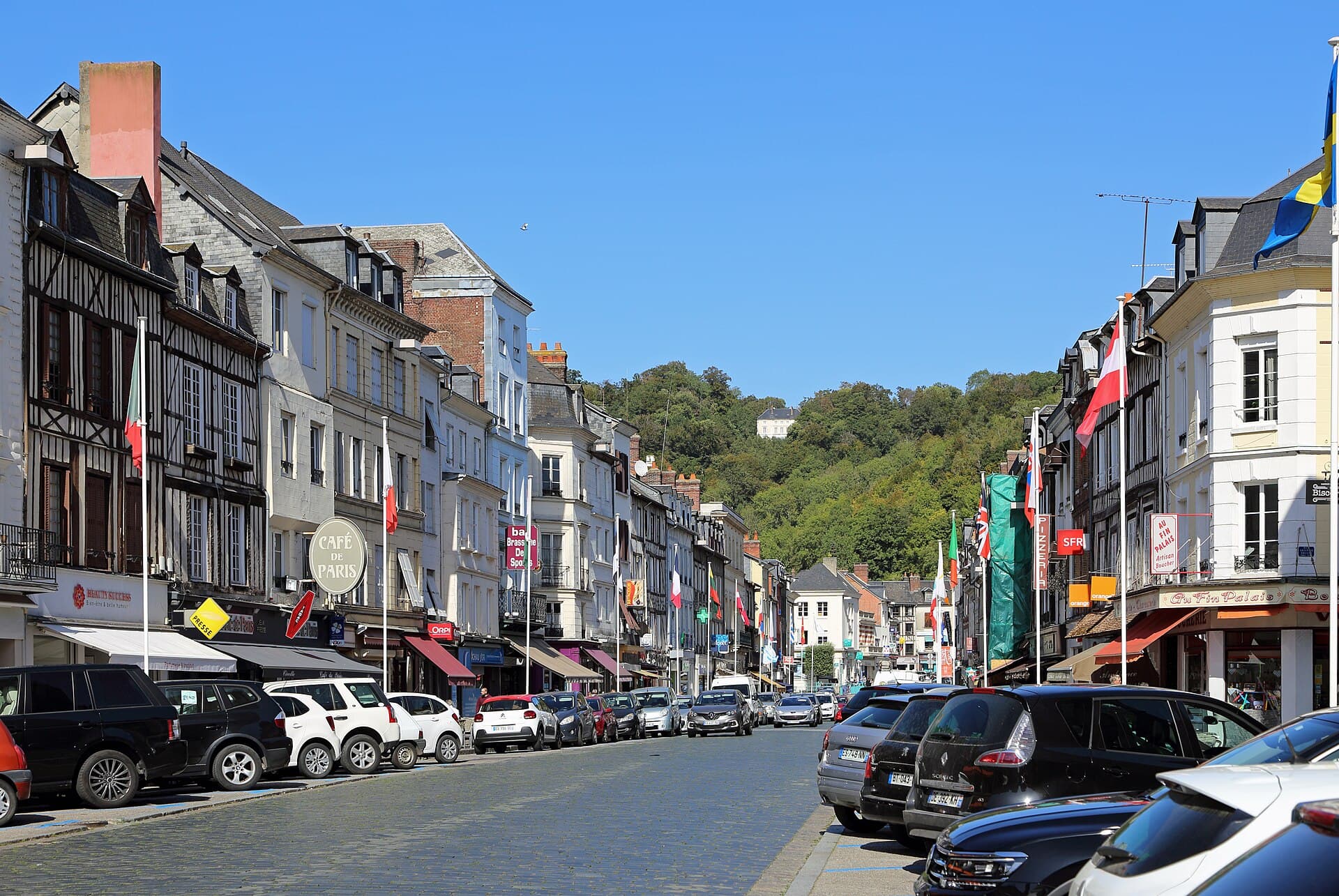
Rue aux Juifs (now Rue des Déportés)
Before it became Rue des Déportés, this street bore a different name, hinting at a long-departed community.
Full story unlocks in the tour
 Marc Ryckaert / CC BY-SA 4.0, via Wikimedia Commons
Self-guided audio walking tour of Pont-Audemer — GPS route, offline playback, story-driven narration in 32 languages.
“Where Norman charm flows with the canals, Pont-Audemer invites you to wander deeper.”
Not the postcards. The stories even locals don't know — whispered in your ear, right where they happened.
Before it became Rue des Déportés, this street bore a different name, hinting at a long-departed community.
The founder of a world-renowned luxury brand refined his craft in Pont-Audemer, his legacy intertwined with the town's industrial past.
Observe the church's interior closely, and you might discern a shield bearing a motto that speaks to the town's enduring spirit.
Discover every secret of Pont-Audemer
Every address, every reveal in full — in your ear, right where it happened.
You pick your stops. You walk. The voice reveals what the others miss.


Your self-guided audio tour of Pont-Audemer is ready — pick your landmarks, choose your language, and start the moment you arrive.
BuyLume has a built-in augmented-reality guide. Hold your phone up and its camera shows the street ahead of you, with a glowing arrow laid over the real view that always points to your next stop — no map to puzzle over, no wrong turns. Like everything in Lume, it works fully offline.
Pont-Audemer, often described as the 'Norman Venice,' is a picturesque town in the Eure department of Normandy, crisscrossed by canals and waterways. This poetic appellation arises from the Risle River and its tributaries, which flow gently through the town, creating serene spots where many houses stand directly over the water, their reflections shimmering in the canals. Its pedestrian-friendly old town features narrow ways and half-timbered houses, offering a blend of medieval character and an artisan spirit.
Once a flourishing center for leather production, Pont-Audemer has gracefully transitioned into a haven of culture and relaxation. The town's unhurried appeal invites visitors to enjoy a riverside coffee, observe ducks gliding under arched bridges, or browse artisan boutiques. Positioned between the Seine Estuary and the Risle Valley, Pont-Audemer provides a peaceful, authentic, and photogenic escape in Normandy.
The origins of Pont-Audemer can be traced back to a Roman military post, strategically positioned to protect two bridges that allowed a Roman road to cross the Risle River. The town was initially known by the Latin name 'ad duos Pontes,' meaning 'The Two Bridges.' Over time, it adopted the 'Audemer' qualifier to distinguish it from other towns like Pont-l'Évêque and Pont-Authou.
During the Middle Ages, particularly around the 11th century, Pont-Audemer began to prosper. It developed around a feudal castle, mentioned as early as 1123, and was granted town privileges in the 13th century. The town's prosperity led to the construction of defensive structures, including fortifications in the 12th century. However, Pont-Audemer endured periods of conflict, notably during the Hundred Years' War, when its defenses and buildings were repeatedly damaged and rebuilt.
From the 16th to the 19th centuries, Pont-Audemer's economy flourished due to its leather craftsmanship. Tanneries and taweries were established along the canals, utilizing the Risle's water for processing hides. The half-timbered houses, often featuring drying sheds, still bear witness to this significant industry. The town's reputation for quality leather was so strong that it supplied the armies of Louis XIV. In the 18th century, English workers and their families settled in Pont-Audemer, introducing new tanning techniques and further boosting the local industry. This period also saw the development of papermills and foundries.
While the tanning industry has largely disappeared, Pont-Audemer has preserved its historical charm. The town was largely spared significant damage to its historic buildings during the Battle of Normandy in World War II. Today, Pont-Audemer embraces its past through its well-preserved architecture and a focus on tourism and culture. The town actively hosts cultural events, including the Festival Les Mascarets in July and August, which features music, street performances, and outdoor festivities.
Begin your exploration in the historic center, where narrow ways wind between half-timbered houses and over small bridges, reflecting in the canals. This area is ideal for leisurely strolls and photography. Do not miss the Church of Saint-Ouen, an impressive Gothic and Renaissance-style church built between the 15th and 16th centuries. It features intricately carved stonework, towering stained-glass windows, and a notable organ.
For a singular perspective, consider a kayak trip along the canals. Les Castors Rislois offers guided tours that allow you to discover the town's architecture and ancient washhouses from the water. The Musée Alfred-Canel, housed in the former home of local historian and politician Alfred Canel, is a fascinating cabinet of curiosities. It contains diverse collections, including fine art, local history, natural sciences, and a library with approximately 25,000 volumes.
Beyond the town center, the surrounding Risle Valley and the Boucles de la Seine Normande Regional Natural Park offer opportunities for nature walks. The Marais Vernier, a vast 4,500-hectare wetland, is a short drive away and is ideal for nature walks, birdwatching, and discovering unique flora.
Pont-Audemer is a delightful destination throughout the year. For warm-weather activities and lively outdoor markets, late June to early September offers comfortable temperatures, averaging 19°C to 24°C, and the clearest skies. Spring (April–June) is ideal for enjoying flowers and greenery along the canals, while autumn brings golden light and a quieter atmosphere. Summer is also when the town hosts lively outdoor events like the Festival Les Mascarets. Winter provides a festive atmosphere with seasonal lights.
Pont-Audemer is situated roughly midway between Rouen and Honfleur. The most convenient way to reach the town is by car, with a journey of approximately 45 minutes from Rouen, 30 minutes from Honfleur, or around 2 hours from Paris via the A13 motorway. While there is no train station directly in Pont-Audemer, nearby towns like Pont-l'Évêque and Bernay offer rail links, with bus or taxi services completing the journey. The local Tourist Office, located at 2 Place du Général de Gaulle, provides maps and information to help you explore the town and the surrounding region. Pont-Audemer's weekly market, a lively event, takes place on Monday and Friday mornings, offering fresh local produce, Norman cheeses, and artisan goods.
Pont-Audemer in Korean, in Chinese or in Hebrew — and 29 more languages, every stop narrated by a native voice. The widest language range of any self-guided audio tour.
Available in: