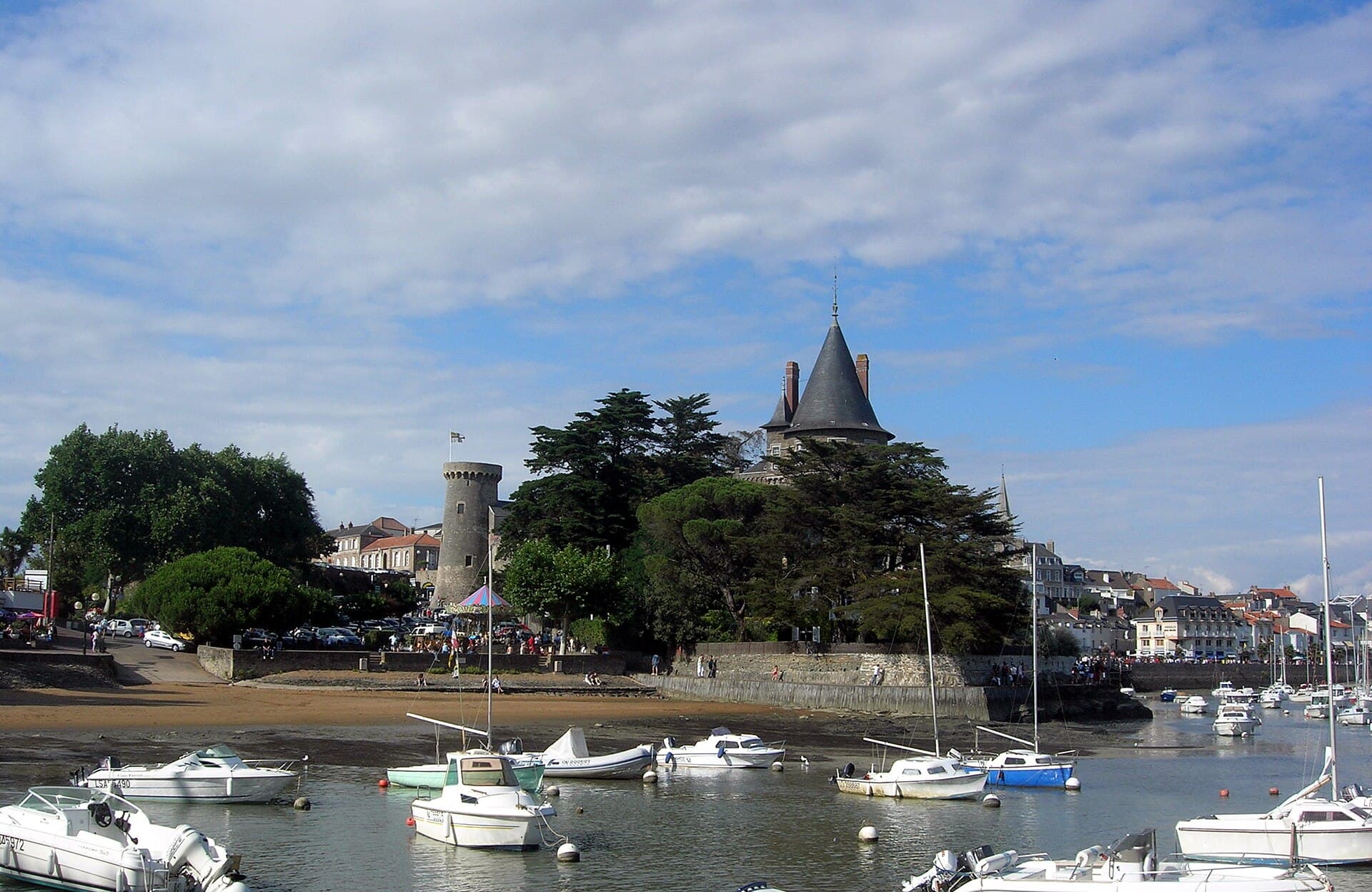
Château de Pornic
The formidable Château de Pornic, a symbol of the town, holds a darker identity.
Full story unlocks in the tour
 No machine-readable author provided. CaptainHaddock assumed (based on copyright claims). / CC BY-SA 3.0, via Wikimedia Commons
Self-guided audio walking tour of Pornic — GPS route, offline playback, story-driven narration in 32 languages.
“Where the Loire-Atlantique meets the sea, a medieval past echoes on the Jade Coast.”
Not the postcards. The stories even locals don't know — whispered in your ear, right where they happened.
The formidable Château de Pornic, a symbol of the town, holds a darker identity.
This modest chapel in the Gourmalon neighborhood exists because its early 19th-century parishioners took matters into their own hands.
The familiar Breton cider bowl, often personalized with a name, has a surprising origin.
Discover every secret of Pornic
Every address, every reveal in full — in your ear, right where it happened.
You pick your stops. You walk. The voice reveals what the others miss.


Your self-guided audio tour of Pornic is ready — pick your landmarks, choose your language, and start the moment you arrive.
BuyLume has a built-in augmented-reality guide. Hold your phone up and its camera shows the street ahead of you, with a glowing arrow laid over the real view that always points to your next stop — no map to puzzle over, no wrong turns. Like everything in Lume, it works fully offline.
Pornic, a delightful seaside town on France's Atlantic coast in the Loire-Atlantique department, offers a quintessential blend of historical allure, coastal serenity, and culinary pleasures. Known for its appealing harbor, sandy expanses, and fresh seafood, it is a destination that draws history enthusiasts, food lovers, and families alike. The town is part of the Côte de Jade, a stretch of coastline celebrated for its jade-green waters, dramatic cliffs, and traditional fishing huts on stilts.
With a population of around 16,000, Pornic maintains the intimate feel of a small seaside community, yet it offers a diverse array of activities. Whether you are exploring its scenic promenades, savoring local oysters, or indulging in thalassotherapy treatments, Pornic provides a pleasant escape into the heart of coastal France. Its medieval heritage is notably preserved in the striking Château de Pornic, which overlooks the harbor, creating a postcard-worthy scene with fishing boats and yachts.
Pornic's appeal extends beyond its visual charm; it is a place where history intertwines with modernity, and traditions are honored. The atmosphere is a pleasing combination of a relaxed resort pace, invigorating sea breezes, and the aroma of local bakeries. It is easily accessible, located about an hour from Nantes by car or a 45-minute train ride, making it a convenient coastal retreat.
Pornic's history extends to prehistoric times, with evidence of human presence on the cliffs of Sainte-Marie as early as 5000 BC. Neolithic people erected megalithic monuments, such as the Tumulus des Mousseaux and the Dolmen de la Joselière, between 4000 and 3500 BC, remnants of a large necropolis. The Romans, under Julius Caesar, later incorporated the region into Aquitaine around 56 BC.
During the Middle Ages, Pornic was a significant stronghold. In the 9th century, it was part of the County of Herbauges, defending against Viking incursions. By the 10th century, Alan Wrybeard, Duke of Brittany, fortified a wooden castle to protect the entrance to Pornic and the bay. The Lords of Rais rebuilt this castle in stone in the 12th and 13th centuries. The town developed a maritime economy, centered around its castle, market, and church, benefiting from its strategic location at the mouth of a navigable river.
Pornic's strategic importance continued through conflicts like the Hundred Years' War, during which its castle was besieged and captured multiple times. In the 17th century, the salt industry flourished, with salt from the surrounding marshes becoming a valuable trade commodity. The town also became an important privateer port. The 19th century marked a significant transformation for Pornic as it evolved into a fashionable seaside resort, drawing notable figures like writer Gustave Flaubert and painter Auguste Renoir. The railway arrived in 1875, connecting Pornic to Nantes and further boosting its popularity. It even inaugurated one of France's first casinos in 1853.
During World War II, Pornic was occupied by German forces and was part of the German St. Nazaire Pocket, leading to a prolonged occupation that lasted until May 1945. In 1973, Pornic merged with the communes of Clion-sur-Mer and Sainte-Marie-sur-Mer, forming the larger entity it is today. Today, the town continues to embrace its extensive past while offering modern amenities and a lively coastal experience.
Begin your exploration at the Old Port, the lively center of Pornic, where colorful fishing boats and yachts bob on the water. It is an ideal spot for a leisurely stroll, a seafood meal with a view, or to simply watch the sunset. Overlooking the harbor is the striking Château de Pornic, a 13th-century castle with origins dating back to the 10th century. While privately owned, its exterior is a prominent feature of the skyline, and guided tours are occasionally available through the Tourist Office.
Wander through Pornic's old town, a maze of narrow streets and quaint squares, particularly appealing along Rue de l'Église with its artisan shops and cafés. For those seeking relaxation, Pornic is known for its thalassotherapy centers, offering treatments using seawater and marine products. Nature lovers can explore the La Ria Botanical Garden for a tranquil retreat.
Discover the unique carrelets, traditional fishing huts on stilts that dot the coastline, adding to the region's distinct character. The Sentier des Douaniers (Customs Officers' Path) offers coastal walks along dramatic cliffs and secluded coves. Do not miss the chance to visit the Faïencerie de Pornic to see the creation of the famous hand-painted Breton cider bowls, or the Curé Nantais factory to learn about the regional cheese. For a glimpse into the distant past, visit megalithic sites like the Dolmen de la Joselière or the Tumulus des Mousseaux.
The best time to visit Pornic is from late spring to early autumn, specifically from late June to mid-September, when the weather is warm and pleasant, and the beaches are at their finest. July is typically the clearest and warmest month, with average highs around 73°F (23°C). Summer is particularly lively, featuring festivals, outdoor events, and bustling markets. For a quieter experience with still-pleasant weather, consider visiting in May or September, when the crowds have thinned. The cooler season, from November to March, brings average daily highs below 54°F (12°C).
Pornic is easily accessible, located about an hour's drive from Nantes via the D751, or a 45-minute train journey with direct services. Nantes Atlantique Airport is the closest major airport, offering car rentals and shuttle services. Parking is available in several locations around town, such as Parking du Château and Parking de la Gare, though spaces can fill quickly during peak summer months, so early arrival is advisable.
Getting around Pornic is convenient, with many attractions easily explored on foot, particularly the old town and harbor. Bicycles are also a popular way to explore the coastline, with rental options available. The town is considered safe, but standard precautions are always wise, especially in crowded areas or at night. For comprehensive tourist information and guided tours, the Pornic Tourist Office is a valuable resource, with its main office in Pornic and several information points in nearby municipalities.
Pornic in Korean, in Chinese or in Hebrew — and 29 more languages, every stop narrated by a native voice. The widest language range of any self-guided audio tour.
Available in: