Near Akka village
Just an hour's drive from Tata, ancient artists left a surprising record of a very different Sahara.
Full story unlocks in the tour
 Peripatesy / CC BY-SA 4.0, via Wikimedia Commons
Self-guided audio walking tour of Tata — GPS route, offline playback, story-driven narration in 32 languages.
“Where the Sahara breathes ancient stories through rose-hued kasbahs and endless palm groves.”
Not the postcards. The stories even locals don't know — whispered in your ear, right where they happened.
Just an hour's drive from Tata, ancient artists left a surprising record of a very different Sahara.
South of Tata, explore the remnants of a community that speaks to Morocco's diverse past, far from typical tourist trails.
In the Anti-Atlas mountains surrounding Tata, you can find what might be one of the world's oldest banking systems.
Discover every secret of Tata
Every address, every reveal in full — in your ear, right where it happened.
You pick your stops. You walk. The voice reveals what the others miss.


Your self-guided audio tour of Tata is ready — pick your landmarks, choose your language, and start the moment you arrive.
BuyLume has a built-in augmented-reality guide. Hold your phone up and its camera shows the street ahead of you, with a glowing arrow laid over the real view that always points to your next stop — no map to puzzle over, no wrong turns. Like everything in Lume, it works fully offline.
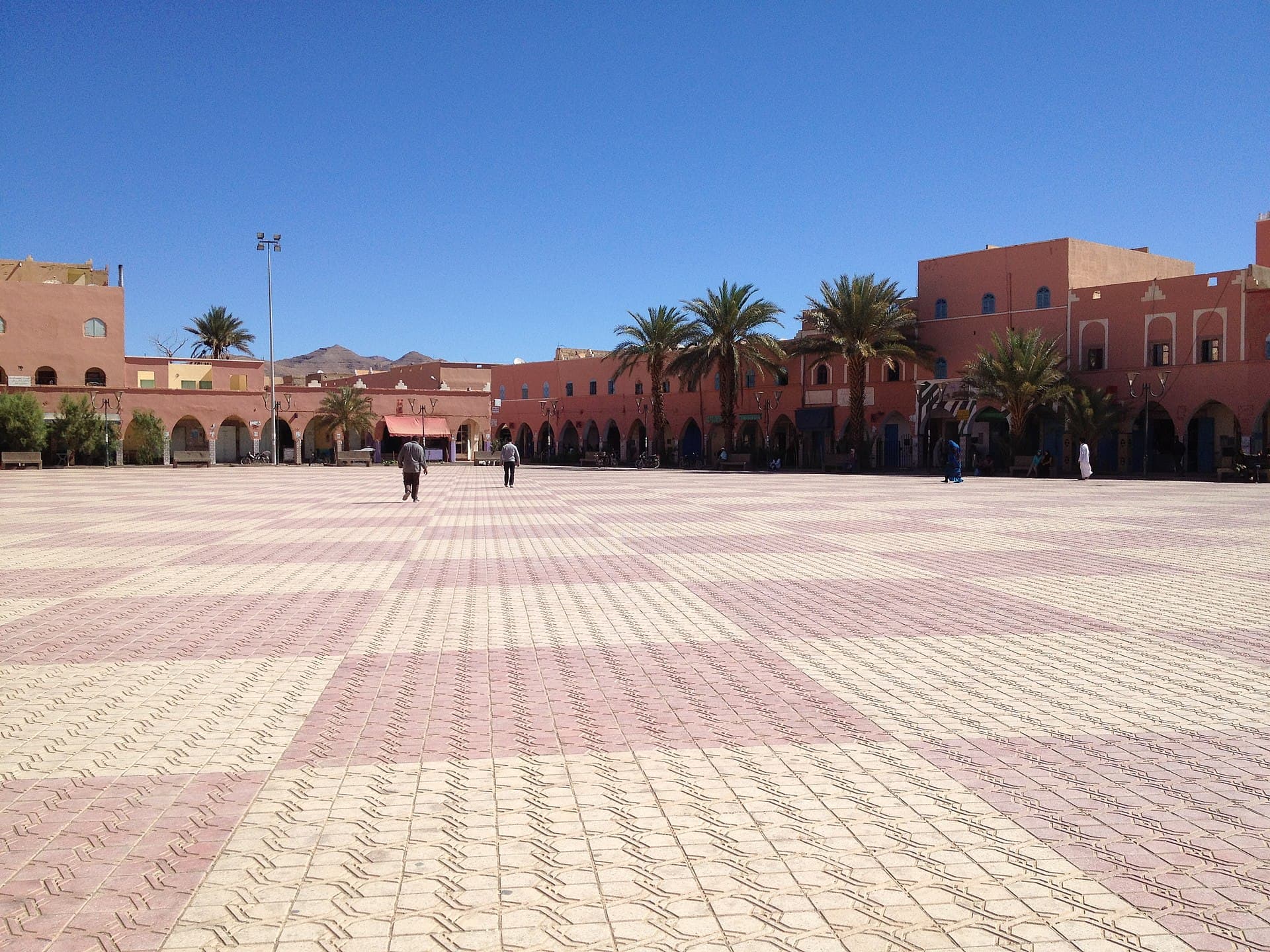
Tata, often called the "Pink City" for its ochre clay buildings, is a serene desert oasis in southwestern Morocco, far removed from the country's more bustling tourist hubs. At the foot of the Jbel Bani mountain range, an outlier of the Anti-Atlas, it is a place where endless palm groves stretch against golden desert horizons, nourished by the Oued Tata, a tributary of the Drâa River. This verdant haven offers an authentic encounter with the pre-Saharan desert's soul, where history breathes from every kasbah wall and tradition flourishes in daily life.
This fortified oasis town served as a crucial stop along ancient trans-Saharan trade and kasbah routes, connecting the southern Atlas foothills with the Sahara Gateway. For intrepid travelers seeking an off-the-beaten-path experience, Tata acts as a gateway to explore vast desert landscapes, unique geological formations, and a living Amazigh (Berber) culture that is experienced every day.
Tata's history is deeply intertwined with its strategic location at the extreme northwestern edge of the Sahara, where three wadis descend from Mount Bani to water a fertile oasis. This made it a vital stop for trans-Saharan camel caravans traveling between Timbuktu and Taroudant, transforming it into a prosperous commercial hub. The region's archaeological heritage is remarkably deep, showcasing a prodigious civilization that radiated for millennia, inhabited by a diverse mix of Amazigh (Berber) tribes and sedentary and nomadic Arabs.
The landscape around Tata is dotted with numerous ksour (fortified villages) and kasbahs, many of which are still inhabited today. These structures, built from local pink clay, appear to rise organically from the earth, designed with thick walls and small windows to naturally regulate interior temperatures—cool in summer, warm in winter. In the 16th century, Sultan Mansur ed-Dehebi utilized Tata as a stronghold against the expansion of the House of Tazeroualt and as a crucial base north of the Sahara for his conquest of Sudan.
The presence of the historic Mellah of Tazart, an ancient Jewish quarter south of Tata, stands as powerful evidence of Morocco's multicultural heritage, where diverse communities once coexisted and traded. While the trans-Saharan slave trade, for which Tata's souk was a major market, gradually declined and was opposed by colonial powers, it continued well into the 20th century. Today, the memory of this past has been replaced by a dynamic market where descendants of former slaves and traders live and work together.
Tata remains a dynamic hub of Amazigh culture, where traditions are lived daily. Communal granaries, or Igoudar, scattered throughout the region, exemplify the Berber practice of shared resources. Local women's cooperatives continue to create intricate weaving, pottery with distinct green glazes, and basketry using ancestral techniques. The region’s numerous rock art sites, some dating back over 5,000 years, serve as an open-air museum, depicting a time when this arid land was a thriving savanna.
Begin your exploration in the heart of Tata, wandering through its active souk where local crafts, from distinctive green-glazed pottery to intricate silver jewelry, are traded. Observe the traditional architecture, with its thick, cooling clay walls, characteristic of desert dwellings. For a sweeping vista of the vast palm groves against the desert and the pink city, seek out the village of Agadir Lehna.
Journey beyond the town to discover the region's ancient past. Just an hour's drive away, near the village of Akka, lie prehistoric rock engravings depicting a surprising array of animals and scenes from daily life, offering a glimpse into a once-lush Sahara. Further south, explore the remains of the Mellah of Tazart, an ancient Jewish quarter that speaks to Morocco's diverse cultural narrative. Consider a visit to the Tissint Waterfalls, a unique desert anomaly where salty cascades create refreshing pools. The surrounding Jbel Bani and Anti-Atlas mountains also offer dramatic landscapes for hiking and discovering communal fortified granaries (Igoudar).
The optimal time to visit Tata is between October and April. During these months, the temperatures are cooler and more comfortable for outdoor activities like hiking and desert exploration. Summers, from June to September, are scorching, with daily highs often exceeding 37°C (99°F), making intense outdoor activities less enjoyable. While the tourism score for general outdoor activities peaks in early April, the shoulder seasons of early March to early May and mid-October to mid-November also offer pleasant conditions.
Reaching Tata is an adventure in itself, often undertaken by road. From Agadir, take the N10 towards Taroudant, then follow the R109 through Igherm. Shared taxis and buses connect Tata to larger hubs, offering an economical option and a chance to interact with locals, though patience is required as they depart when full. The driving distance from Marrakech is approximately 359 km, taking around 6.5 hours, while from Agadir it's about 289 km. While there is a small airport near Tata, the scenic drive is highly recommended. Accommodation options in Tata combine comfort with reasonable pricing, and the town center serves as a hub for local restaurants and cafés.
Tata in Korean, in Chinese or in Hebrew — and 29 more languages, every stop narrated by a native voice. The widest language range of any self-guided audio tour.
Available in: