Volkswagen Factory
The most produced 'part' from the Volkswagen factory isn't what you'd expect.
Full story unlocks in the tour
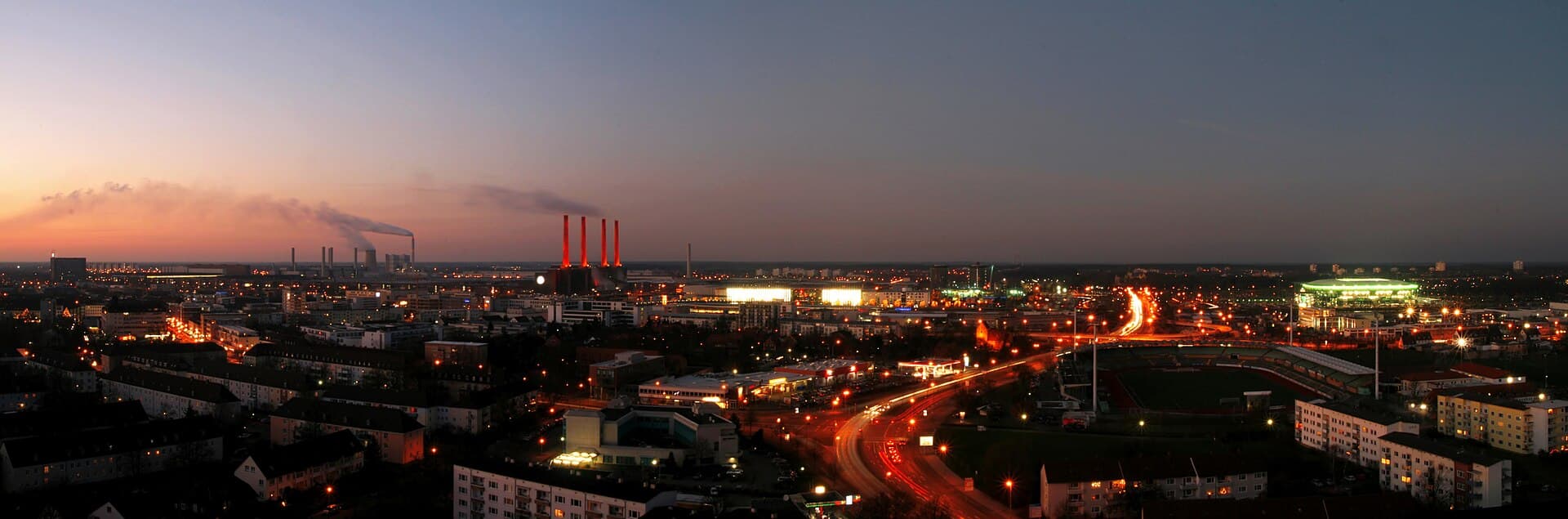 Timmy S. & Cubanito / Public domain, via Wikimedia Commons
Self-guided audio walking tour of Wolfsburg — GPS route, offline playback, story-driven narration in 32 languages.
“Where automotive innovation meets an unfolding urban narrative.”
Not the postcards. The stories even locals don't know — whispered in your ear, right where they happened.
The most produced 'part' from the Volkswagen factory isn't what you'd expect.
This science center's gravity-defying architecture was designed by a Pritzker Prize winner and has been called 'Germany's biggest walk-in sculpture.'
The city of Wolfsburg takes its name from a medieval water castle that endured a major conflict largely undamaged.
Discover every secret of Wolfsburg
Every address, every reveal in full — in your ear, right where it happened.
You pick your stops. You walk. The voice reveals what the others miss.


Your self-guided audio tour of Wolfsburg is ready — pick your landmarks, choose your language, and start the moment you arrive.
BuyLume has a built-in augmented-reality guide. Hold your phone up and its camera shows the street ahead of you, with a glowing arrow laid over the real view that always points to your next stop — no map to puzzle over, no wrong turns. Like everything in Lume, it works fully offline.
Wolfsburg, a city in the German state of Lower Saxony, stands as a testament to 20th-century urban planning and industrial prowess. Born from the vision of a "City of the KdF-Wagen" in 1938, it was purpose-built to house workers for the Volkswagen factory, which remains its economic and cultural heart.
While its identity is deeply intertwined with the automotive giant, Wolfsburg offers more than just cars. It's a city of striking modern architecture, expansive green spaces like the Allerpark, and a surprising array of cultural institutions, including a renowned science center and an art museum dedicated to contemporary works. This unique blend of industrial innovation and forward-thinking urban design makes Wolfsburg a fascinating destination for those seeking a different facet of Germany.
Wolfsburg's origins are relatively recent, a stark contrast to many older German cities. It was officially founded on July 1, 1938, under the name "Stadt des KdF-Wagen bei Fallersleben" (City of the Strength Through Joy Car near Fallersleben). The city's creation was directly linked to the establishment of the Volkswagen factory, intended to produce the "KdF-Wagen," later known globally as the Volkswagen Beetle. Austrian architect Peter Koller, under the supervision of Albert Speer, designed the original city plan, envisioning a model community integrated with green spaces.
During World War II, the factory shifted its focus to military production, utilizing forced laborers and prisoners of war. The city itself was heavily bombed in 1944. A pivotal moment arrived after the war in May 1945, when the British occupying forces made the crucial decision not to dismantle the Volkswagen factory. Instead, they opted to continue production of the Beetle, a decision that proved instrumental in Germany's post-war economic recovery, with Volkswagen becoming a symbol of the "Wirtschaftswunder" (economic miracle).
On May 25, 1945, the city was renamed Wolfsburg, after the nearby 13th-century Renaissance castle. The city experienced rapid growth and expansion in the 1960s and 1970s, driven by the success of Volkswagen. In 1972, a municipal territorial reform incorporated several surrounding villages and the towns of Fallersleben and Vorsfelde, significantly expanding Wolfsburg's area and population, granting it the status of a large city. Today, Wolfsburg continues to be a dynamic economic and cultural center, constantly evolving while embracing its unique industrial heritage.
Wolfsburg offers a blend of automotive marvels, striking architecture, and recreational green spaces. The Autostadt is an absolute essential, an expansive automotive theme park and exhibition complex by Volkswagen. Here, you can explore brand pavilions, visit the ZeitHaus car museum with its collection of iconic vehicles, and even witness new cars being delivered from impressive glass towers. You can even take a tour of the Volkswagen factory itself.
For a dose of cutting-edge design and interactive learning, the Phaeno Science Center is a highlight. Designed by Zaha Hadid, its futuristic concrete structure houses over 350 interactive experiment stations, making science and technology engaging for all ages.
Escape to nature at the Allerpark, a vast public leisure park centered around the artificial Allersee lake. Enjoy swimming, paddleboarding, or simply strolling along scenic trails. The park also features the BadeLand water park, Eis Arena ice rink, and the Volkswagen Arena.
Delve into the past at Wolfsburg Castle (Schloss Wolfsburg), a Renaissance palace with medieval origins that now houses a museum and contemporary art gallery. The Kunstmuseum Wolfsburg presents international modern and contemporary art in a striking building known for its flexible exhibition spaces.
Do not overlook the charming old town of Fallersleben, now part of Wolfsburg, with its half-timbered houses and a 16th-century castle housing the Hoffmann von Fallersleben Museum. For shopping, the Designer Outlets Wolfsburg offer a wide array of international brands.
The most agreeable time to visit Wolfsburg is during the warmer months, from May through September. During this period, the weather is typically mild to pleasantly warm, ideal for outdoor activities and exploring the city's attractions. July and August are the warmest months, with average highs around 23-25°C (73-77°F). For those looking to avoid larger crowds and potentially find better value, the quieter months of December through March offer a cooler experience.
Wolfsburg is well-connected and easy to navigate. The nearest international airport is in Hanover (HAJ), approximately 90 km away, with shuttle services available to Wolfsburg. The city's main ICE train station provides excellent connections to other major German cities. Once in Wolfsburg, many attractions are within walking distance of each other, particularly in the city center. Buses also serve the city, offering a practical way to get around.
For those driving, Wolfsburg is directly on the A39 motorway and close to the A2, a major east-west route in Germany, providing flexibility for exploring the surrounding region. Free parking is often available at attractions like Wolfsburg Castle. The city offers a range of dining options, including European and Italian cuisine, and do not forget to try the local specialty, currywurst.
Wolfsburg in Korean, in Chinese or in Hebrew — and 29 more languages, every stop narrated by a native voice. The widest language range of any self-guided audio tour.
Available in: