Yoshkin Cat Monument
In a city celebrated for its singular architecture, a bronze feline has become a local icon and a harbinger of good fortune.
Full story unlocks in the tour
 Alexxx1979 / CC BY-SA 4.0, via Wikimedia Commons
Self-guided audio walking tour of Yoshkar-Ola — GPS route, offline playback, story-driven narration in 32 languages.
“Where European fairytales meet Mari traditions, a canvas in the heart of Russia.”
Not the postcards. The stories even locals don't know — whispered in your ear, right where they happened.
In a city celebrated for its singular architecture, a bronze feline has become a local icon and a harbinger of good fortune.
While most Russian Kremlins are centuries old, Yoshkar-Ola presents a much younger, yet historically resonant, fortress.
Beyond the celebrated 'Twelve Apostles' clock, another intricate, dynamic timepiece mesmerizes onlookers in the city center.
Discover every secret of Yoshkar-Ola
Every address, every reveal in full — in your ear, right where it happened.
You pick your stops. You walk. The voice reveals what the others miss.


Your self-guided audio tour of Yoshkar-Ola is ready — pick your landmarks, choose your language, and start the moment you arrive.
BuyYoshkar-Ola, the capital of the Mari El Republic, stands as a distinctive and surprising city in the heart of European Russia. Its name, translating to 'Red City' in the Mari language, historically conveyed beauty. Situated on the banks of the Malaya Kokshaga River, Yoshkar-Ola offers a singular blend of provincial appeal and ambitious modern development, serving as a cultural core for the Finno-Ugric peoples.
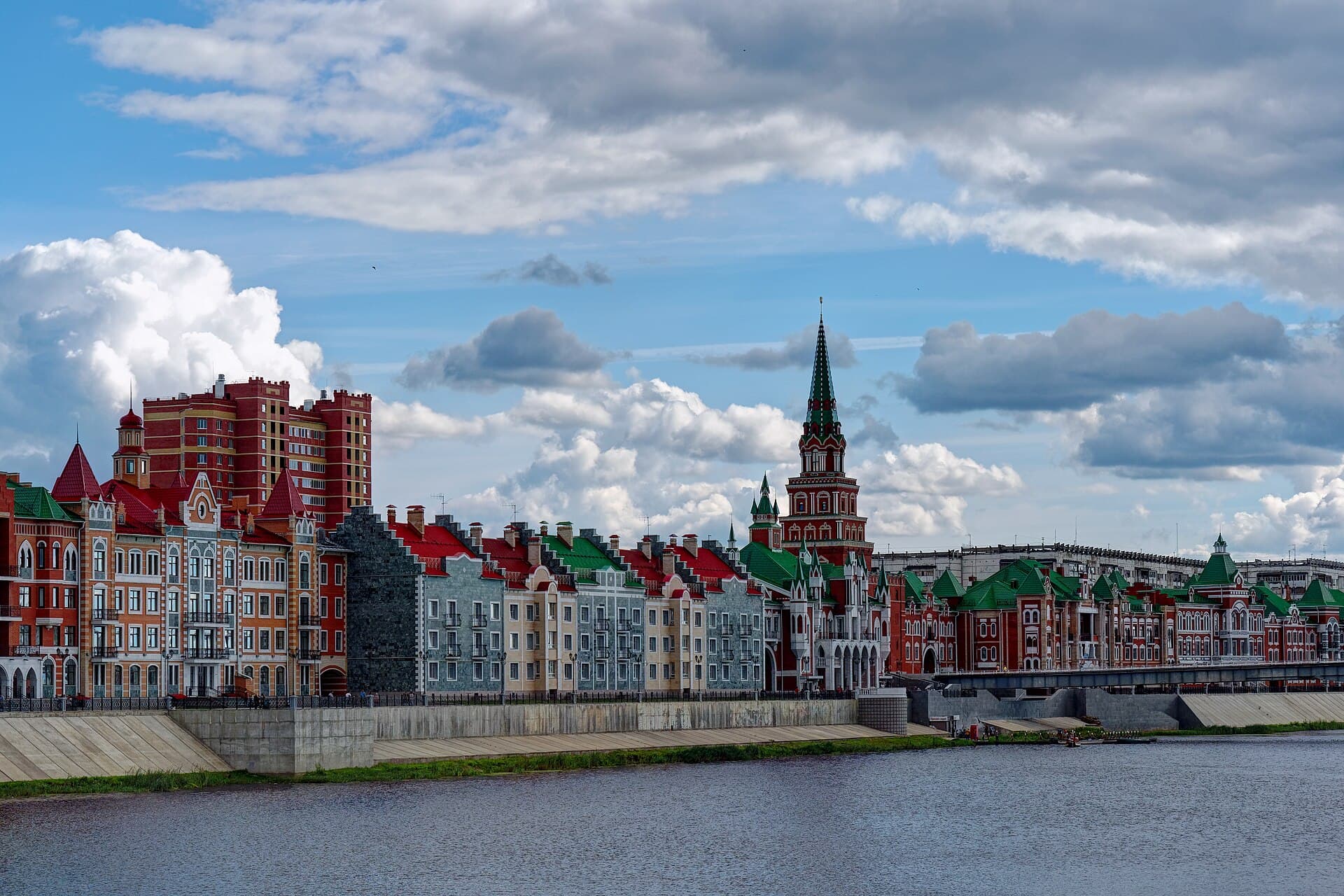
What truly distinguishes Yoshkar-Ola is its eclectic city center, where an unexpected fusion of European and Russian architectural replicas crafts a surreal landscape. From colorful facades evoking a Flemish town along the Bruges Embankment to a replica of Moscow's Spasskaya Tower, the city provides a visual experience that often feels like stepping into a fairytale. With a population of approximately 285,396 residents, Yoshkar-Ola has transformed into a notable destination in the Volga region, inviting visitors to uncover a truly singular aspect of Russia.
The history of Yoshkar-Ola commences in 1584 when it was established as a military fortress by decree of Tsar Feodor Ioannovich. Initially named 'Tsar's City on the Kokshaga,' or Tsarevokokshaysk, its purpose was to solidify the state's position in the newly acquired lands of the Volga region after the fall of the Kazan Khanate. The wooden fortress functioned as a stronghold to control the territory and ensure border security, its strategic location in a swampy and forested area on the Malaya Kokshaga River offering natural protection.
For centuries, Tsarevokokshaysk remained a quiet military-administrative hub. Its population initially comprised primarily musketeers and servicemen. Over time, as its military significance diminished, the city reoriented towards civilian life, with agriculture, hop cultivation, and fur trade developing. The 18th century witnessed the construction of the first stone houses, mainly churches and merchant residences, replacing earlier wooden structures. The oldest surviving civil building in stone is the Merchant Pchelin's House, dating from the mid-18th century.
Following the Russian Revolution of 1917, the city underwent substantial transformations. In 1919, Tsarevokokshaysk was renamed Krasnokokshaysk, aligning with the revolutionary fervor. Just a few years later, in 1928, it received its modern national name, Yoshkar-Ola, which translates from the Mari language as 'Red City.' This renaming also coincided with its designation as the capital of the Mari Autonomous Soviet Socialist Republic in 1936. During World War II, the relocation of several large factories to Yoshkar-Ola spurred significant industrial development, creating numerous employment opportunities and establishing the city as a successful industrial center during Soviet rule.
In recent decades, Yoshkar-Ola has embraced a singular architectural vision, its city center presenting an eclectic array of buildings replicating celebrated European and Russian landmarks, contributing to its growing appeal as a tourist destination.
A walk through Yoshkar-Ola's city center resembles a journey through architectural fancy. Begin at Patriarchal Square, where the 'Twelve Apostles' clock captivates with its hourly mechanical procession. Nearby, the Bruges Embankment invites a picturesque stroll along the Malaya Kokshaga River, lined with colorful buildings that evoke a Flemish town. Be sure to visit the Tsarevokokshaysk Kremlin, a modern fortress built on historical grounds, now serving as a cultural complex.
For a touch of Moscow, explore the Square of the Republic and the Blessed Virgin Mary, home to the Annunciation Tower, a replica of the Kremlin's Spasskaya Tower. Seek out the beloved Yoshkin Cat monument, a bronze feline on a bench, a local charm for good fortune. Delve into the region's heritage at the Timofey Yevseev National Museum of the Mari El Republic and its branch, the Museum of Applied Folk Arts, housed in a charming wooden structure. Discover the Museum of the History of Yoshkar-Ola for insights into the city's past. For a singular experience, locate the House of Merchant Pchelin, an 18th-century stone building rumored to contain secret rooms.
Yoshkar-Ola experiences a continental climate with distinct seasons. Summers (June to August) are generally warm and pleasant, with average temperatures in July reaching around 19.3°C (66.7°F) and highs up to 24.1°C (75.4°F). This period is ideal for warm-weather activities and exploring the city on foot. Winters (November to March) are cold and snowy, with January being the chilliest month, averaging around -9.8°C (14.4°F) and lows dipping to -12.1°C (10.2°F). While cold, the snow transforms the city into a picturesque winter landscape. Precipitation is moderate throughout the year, with July typically being the wettest month.
The official currency in Yoshkar-Ola is the Russian Ruble (RUB). While credit cards are widely accepted in supermarkets and restaurants, it is wise to carry cash, especially for smaller shops, local transport, or gratuities. Currency exchange is available at major bank branches. Russian is the primary language, and English is not widely spoken outside of major hotels, so a translation app or basic Russian phrases can be helpful.
Yoshkar-Ola is generally considered a calm and secure city for travelers. For emergencies, dial 112. The city center is compact and best explored on foot. For longer distances, trolleybuses, minibuses (marshrutkas), and ride-hailing apps like Yandex Go are convenient and affordable options. Women visiting Orthodox churches should bring a headscarf, and men should avoid wearing shorts.
Yoshkar-Ola Airport (JOK) is located approximately 7 km from the city center, with direct flights from Moscow. Alternatively, you can fly into Cheboksary (70 km away) or Kazan (122 km away), which offer a wider range of flights and are a few hours' drive from Yoshkar-Ola. Direct train services from Moscow are also available, providing an overnight journey directly to the city center.
Yoshkar-Ola in Korean, in Chinese or in Hebrew — and 29 more languages, every stop narrated by a native voice. The widest language range of any self-guided audio tour.
Available in: