Yuma Territorial Prison
The infamous Yuma Territorial Prison, often called the 'Alcatraz of the Desert,' held a surprising demographic within its walls.
Full story unlocks in the tour
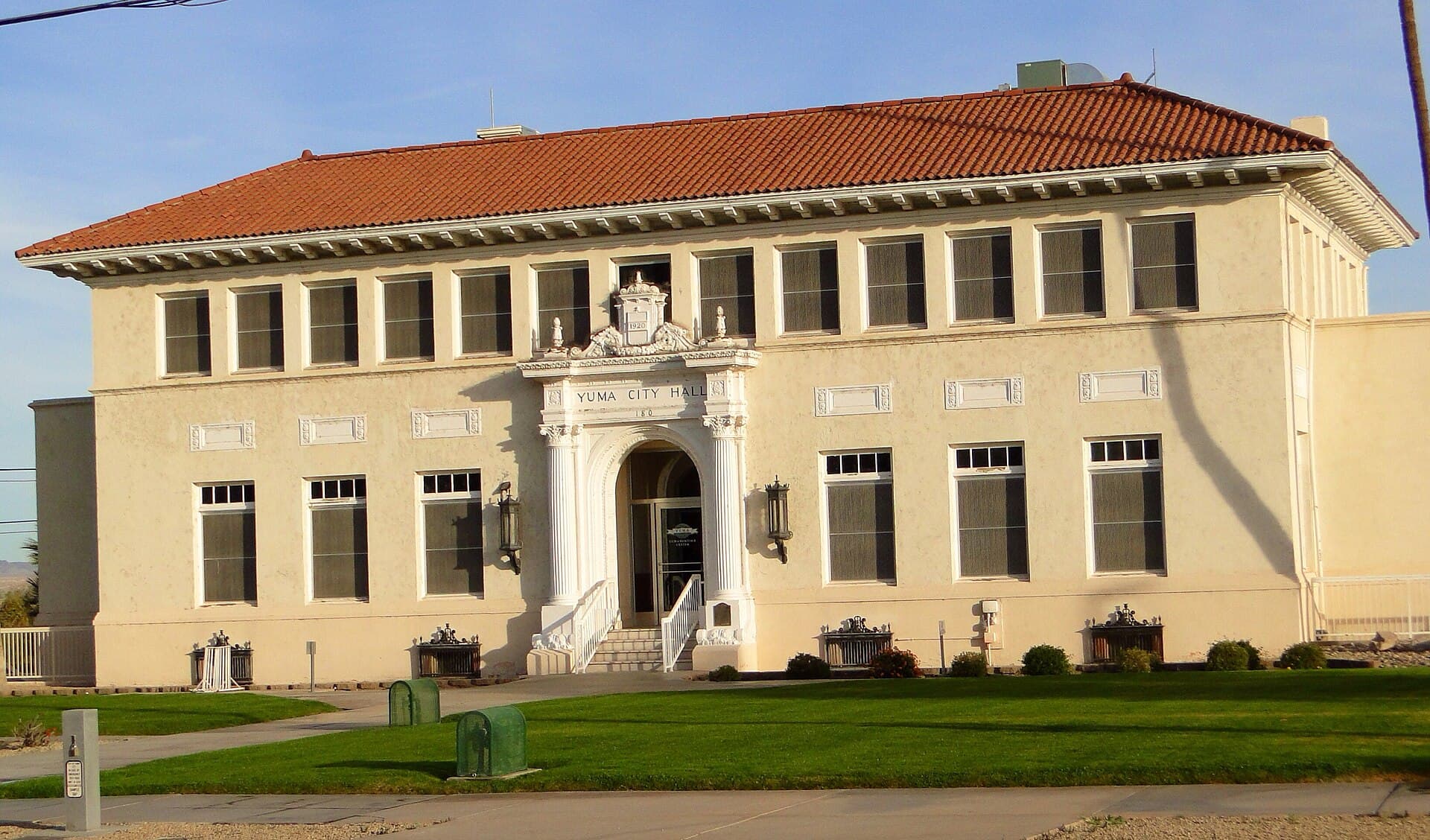 Cbl62 / CC BY-SA 3.0, via Wikimedia Commons
Self-guided audio walking tour of Yuma — GPS route, offline playback, story-driven narration in 32 languages.
“Where the desert sun meets the mighty Colorado, forging a history of crossings and cultivation.”
Not the postcards. The stories even locals don't know — whispered in your ear, right where they happened.
The infamous Yuma Territorial Prison, often called the 'Alcatraz of the Desert,' held a surprising demographic within its walls.
Yuma is known as the 'Winter Lettuce Capital of the World,' but the desert's bounty extends beyond leafy greens to an unexpected religious staple.
This historic park, once a crucial supply hub, played a role in supplying frontier outposts with a unique mode of transport.
Discover every secret of Yuma
Every address, every reveal in full — in your ear, right where it happened.
You pick your stops. You walk. The voice reveals what the others miss.


Your self-guided audio tour of Yuma is ready — pick your landmarks, choose your language, and start the moment you arrive.
BuyLume has a built-in augmented-reality guide. Hold your phone up and its camera shows the street ahead of you, with a glowing arrow laid over the real view that always points to your next stop — no map to puzzle over, no wrong turns. Like everything in Lume, it works fully offline.
Yuma, Arizona, a city carved by the powerful Colorado River, stands as a testament to resilience and ingenuity in the Sonoran Desert. Known as the 'Sunniest City on Earth,' Yuma experiences approximately 90% of daylight hours as sunshine, with an average of 4,055 hours per year. This abundant sunshine, coupled with its strategic location at a natural narrowing of the Colorado River, has shaped its identity for centuries.
Today, Yuma is a lively community with deep American Indian, Hispanic, and Anglo-American influences. It's a place where history comes alive through well-preserved sites, and where the desert landscape offers a unique playground for outdoor enthusiasts. From its pivotal role in westward expansion to its modern-day agricultural prowess, Yuma offers a compelling narrative of human adaptation and thriving in an extreme environment.
The story of Yuma begins with the Colorado River. The natural granite outcroppings at the Yuma Crossing created one of the few safe and convenient places to traverse the mighty waterway for hundreds of miles. This made it a crucial meeting point for early Native American tribes, including the ancestors of the modern-day Quechan and Cocopah.
The first Europeans arrived in 1540 when Spanish explorers Hernando de Alarcon and Melchior Diaz navigated the Colorado River from the Sea of Cortez. They encountered thriving communities and, observing the smoke from Native American cooking fires, coined the name 'Yuma' from the Spanish word for smoke, 'humo.'
During the Spanish colonial period, the Yuma Crossing became an important gateway between New Spain and Alta California. Later, it served as a vital transportation and communication link during the American westward movement, with over 60,000 pioneers crossing the river in 1849 on their way to the Gold Rush. The town was formally incorporated as Arizona City in 1871, and then renamed Yuma in 1873.
Yuma's strategic importance led to its establishment as a key military post. Fort Yuma was constructed in 1850, and the Yuma Quartermaster Depot, a crucial supply base for Army posts throughout Arizona and New Mexico, followed in 1865. The arrival of the first railroad in 1877 and the construction of the Ocean to Ocean highway bridge in 1915 further solidified Yuma's role as a trans-shipment hub.
A significant turning point for Yuma was the development of its first dam and irrigation systems in 1905. This brought a consistent water source to the desert, revolutionizing farming and transforming Yuma into one of the most productive agricultural areas in the nation. President Theodore Roosevelt's vision to 'make the desert bloom' was realized through an intricate system of dams and canals, enabling Yuma to supply 80-90% of America's leafy greens during the winter months.
Today, Yuma remains a significant military hub, home to Marine Corps Air Station Yuma (MCAS) and the Yuma Proving Ground (YPG), both with roots stretching back decades. MCAS Yuma, which began as a civilian airfield in 1928 and hosted Amelia Earhart, is now the Marine Corps' busiest air station. YPG, established in the 1930s-1940s for training soldiers, continues to provide realistic testing for U.S. military equipment.
Begin your exploration at the Yuma Territorial Prison State Historic Park, where you can walk through cells and learn about frontier justice. Nearby, the Colorado River State Historic Park, formerly the Yuma Quartermaster Depot, offers insights into the region's past as a vital supply center. The Yuma Crossing National Heritage Area connects these sites with restored wetlands and walking trails along the river.
For a glimpse into Yuma's agricultural heart, consider an agritourism experience to see how 90% of North America's winter leafy greens are grown. The Imperial Sand Dunes, often called 'The World's Largest Sandbox,' are a short drive west and offer vast expanses for off-roading and exploring. Nature lovers can also visit the Imperial National Wildlife Refuge for birding and desert wildlife viewing. In downtown Yuma, explore local shops and eateries, including Lute's Casino, the state's oldest pool hall, known for its memorabilia and unique cheeseburger/hot dog combo.
The best time to visit Yuma for comfortable outdoor activities is from late March to mid-June and from late September to early November, with a peak in the third week of October. For warm and sunny weather, February, March, and November are ideal. Yuma experiences extremely hot summers, with average daily high temperatures above 99°F from June to September. Winters are mild and dry, with average highs in the 60s and 70s.
Yuma is accessible by car via Interstate 8, and an international airport offers daily flights to Phoenix and Fort Worth, Texas. There is also a train station with connections to Los Angeles and points east, though train times can be very early or late. While in Yuma, consider renting a car for flexibility in exploring the wider area, including the Imperial Sand Dunes and wildlife refuges. The city offers a range of accommodations and dining options, from authentic Mexican cuisine to patio cafes. Remember to stay hydrated, especially during warmer months, and be aware of the intense desert sun. Yuma's time zone is America/Phoenix.
Yuma in Korean, in Chinese or in Hebrew — and 29 more languages, every stop narrated by a native voice. The widest language range of any self-guided audio tour.
Available in: