Toomer's Corner
Before toilet paper became the iconic celebratory streamer at Toomer's Corner, a different, less sanitary material was used after big wins.
Full story unlocks in the tour
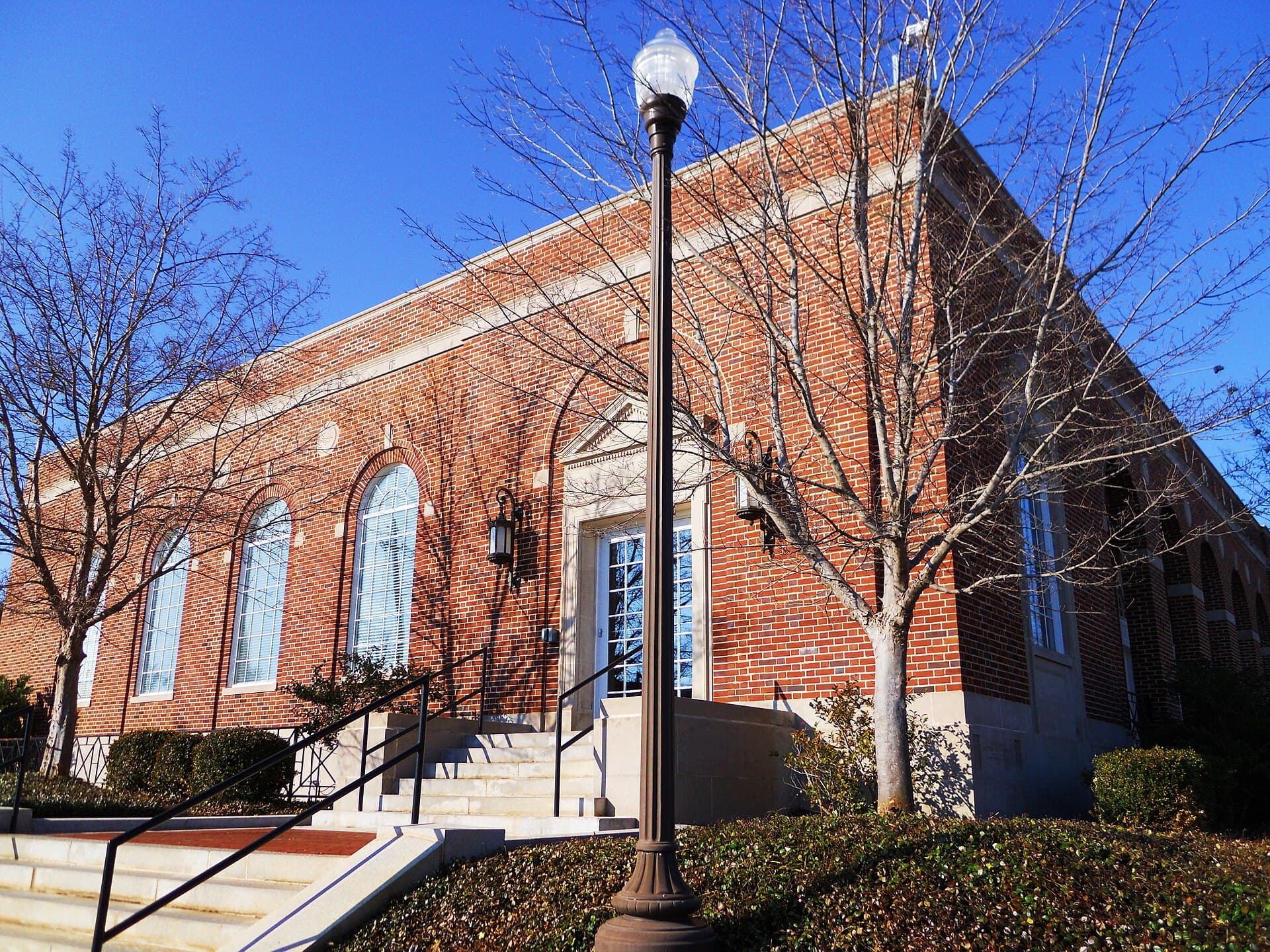 Rivers Langley SaveRivers / CC BY-SA 3.0, via Wikimedia Commons
Self-guided audio walking tour of Auburn — GPS route, offline playback, story-driven narration in 32 languages.
“Where Southern grace meets the roar of the War Eagle, a village on the plains unfolds with surprising depths.”
Not the postcards. The stories even locals don't know — whispered in your ear, right where they happened.
Before toilet paper became the iconic celebratory streamer at Toomer's Corner, a different, less sanitary material was used after big wins.
Beyond the roar of the crowd, a persistent rumor suggests that Auburn's football stadium possesses a unique acoustic secret.
Students at Auburn University often go out of their way to avoid stepping on a specific seal on campus, believing it carries a triple curse.
Discover every secret of Auburn
Every address, every reveal in full — in your ear, right where it happened.
You pick your stops. You walk. The voice reveals what the others miss.
Your self-guided audio tour of Auburn is ready — pick your landmarks, choose your language, and start the moment you arrive.
BuyAuburn, Alabama, often called "The Loveliest Village on the Plains," is a city in Lee County, deeply intertwined with the spirit of Auburn University. This historic college town, with a population of over 76,000, is not only the largest city in eastern Alabama but also one of the fastest-growing metropolitan areas in the United States. Its charm lies in a unique blend of academic energy, Southern hospitality, and a surprising array of outdoor adventures and cultural experiences.
Visitors are drawn to Auburn for its lively downtown, home to local shops, diverse restaurants, and cherished landmarks like Toomer's Corner. The city's identity is heavily influenced by Auburn University, a leader in arts and applied science education, whose traditions and athletic events create an electric atmosphere. Beyond the campus, Auburn offers a captivating glimpse into its past, alongside opportunities for hiking, exploring state parks, and engaging with a thriving local arts scene.
## From Frontier Settlement to Academic Hub Auburn's story began in 1836, founded by settlers from Georgia, and was officially incorporated on February 2, 1839. Initially, it was part of Macon County. The city's early development was significantly shaped by a concentration of educational institutions, attracting planter families in the 1840s and 1850s. By 1858, an impressive 500 of Auburn's roughly 1,000 free residents were students.
In 1856, the East Alabama Male College, a Methodist institution, was chartered in Auburn, opening its doors in 1859. However, the onset of the Civil War in 1861 brought a halt to Auburn's growth, with schools closing and businesses shuttering. The college itself was closed from 1861 to 1866. Following the war, in 1872, the East Alabama Male College was transferred to the state and, with federal funding from the Morrill Act, was renamed Alabama Agricultural and Mechanical College, becoming a land-grant institution. The passage of the Hatch Act in 1887 further expanded agricultural research facilities on campus. A significant milestone occurred in 1892 when the college became the first four-year institution in Alabama to admit women. This, combined with renewed interest in scientific agriculture and engineering, spurred the city's expansion, and by 1910, Auburn's population had returned to its pre-Civil War levels.
The college underwent another name change in 1899, becoming the Alabama Polytechnic Institute, and finally, in 1960, it officially became Auburn University. The city's unofficial nickname, "The Loveliest Village on the Plains," is a direct reference to Oliver Goldsmith's 1770 poem, "The Deserted Village," which even uses the name Auburn. Today, Auburn continues to embrace its identity as a historic college town, with Auburn University being the highest academically ranked university in the state.
Begin your exploration at Toomer's Corner, the intersection of College Street and Magnolia Avenue, home to Toomer's Drugs, a historic soda fountain established in 1896. This is the heart of Auburn's celebration traditions, especially after athletic victories.
Immerse yourself in arts and culture at the Jule Collins Smith Museum of Fine Art on the Auburn University campus. This 40,000-square-foot contemporary museum houses over 2,500 works, including pieces from the famous Toomer's Oaks and impressive outdoor sculptures.
For outdoor enthusiasts, Chewacla State Park offers 696 acres of scenic wilderness just 10 minutes from town. Enjoy swimming, fishing, canoeing, kayaking on its 26-acre lake, and an extensive network of hiking and mountain biking trails. Another outdoor destination is Kreher Preserve and Nature Center, offering over six miles of trails, butterfly and sensory gardens, and a nature playground.
Consider a visit to Downtown Opelika, Auburn's sister city, just a few minutes away. It offers a historic district with breweries, small shops, and live music venues. For sports fans, the Lovelace Hall of Honor provides an inspiring look into Auburn sports history. And for a unique local culinary experience, seek out the off-campus barbecue shacks, taco trucks, and cozy cafés favored by locals.
The best times to visit Auburn are during the spring (mid-March to May) and fall (mid-September to mid-November). During these seasons, the weather is mild and comfortable, perfect for exploring outdoor attractions and enjoying university events. Spring offers blooming flowers, while fall showcases colorful foliage and the excitement of football season. Summers (June to August) are hot and humid, with average highs around 89°F (32°C), while winters (December to February) are cooler and wetter, with average lows around 34°F (1°C).
Auburn is primarily served by the Hartsfield-Jackson Atlanta International Airport (ATL), located about 90 minutes away. Be mindful of the one-hour time difference between Atlanta (Eastern Time) and Auburn (Central Time) when planning travel. Other nearby options include Montgomery Regional Airport (MGM), Birmingham-Shuttlesworth International Airport (BHM), and Columbus, GA Airport (CSG).
Within Auburn, Tiger Transit provides bus service for Auburn University students, faculty, and staff, operating Monday-Friday during semesters. The Lee-Russell Public Transit offers public transportation for the wider Lee County area. For those traveling within Auburn, Tiger Taxi offers 24/7 service, and Groome Transportation provides shuttle services between the Atlanta Airport and various Auburn-Opelika locations. Public parking is available throughout downtown Auburn, with over 1,300 spaces.
For accommodations, a range of hotels and vacation rentals are available, with downtown being a popular area for rentals. During peak times like commencement or football weekends, nearby communities such as Lake Martin, LaGrange, or Columbus, Georgia, can offer additional lodging options.
Auburn in Korean, in Chinese or in Hebrew — and 29 more languages, every stop narrated by a native voice. The widest language range of any self-guided audio tour.
Available in: