Edmund Pettus Bridge
The iconic Edmund Pettus Bridge carries a name that might surprise you, given its significance in the Civil Rights Movement.
Full story unlocks in the tour
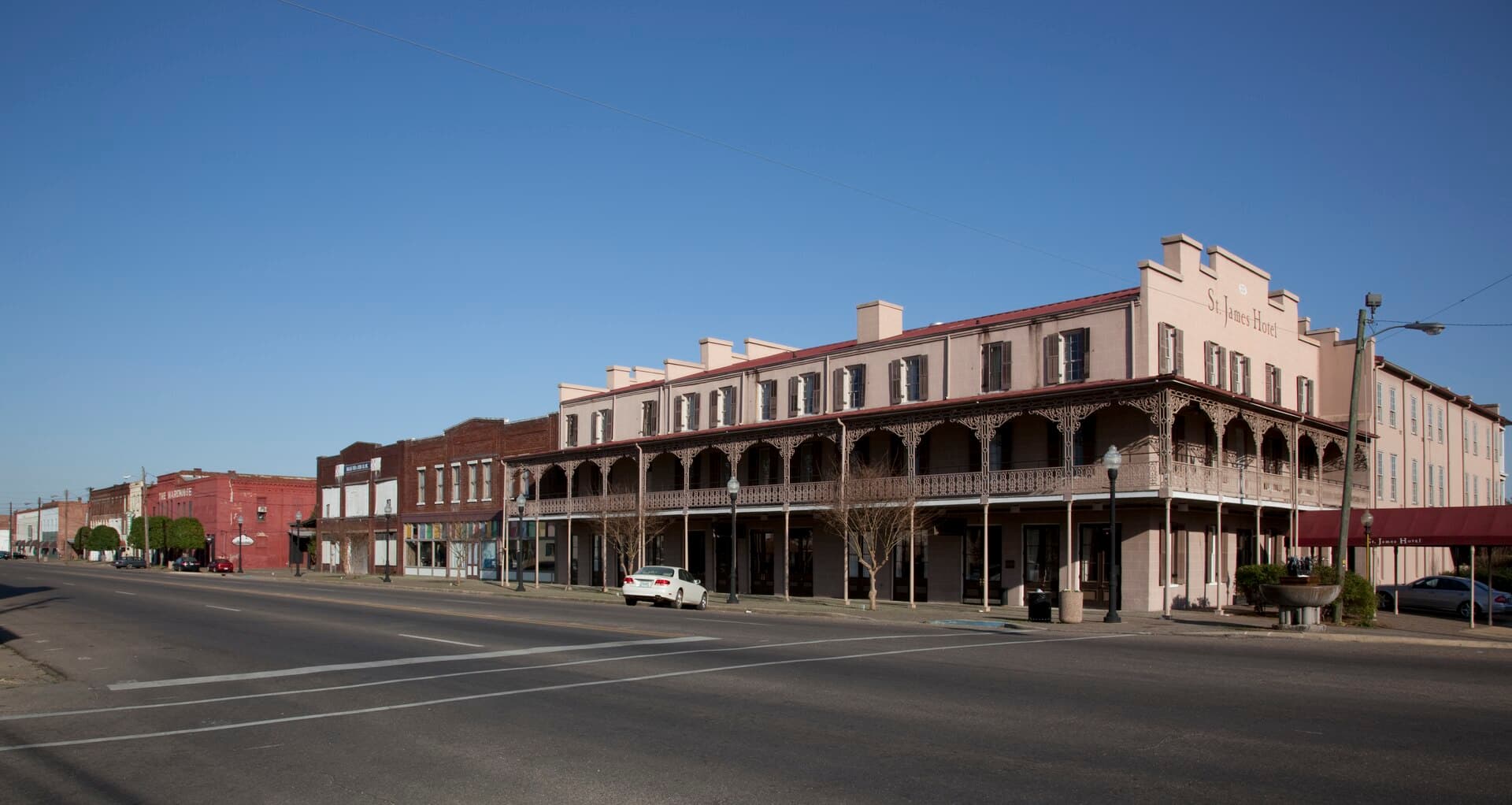 Carol M. Highsmith / Public domain, via Wikimedia Commons
Self-guided audio walking tour of Selma — GPS route, offline playback, story-driven narration in 32 languages.
“A small city with a mighty past, Selma's story is etched into the very fabric of American freedom.”
Not the postcards. The stories even locals don't know — whispered in your ear, right where they happened.
The iconic Edmund Pettus Bridge carries a name that might surprise you, given its significance in the Civil Rights Movement.
Some locals whisper about a network of tunnels beneath Selma, with stories stretching back further than you might imagine.
Among the ancient oaks and Spanish moss in Selma's historic cemetery, you'll find a surprising connection to a high-ranking U.S. official.
Discover every secret of Selma
Every address, every reveal in full — in your ear, right where it happened.
You pick your stops. You walk. The voice reveals what the others miss.
Your self-guided audio tour of Selma is ready — pick your landmarks, choose your language, and start the moment you arrive.
BuyLume has a built-in augmented-reality guide. Hold your phone up and its camera shows the street ahead of you, with a glowing arrow laid over the real view that always points to your next stop — no map to puzzle over, no wrong turns. Like everything in Lume, it works fully offline.
Selma, Alabama, a city along the Alabama River, holds a profound place in American history, particularly for its pivotal role in the Civil Rights Movement. While its name is synonymous with the struggle for voting rights, Selma's story is far more expansive, encompassing its development as a vital transportation and manufacturing center, and its enduring spirit in the face of adversity.
Visitors to Selma today are invited to engage with a past that is both challenging and inspiring. The city serves as a powerful testament to the extraordinary impact ordinary people can have in shaping the course of a nation. Exploring Selma offers a unique opportunity to reflect on the ongoing pursuit of justice and equality, and to understand how historical events continue to resonate in contemporary society.
## From Bluff to Battleground: Selma's Early Years Selma's origins trace back to 1732, appearing on a map as Ecor Bienville, a French designation. European settlers began to frequent the site in the early 1800s, referring to it as "High Soap Stone Bluff," and later "Moore's Bluff" after settler Thomas Moore built a cabin there in 1815. In 1820, a group of influential settlers, including future Vice President William Rufus King, formed the Selma Town Land Company, leading to the city's incorporation by the state legislature on December 4, 1820. The name "Selma" itself is said to derive from Ossian's poems, meaning "high seat" or "throne."
Selma's early growth was initially hampered by its proximity to Alabama's first capital, Cahawba. However, with the capital's relocation to Tuscaloosa in 1826, Selma began to flourish, becoming a significant agricultural and cotton-producing community. Its strategic location on the Alabama River and its extensive rail network established it as a major transportation center, with as many as 49 different railroads operating in and out of the city at one time.
## A Confederate Stronghold and Union Target By the Civil War, Selma had transformed into one of the South's primary military manufacturing centers. Its foundries produced essential supplies, including iron and munitions, and its Navy yard constructed Confederate warships like the ironclad CSS Tennessee. This vital contribution to the Confederate war effort made Selma a major target for the Union Army, leading to several attempts to capture the city between 1863 and 1865. In March 1865, Union General James H. Wilson led a raid into Alabama, ultimately capturing Selma and destroying its arsenal and naval foundry.
## The Heart of the Voting Rights Movement A century after the Civil War, Selma once again found itself at the center of a national struggle—the Civil Rights Movement. In the 1950s and early 1960s, local Black activists, including the Dallas County Voters League (DCVL), campaigned for voting rights, facing violence, economic intimidation, and racist policies that suppressed Black voter registration. The Student Nonviolent Coordinating Committee (SNCC) also began organizing in Selma in the early 1960s.
Selma became the starting point for three marches in 1965, aiming to secure voting rights for African Americans. The first march, on March 7, 1965, known as "Bloody Sunday," saw approximately 600 peaceful marchers, led by John Lewis and Hosea Williams, brutally attacked by state troopers and mounted deputies at the Edmund Pettus Bridge. Images of this violence, broadcast globally, galvanized public opinion and brought the plight of African Americans to international attention.
A second, symbolic march, known as "Turnaround Tuesday," took place on March 9. The third march, commencing on March 21 under federal protection, successfully reached the Alabama State Capitol in Montgomery on March 25, with thousands of participants. These events were instrumental in the passage of the Voting Rights Act of 1965, signed into law by President Lyndon B. Johnson, which prohibited racial discrimination in voting and expanded opportunities for Black and Brown people to participate in the political system.
Selma offers a compelling journey through American history, with many sites directly connected to its pivotal past. The Edmund Pettus Bridge is an essential stop, a steel through-arch bridge spanning the Alabama River, and the site of "Bloody Sunday." Walking across it allows for reflection on its profound historical significance. Nearby, the National Voting Rights Museum and Institute provides an in-depth look at the struggle for voting rights through exhibits, photographs, and personal stories.
Brown Chapel AME Church served as a crucial meeting place for civil rights leaders and activists during the 1965 Selma to Montgomery marches. Visitors can tour the church and learn about its role in the movement. The Selma to Montgomery National Historic Trail begins at Brown Chapel AME Church and traces the 54-mile route to the Alabama State Capitol, with interpretive centers and markers along the way.
Beyond the Civil Rights Movement, Selma also offers glimpses into its earlier history. Old Cahawba Archaeological Park, Alabama's first state capital, provides a look at an abandoned town with ruins and preserved structures. Sturdivant Hall Museum, a Greek Revival mansion built in 1856, showcases antebellum architecture. For those interested in local history, the Old Depot Museum houses artifacts from Selma's beginnings through the Civil War and Civil Rights Movement. The Old Live Oak Cemetery offers a peaceful stroll among ancient trees and historical monuments.
Selma experiences a humid subtropical climate, with mild winters and warm, humid summers. The most comfortable times to visit for outdoor activities and sightseeing are generally from mid-April to late May and from mid-September to late October. During these periods, temperatures are pleasant, averaging around 18-20°C (64-68°F), and there is less chance of rain. Summers can be hot, with daily highs often exceeding 33°C (91°F) in July and August. Winters are relatively mild, with average temperatures around 9-15°C (48-59°F).
Selma is located in Dallas County, Alabama, and is accessible by road, primarily via U.S. Route 80. While the Selma to Montgomery National Historic Trail is a significant attraction, walking the entire 54-mile route is not advised due to unsafe walking conditions along busy U.S. Highway 80 and a lack of services. Visitors are encouraged to drive the route, allowing two to three hours to make the most of the stops and interpretive centers.
Accommodation options in Selma include local inns and hotels. For a unique stay, consider the Woolworth Lofts, renovated apartments in a historic early 1900s building. Dining options range from local establishments like the Downtowner Restaurant, known for its breakfast, to other local eateries. The city publishes a guide to 16 historic churches, offering further exploration of its architectural and cultural heritage.
Selma in Korean, in Chinese or in Hebrew — and 29 more languages, every stop narrated by a native voice. The widest language range of any self-guided audio tour.
Available in: