The Clock Tower
This prominent 15th-century belfry bears a Latin inscription on its facade.
Full story unlocks in the tour
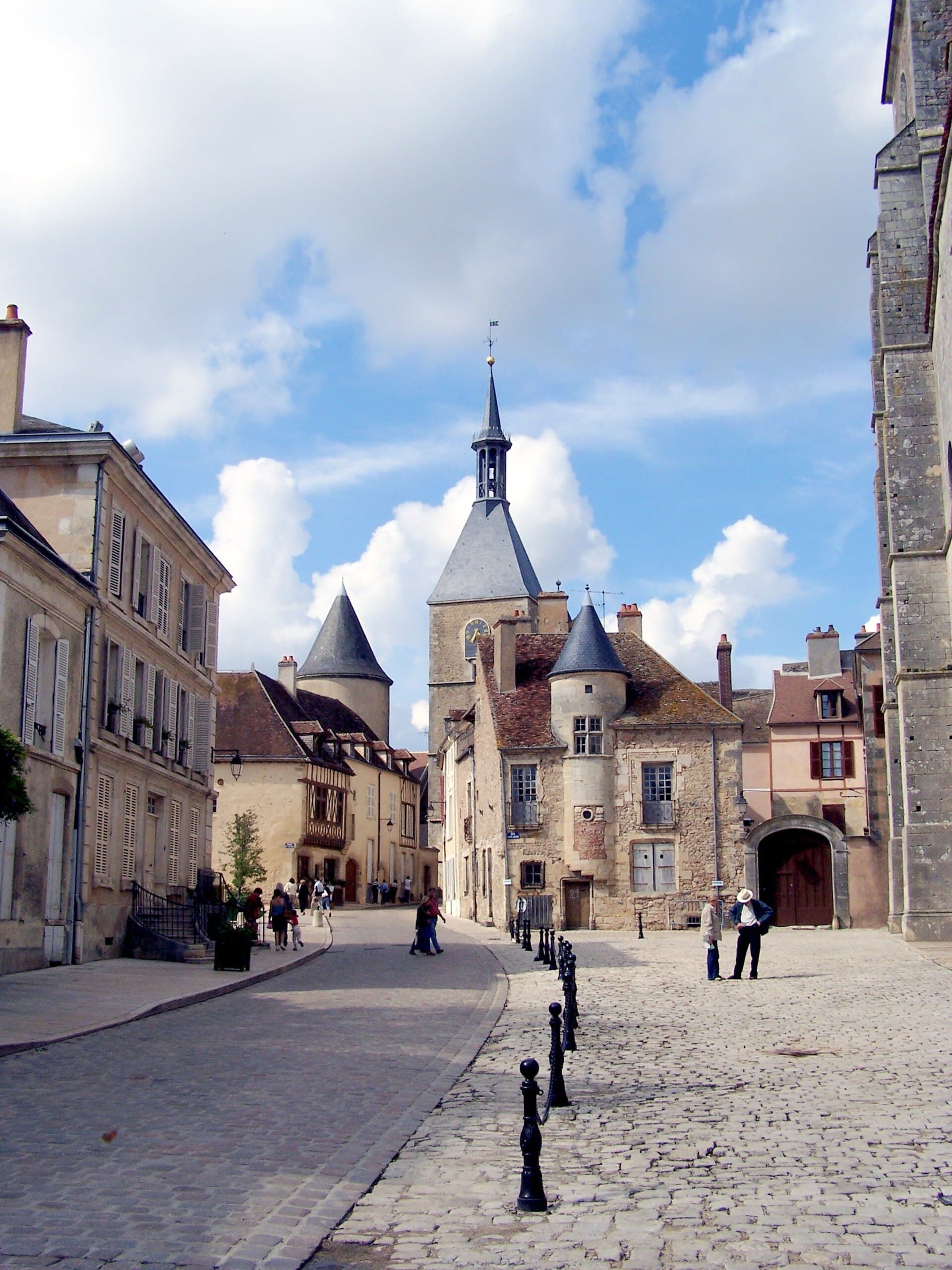 No machine-readable author provided. Valérie75 assumed (based on copyright claims). / CC BY-SA 2.5, via Wikimedia Commons
Self-guided audio walking tour of Avallon — GPS route, offline playback, story-driven narration in 32 languages.
“Beyond the ancient ramparts, a Burgundian town reveals its layered past.”
Not the postcards. The stories even locals don't know — whispered in your ear, right where they happened.
This prominent 15th-century belfry bears a Latin inscription on its facade.
Below Avallon's fortifications, a series of cultivated terraces descend towards the Cousin River.
The main portal of Avallon's Collegiate Church of Saint-Lazare features a curious detail amidst its Romanesque carvings.
Discover every secret of Avallon
Every address, every reveal in full — in your ear, right where it happened.
You pick your stops. You walk. The voice reveals what the others miss.

Your self-guided audio tour of Avallon is ready — pick your landmarks, choose your language, and start the moment you arrive.
BuyLume has a built-in augmented-reality guide. Hold your phone up and its camera shows the street ahead of you, with a glowing arrow laid over the real view that always points to your next stop — no map to puzzle over, no wrong turns. Like everything in Lume, it works fully offline.
Avallon, a fortified town in Burgundy, rests on a granite spur overlooking the picturesque Cousin Valley. Known as "Aballo" in Celtic times, the town's story stretches back to the Roman era, when it served as a trade center on the road between Autun and Lyon. Today, Avallon acts as the northern gateway to the Morvan Regional Natural Park, offering a blend of historical character and natural splendor.
The town's historic core is a labyrinth of winding streets, venerable buildings, and remnants of its medieval fortifications, including towers, bastions, and watch turrets. Avallon's distinctive terraced gardens, which descend towards the Cousin River, offer tranquil spaces and expansive views. It is a place where history feels close at hand, yet the rhythm of life remains unhurried, inviting visitors to linger and explore.
Avallon is located approximately 224 km (139 miles) southeast of Paris, 52 km (32 miles) southeast of Auxerre, and 96 km (60 miles) northwest of Dijon. With a population of just over 7,000, it maintains a small-town atmosphere while providing a meaningful cultural experience.
Avallon's origins trace back to the Celtic period, when it was known as "Aballo," a name believed to reference apples. Its strategic location on a granite promontory, overlooking multiple valleys, made it a significant trade center on the Roman Via Agrippa, connecting the Mediterranean to northern Europe. Evidence suggests continuous human settlement in this naturally protected site since prehistoric times.
During the Gallo-Roman era, a castle, temple, court, and theater were established near the Via Agrippa. The 4th century saw the region's conversion to Christianity by St. Martin de Tours, and a church was soon dedicated to him. The town's early fortifications, initially a wood wall, were replaced by stone in the 9th century to defend against conflicts between the Franks and Burgundians, and later against Merovingian and Carolingian wars.
The 11th century brought a period of peace under King Henry I, but the 14th century and the Hundred Years' War subjected Avallon to new hardships, including plunder, destruction, plague, and starvation. This led to the restoration of fortifications, with 17 new towers being built. As a border town, Avallon was occupied by opposing sides during these conflicts. In 1477, the Duchy of Burgundy became part of France, ushering in a period of prosperity for Avallon.
The 15th century saw the construction of the iconic Clock Tower, a 49-meter belfry built between 1456 and 1459, which served as a warning system for invaders. The Collegiate Church of Saint-Lazare, originally built in the 8th century and significantly altered in the 12th, became a pilgrimage site after reportedly receiving a relic of St. Lazarus around 1000 A.D. Its Romanesque portals, with twisted and fluted columns, are notable architectural features. Today, Avallon's enduring medieval atmosphere is evident in its well-preserved ramparts, watchtowers, and timber-framed houses.
Begin your exploration at the Clock Tower (Tour de l'Horloge), a 15th-century belfry that serves as a gateway to the historic quarter. From here, wander through the pedestrianized streets, discovering old houses, towers, and bastions. The Collegiate Church of Saint-Lazare, dating back to the 8th century with significant 12th-century alterations, is a focal point, known for its Romanesque portals and a large pipe organ from 1850.
Follow the self-guided Frog Circuit (Circuit de la Grenouille), a trail that leads you through the historic center, highlighting 26 points of interest. A booklet with a map and information is available at the Tourist Office. Explore the Maison des Sires de Domecy, a fine example of 15th-century Burgundian architecture. For a different perspective, stroll along the town's ramparts, particularly the Promenade de la Petite Porte, which offers sweeping views of the Cousin Valley.
Delve into local culture at the Musée de l'Avallonnais (Jean Després Museum), which showcases the region's history, art, and archaeological artifacts. The Costume Museum presents the evolution of clothing and fashion from the 18th century to the present day. Spend time in the unique terraced gardens below the fortifications, a tranquil space with a profound biodiversity.
The best time to visit Avallon for pleasant weather is from May through October. During these months, temperatures are generally mild, ranging from highs of 20-27°C (68-81°F) during the day and lows of 9-15°C (48-59°F) at night, with moderate rainfall. This period is ideal for exploring the town's historical sites and enjoying outdoor activities in the surrounding natural park. The warmest months are typically July and August. For those who prefer slightly cooler temperatures and fewer crowds, May, June, and September offer a comfortable experience.
Avallon is accessible by car via exits 21 and 22 of the A6 national highway, which connects Paris to Lyon. Train services are available from Paris-Bercy station to Avallon, with tickets often cheaper when booked in advance through the TER Bourgogne-Franche-Comté website. Regional buses also connect Avallon to other towns within Burgundy.
Once in Avallon, the historic center is easily explored on foot. The town offers various accommodation options, including hotels, Airbnbs, and campsites. For dining, you'll find a mix of restaurants and bistros, with Saturday mornings bringing a lively local produce market to Place Général de Gaulle. The Tourist Office is a valuable resource for maps, information, and guided tours.
Avallon in Korean, in Chinese or in Hebrew — and 29 more languages, every stop narrated by a native voice. The widest language range of any self-guided audio tour.
Available in: