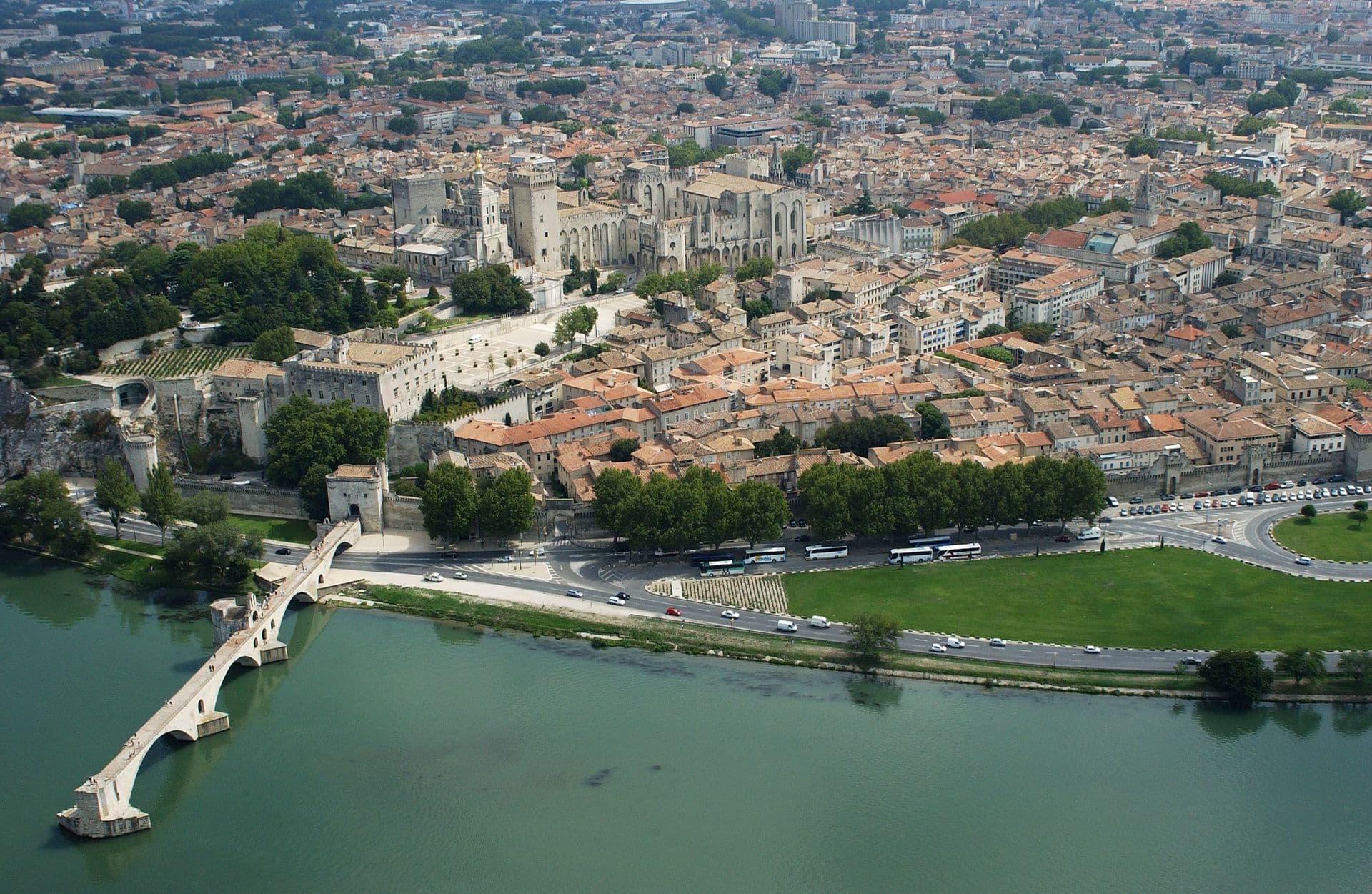
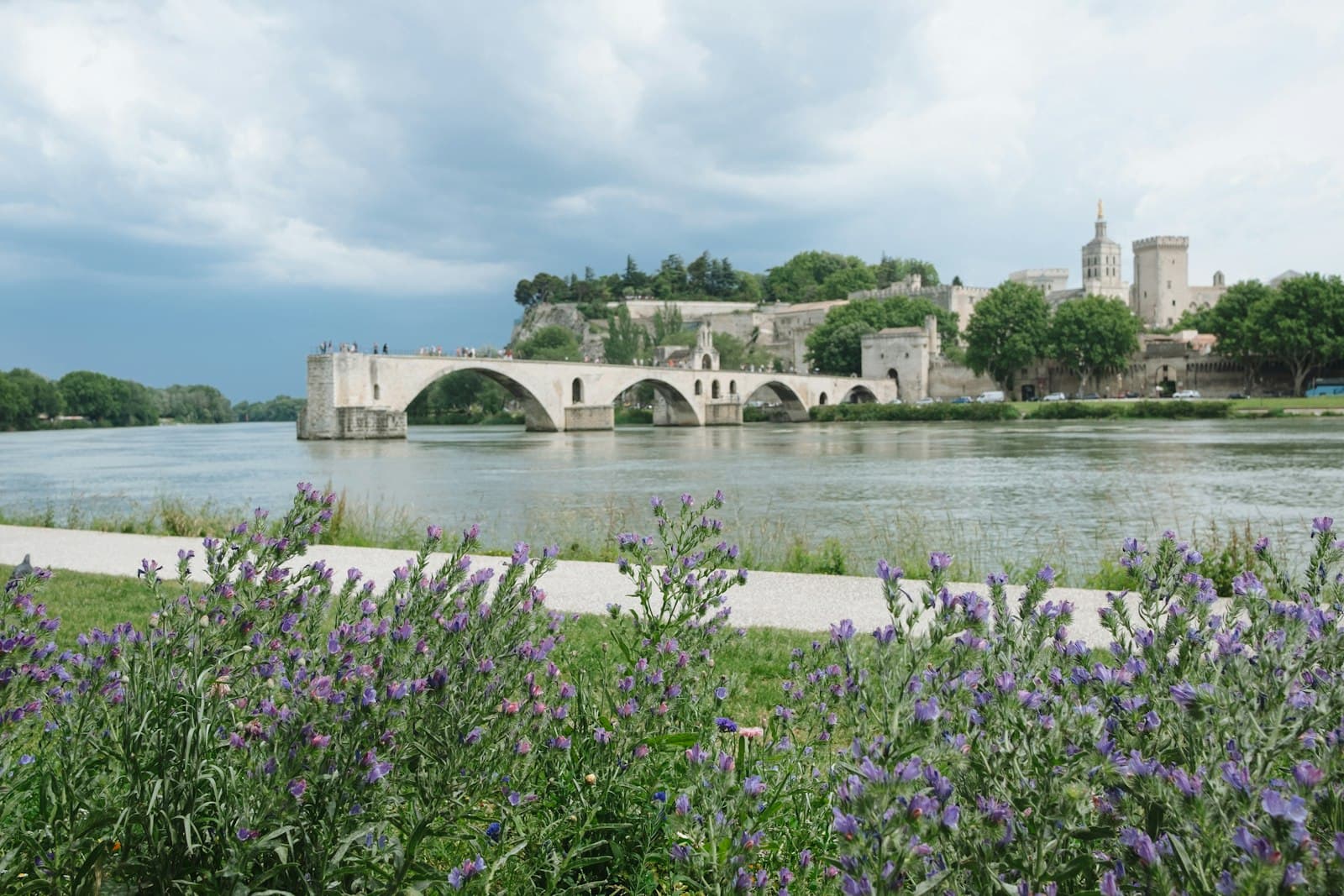
It stops dead in the middle of the Rhône. The official story for why anyone built it at all involves a teenage shepherd, a voice from the sky, and a stone no ordinary man could lift.
OT Avignon / CC BY-SA 4.0, via Wikimedia CommonsAvignon
Self-guided audio walking tour of Avignon — GPS route, offline playback, story-driven narration in 32 languages.
“The city where the popes lived, the bridge stops halfway, and the song lies to you.”
Avignon, as no one tells it.
Not the postcards. The stories even locals don't know — whispered in your ear, right where they happened.
Every French child sings about dancing 'on' this bridge. Stand on it and you'll see the problem at once: it's far too narrow for a ring of dancers. So the song has a word wrong — and it changes where the whole thing happened.
In the pope's own private study, the walls show no saints, no crucifixions, no scripture. They show young men hunting, fishing, picking fruit and bathing. And these pagan-feeling scenes survived precisely because of an insult to the building.
Discover every secret of Avignon
Every address, every reveal in full — in your ear, right where it happened.
You pick your stops. You walk. The voice reveals what the others miss.


How long do you have in Avignon?
Avignon — self-guided audio tour
The story of Avignon
Avignon is the rare town whose two most famous landmarks both refuse to behave. The bridge stops halfway across the Rhône and ends in open air. The palace on the hill is a fortress built by popes who weren't supposed to be in France at all. Hold both facts in your head and you start to understand the place: a small walled city that once outranked Rome, and never quite got over it.
For most of the 14th century the head of the Catholic Church ruled from here, and the wealth of that strange interlude is still everywhere — in the 15,000 square metres of the Palais des Papes, in the ring of walls that still circles the old town, in the grand cardinal mansions standing across the river. Then in July the whole city is handed over to actors, and chapels and courtyards fill with more than a thousand shows.
It's a town made for walking: compact, ringed by ramparts, and full of corners where a single building rewrites what you thought you knew.
The popes who weren't in Rome
In 1309 Pope Clement V settled in Avignon, and for nearly seventy years — until 1377 — seven popes ruled the Catholic world from the banks of the Rhône rather than from Rome. Critics called it the 'Babylonian Captivity', and the poet Petrarch, who knew the court personally, nicknamed the city the 'Babylon of the West', accusing it of drowning the faith in luxury.
The popes built to match their ambition. The Palais des Papes went up fast and huge, becoming the largest Gothic palace in Europe at around 15,000 square metres. When the papacy split during the Great Western Schism, rival 'antipopes' kept a foothold in Avignon until 1403.
Walls, a bridge, and a long afterlife
From 1357 Pope Innocent VI ringed the enlarged city with new ramparts — over four kilometres of wall, dozens of towers and gates — and Avignon remains one of the few French cities to keep its medieval walls more or less complete.
The Pont Saint-Bénézet, begun in 1177 after a shepherd's vision, once reached the far bank on around 22 arches. The Rhône's floods kept destroying it, and after the great flood of 1669 the city stopped rebuilding. After the popes left, Avignon belonged to the Church until the French Revolution annexed it in 1791. Under Napoleon the palace became an army barracks, vacated only in 1906 — a rough century that, by accident, plastered over and saved some of its finest frescoes.
Palais des Papes. Europe's largest Gothic palace, and far more than empty halls. Seek out the Chambre du Cerf, Clement VI's private study, where the walls carry rare 14th-century secular frescoes of hunting, fishing and fruit-picking — worldly scenes you'd never expect in a pope's apartment, saved because soldiers later whitewashed over them.
Pont Saint-Bénézet. Walk out onto the four surviving arches and feel the bridge simply stop over the river. The little chapel of Saint Nicholas sits on the structure across two levels. Then learn the twist: the song says 'on' the bridge, but people really danced under it.
Rocher des Doms. The garden above the palace, and the literal birthplace of the city — inhabited since the Neolithic. Climb for the panorama over the Rhône, the broken bridge, Mont Ventoux and the towers of Villeneuve across the water.
Rue des Teinturiers. A cobbled street following a channel of the Sorgue, named for the dyers who once worked here. Four old waterwheels still turn where there were once more than twenty.
Villeneuve-lès-Avignon. Across the river, the cardinals' 'livrées' and the Tour Philippe-le-Bel, the French king's watchtower guarding the old bridgehead — and the best view back onto Avignon's skyline.
July is the festival. The official Festival d'Avignon, founded by Jean Vilar in 1947, takes over the Cour d'honneur of the Palais des Papes and other venues. Alongside it runs the Festival Off, born in 1966 from one playwright's act of defiance and now the largest performing-arts gathering on earth — in 2024 it counted more than 1,600 shows across 130-plus venues. The city is electric, packed and expensive; book months ahead or come knowing what you're walking into.
Spring and autumn are kinder. May, June, September and early October give you warm Provençal light, the plane trees in leaf, and the monuments without the festival crush.
Summer outside July is hot and bright, with the Mistral wind occasionally scouring the sky to a hard blue. Winter is quiet and cool, the old town nearly to itself, though some sites keep shorter hours.
On foot. The old town inside the ramparts is small and best walked — most of what matters sits within a 20-minute stroll, from the Palais des Papes down to Rue des Teinturiers. Wear real shoes for the cobbles and the climb up the Rocher des Doms.
Getting there. Avignon has two stations: Avignon Centre, just outside the walls, and Avignon TGV to the south, linked to the centre by a short shuttle train. Paris is roughly 2 hours 40 by TGV.
Across the river. A free seasonal shuttle boat crosses to the Île de la Barthelasse, and Villeneuve-lès-Avignon is a walk or short bus over the bridge — go for the view back at Avignon and the Tour Philippe-le-Bel.
Tips. A combined ticket links the Palais des Papes and the Pont Saint-Bénézet. If you come in July, reserve accommodation early and expect crowds; the rest of the year, Avignon is calm and walkable.
- Why does the Pont d'Avignon stop in the middle of the river?
- Repeated floods of the Rhône destroyed its arches over the centuries. After the major flood of 1669, the city decided it was too costly to keep rebuilding and abandoned the bridge. Of the roughly 22 original arches, only four survive today.
- Did people really dance 'on' the Pont d'Avignon?
- Not really. The bridge is too narrow for a ring dance. The original song was 'sous le pont' — *under* the bridge — referring to dancing on the riverbanks and the Île de la Barthelasse below the arches. The familiar 'sur le pont' version was fixed in 1853 via Adolphe Adam's comic opera.
- Why were the popes in Avignon instead of Rome?
- From 1309 to 1377, seven popes ruled from Avignon during a period critics called the 'Babylonian Captivity', shaped by instability in Italy and close ties to the French crown. The papacy returned to Rome in 1377, though rival antipopes kept a presence in Avignon into the early 1400s.
- How long do you need in Avignon?
- One full day covers the Palais des Papes, the bridge and the Rocher des Doms at a relaxed pace. A second day lets you add Rue des Teinturiers and Villeneuve-lès-Avignon across the river. Visiting during the July festival, you could easily spend longer.
- When is the Avignon theatre festival?
- Every July. The official Festival d'Avignon (since 1947) and the larger Festival Off (since 1966) run together for about three weeks. It is the world's biggest performing-arts gathering — book accommodation well ahead if you plan to attend.
- Is Avignon walkable?
- Yes. The historic centre sits inside intact 14th-century ramparts and is easily covered on foot, with the main sights within about 20 minutes of each other. Expect cobblestones and a short climb up to the Rocher des Doms garden.
Avignon in your own language — all 32· 32
Avignon in Korean, in Chinese or in Hebrew — and 29 more languages, every stop narrated by a native voice. The widest language range of any self-guided audio tour.
Available in:
- English
- FrenchFrançais
- SpanishEspañol
- GermanDeutsch
- ItalianItaliano
- PortuguesePortuguês
- DutchNederlands
- PolishPolski
- SwedishSvenska
- DanishDansk
- NorwegianNorsk
- FinnishSuomi
- RussianРусский
- UkrainianУкраїнська
- TurkishTürkçe
- CzechČeština
- HungarianMagyar
- RomanianRomână
- BulgarianБългарски
- GreekΕλληνικά
- Japanese日本語
- Korean한국어
- Chinese中文
- Arabicالعربية
- Hebrewעברית
- Hindiहिन्दी
- Thaiไทย
- VietnameseTiếng Việt
- IndonesianBahasa Indonesia
- MalayBahasa Melayu
- CatalanCatalà
- BasqueEuskara