Baume Abbey
The village's name itself holds a clue to a significant shift in the abbey's history, reflecting a change not just in title, but in the very nature of its inhabitants.
Full story unlocks in the tour
 User:PRA / CC BY 2.5, via Wikimedia Commons
Self-guided audio walking tour of Baume-les-Messieurs — GPS route, offline playback, story-driven narration in 32 languages.
“Where ancient stones meet the roar of the earth.”
Not the postcards. The stories even locals don't know — whispered in your ear, right where they happened.
The village's name itself holds a clue to a significant shift in the abbey's history, reflecting a change not just in title, but in the very nature of its inhabitants.
The striking appearance of the Cascade des Tufs is not merely a product of water and gravity, but a testament to a unique geological process that builds as much as it erodes.
The dramatic valley that cradles Baume-les-Messieurs is a geological marvel, but its formation involved a force far more ancient and powerful than the river flowing through it today.
Discover every secret of Baume-les-Messieurs
Every address, every reveal in full — in your ear, right where it happened.
You pick your stops. You walk. The voice reveals what the others miss.

Lume has a built-in augmented-reality guide. Hold your phone up and its camera shows the street ahead of you, with a glowing arrow laid over the real view that always points to your next stop — no map to puzzle over, no wrong turns. Like everything in Lume, it works fully offline.
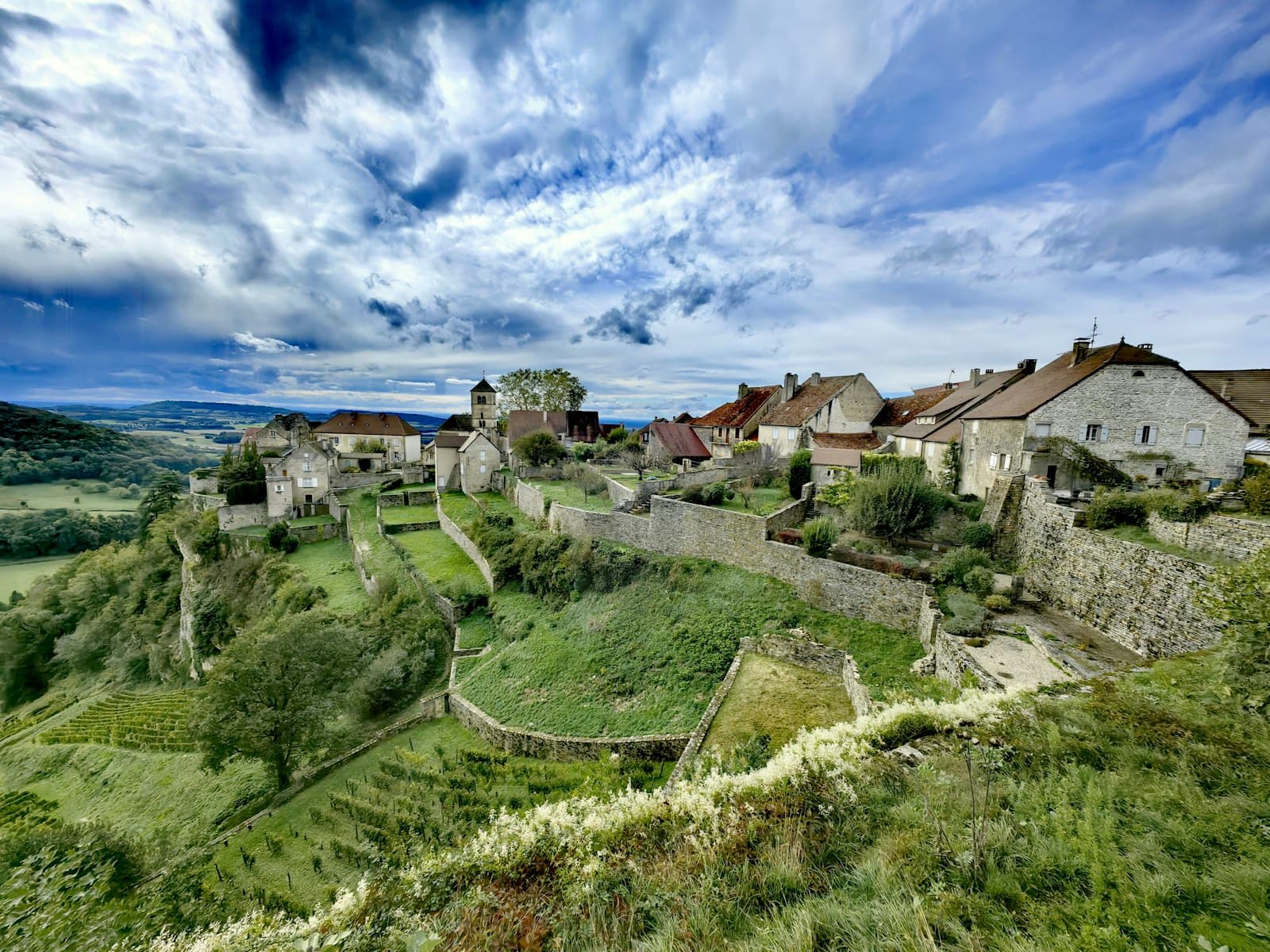
Baume-les-Messieurs, a designated 'Most Beautiful Village of France,' is a captivating destination in the Jura department of Bourgogne-Franche-Comté. This small village, with fewer than 200 residents, is dramatically set within a 'reculée'—a deep, limestone valley surrounded by towering cliffs that can reach over 200 meters in height. The landscape here is a striking blend of natural grandeur and historical significance, offering a sense of stepping back in time.
The village is celebrated for its ancient Benedictine abbey, spectacular caves, and the picturesque Cascade des Tufs. The surrounding countryside, with its unique geological formations and expansive viewpoints, draws visitors as much as the village itself. Baume-les-Messieurs is a place where history, geology, and natural beauty converge, inviting exploration of its quiet streets and remarkable surroundings.
The area around Baume-les-Messieurs has been inhabited since the Neolithic era, with archaeological traces of rock shelters found on site. Evidence of Gallo-Roman culture has also been discovered, suggesting a long history of human presence in this naturally sheltered valley.
The written history of Baume-les-Messieurs truly begins in the 9th century with the founding of a small monastery. Around 886, Bernon, a Burgundian nobleman and monk, introduced the Benedictine rule to the community. This monastery would become the influential Baume Abbey, and in a pivotal moment for European monasticism, Abbot Bernon departed Baume-les-Messieurs in 909 with six monks to establish the renowned Abbey of Cluny. For centuries, Baume Abbey was a significant religious institution in Franche-Comté, prospering from its ties to Cluny, its landholdings, and its spiritual authority.
By the 12th century, the abbey housed 40 monks and possessed numerous properties. However, from the 16th century onward, its influence waned as it was placed under commendam, a system where abbots, often lay lords, were more interested in income than spiritual leadership. This shift led to the monks abandoning traditional dormitories for private houses within the abbey grounds. In 1753, the abbey was secularized, and its monks were replaced by canons, leading to the village's renaming from Baume-les-Moines to Baume-les-Messieurs in 1759.
The French Revolution brought further changes, with abbey buildings declared national property and sold to villagers. While much of the heritage was lost, including the demolition of the cloister in the early 19th century, the 12th-century Romanesque abbey church of Saint-Pierre was preserved and became the parish church. The abbey church was listed as a Historical Monument in 1862, and other monastic buildings received protection throughout the 20th century, ensuring the survival of this architectural ensemble.
Baume-les-Messieurs offers a blend of natural wonders and historical architecture. The Abbaye Impériale de Baume-les-Messieurs is a central attraction, with its 11th-century Romanesque church housing a 16th-century Flemish altarpiece. Visitors can explore the abbey's three courtyards: the Abbot's Courtyard with its 16th-century facades, the former Cloister Courtyard, and the 17th-century Canons' Courtyard.
Just outside the village, the Grottes de Baume-les-Messieurs are a network of underground galleries and chambers, some reaching up to 80 meters high. These caves feature an underground river and lake, and guided tours offer a journey 120 meters below ground, with sound and light installations enhancing the experience. Adjacent to the caves is the Cascade des Tufs, a striking tufa waterfall fed by the Dard river. The waterfall's appearance changes with the seasons, from abundant flow in spring to impressive ice sculptures in winter.
For expansive views, the Belvédère des Roches de Baume offers a sweeping vista of the village and the dramatic reculée. Another recommended viewpoint is the Belvédère de Grange sur Baume, accessible via a short walk from the village of Grange sur Baume. The village itself, with its unspoiled streets and traditional stone buildings, is a pleasure to wander through.
The best time to visit Baume-les-Messieurs is during the months of June, July, August, and September, when temperatures are pleasant. While summer offers warm weather, the Cascade des Tufs is most impressive in spring due to increased water flow from melting snow, and during periods of heavy rainfall. In winter, if temperatures drop low enough, the waterfall can transform into striking ice sculptures. The Baume Caves are generally open from April to September.
Baume-les-Messieurs is located in the center of the Jura department, approximately 20 minutes east of Lons-le-Saunier. There are several free parking areas available, including Parking de l'Abbaye in the village and parking spots near the Cascade des Tufs and Grottes de Baume. While the village is small and easily explored on foot, comfortable shoes are recommended, especially for visiting the caves and hiking the surrounding trails.
Guided tours are highly recommended for the Baume Caves, which can book up quickly in high season, and for the abbey to gain deeper insight into its history. The caves maintain a cool temperature of around 11°C, so bringing a sweater is advisable even in summer.
Baume-les-Messieurs in Korean, in Chinese or in Hebrew — and 29 more languages, every stop narrated by a native voice. The widest language range of any self-guided audio tour.
Available in: