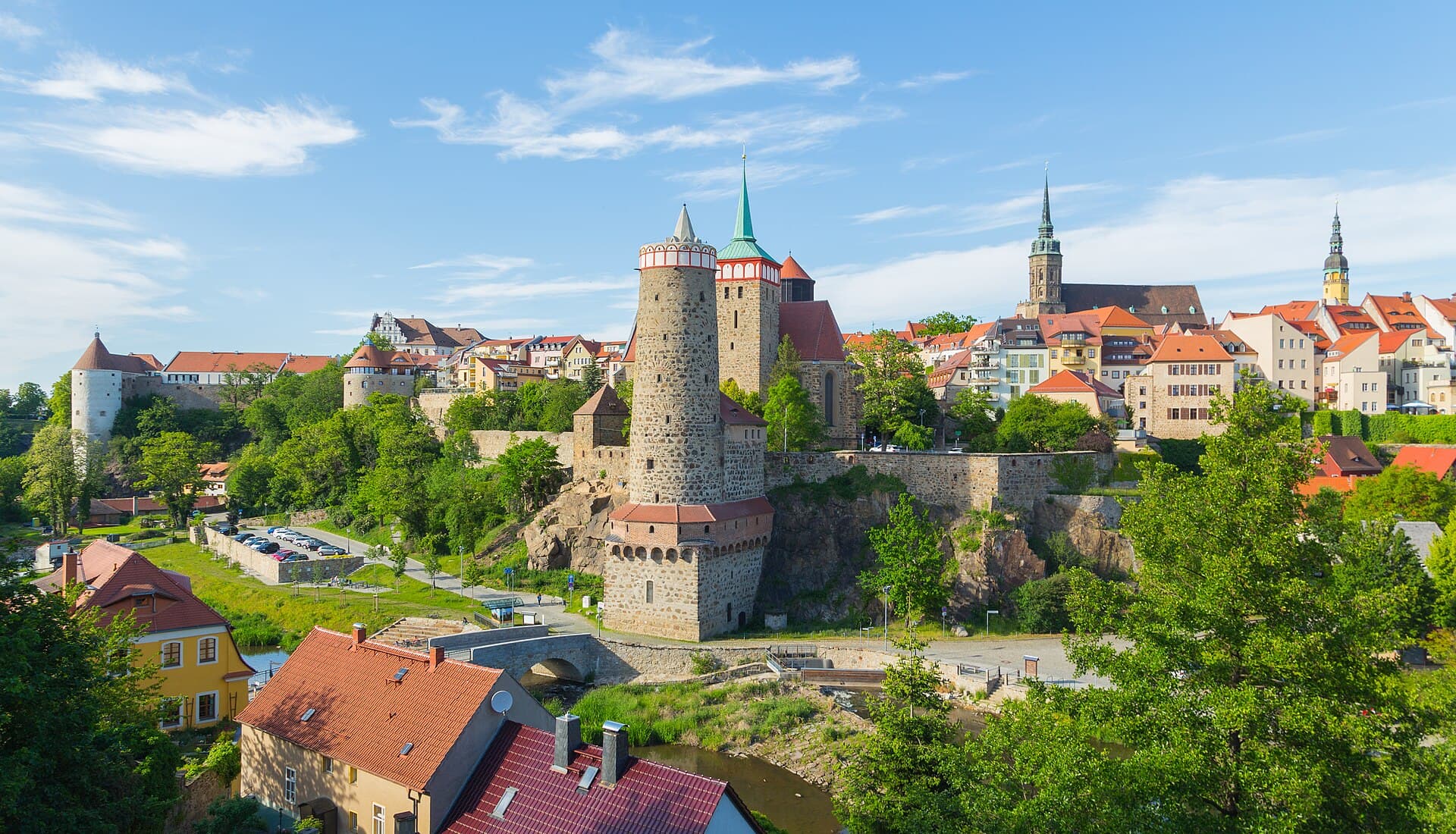
Reichenturm (Tour Riche)
Bautzen possède sa propre tour penchée, mais son inclinaison n'est pas le seul secret qu'elle garde.
L'histoire complète se débloque dans le tour
 Jan-Herm Janßen / CC BY-SA 4.0, via Wikimedia Commons
Visite audio autoguidée de Bautzen — parcours GPS à pied, lecture hors ligne, narration en 32 langues.
“D'anciennes flèches s'élèvent sur un esprit slave.”
Pas les cartes postales. Les histoires que même les habitants ignorent — soufflées à l'oreille, là où elles se sont passées.
Bautzen possède sa propre tour penchée, mais son inclinaison n'est pas le seul secret qu'elle garde.
Sous les rues pavées de Bautzen se cache un réseau invisible qui a autrefois servi à plusieurs fonctions cruciales.
Cette cathédrale de Bautzen détient un honneur singulier, reflétant un accord local de longue date.
Découvrez tous les secrets de Bautzen
Chaque adresse, chaque révélation en entier — dans ton oreille, là où elle s'est passée.
Tu choisis tes lieux. Tu marches. La voix te révèle ce que les autres ignorent.

Votre visite audioguidée de Bautzen vous attend — choisissez vos lieux, votre langue, et lancez-vous dès votre arrivée.
AcheterLume intègre un guide en réalité augmentée. Levez votre téléphone : sa caméra montre la rue devant vous, avec une flèche lumineuse posée sur l'image réelle qui pointe toujours vers votre prochain arrêt — aucune carte à déchiffrer, aucun mauvais virage. Comme tout dans Lume, ça fonctionne entièrement hors-ligne.
Bautzen, une ville vénérable de Haute-Lusace, en Allemagne, offre un profond voyage à travers le temps. Sa silhouette, définie par une couronne de tours et de murs, témoigne de siècles d'existence. C'est un lieu où la langue sorabe, une langue slave occidentale, est encore parlée, conférant une texture culturelle distincte à la vie quotidienne. Promenez-vous dans ses ruelles anciennes, et vous rencontrerez une ville qui a gracieusement traversé les âges, chaque pierre témoignant d'empires changeants et de traditions durables.
L'élévation de la ville au-dessus de la rivière Spree lui confère des vues imprenables sur le paysage environnant. L'architecture, un mélange de fortification médiévale et d'embellissements ultérieurs, invite à la contemplation. Ici, le passé n'est pas seulement préservé ; il est un participant actif au présent, influençant le rythme de la ville et le caractère de ses habitants. Bautzen est une destination pour ceux qui cherchent à comprendre les couches de l'histoire européenne, où les frontières culturelles se sont longtemps entrelacées et ont laissé une marque indélébile.
## Premières fondations et racines slaves Les origines de Bautzen remontent au début du Moyen Âge, avec des preuves d'un peuplement slave antérieur à sa mention officielle. Les Sorabes, un peuple slave occidental, ont établi des communautés dans la région, et leur empreinte culturelle reste une caractéristique déterminante de la ville à ce jour. La première mention documentée de Bautzen, sous le nom de 'Budusin', date de 1002, marquant son importance en tant que bastion stratégique dans les conflits continus entre le Saint Empire romain germanique et la Pologne.
## Une allégeance changeante : de la Couronne de Bohême à la domination saxonne Tout au long du Haut Moyen Âge, l'allégeance de Bautzen a souvent changé. Elle fut un avant-poste crucial pour le Royaume de Bohême pendant plusieurs siècles, servant de centre administratif régional. Cette période a vu la construction de nombreuses de ses fortifications et structures religieuses durables. La prospérité économique de la ville a augmenté, alimentée par les routes commerciales et l'artisanat local. Cependant, le paysage politique tumultueux de l'Europe centrale a fait que Bautzen s'est fréquemment retrouvée au carrefour de puissances plus grandes. Au XVIIe siècle, après la guerre de Trente Ans, Bautzen, avec le reste de la Haute-Lusace, passa aux mains de l'Électorat de Saxe, où elle est restée en grande partie jusqu'au XXe siècle.
## Époques modernes et préservation culturelle À l'époque moderne, Bautzen a poursuivi son développement, connaissant à la fois des périodes de croissance industrielle et les profonds impacts de deux guerres mondiales. Après la Seconde Guerre mondiale, la ville est devenue une partie de l'Allemagne de l'Est, et pendant cette période, elle a acquis une sombre réputation pour ses prisons politiques. Après la réunification allemande en 1990, Bautzen s'est lancée dans un voyage de renouveau, restaurant son cœur historique et réembrassant son héritage sorabe avec une vigueur renouvelée. Aujourd'hui, la ville témoigne de la résilience, un lieu où les coutumes anciennes sont chéries aux côtés de la vie contemporaine, et où la langue et la culture sorabes sont activement promues et célébrées.
Explorez l'Alte Wasserkunst (Ancien Art de l'Eau), une merveille d'ingénierie qui alimentait autrefois la ville en eau, offrant des vues impressionnantes sur la rivière Spree. Promenez-vous le long des anciens remparts de la ville, dont des sections subsistent, donnant un aperçu du passé formidable de la ville. Visitez le Musée Sorabe, qui éclaire la culture et les traditions uniques du peuple sorabe. La Michaeliskirche (Église Saint-Michel), avec son architecture saisissante, invite à la contemplation tranquille. Ne manquez pas l'Alte Wasserkunst, une ancienne usine hydraulique offrant des vues imprenables sur la vallée de la Spree. Le Dom St. Petri (Cathédrale Saint-Pierre) témoigne de siècles de culte partagé.
Le printemps et le début de l'automne présentent Bautzen sous son jour le plus accueillant. Le temps est doux, parfait pour explorer les rues anciennes et profiter des cafés en plein air. Le feuillage en automne apporte une douce beauté au paysage. L'été offre également des conditions agréables, bien qu'il puisse y avoir plus de voyageurs.
Bautzen est facilement accessible en train, avec des connexions depuis Dresde et d'autres grandes villes allemandes. Le centre-ville est compact et se visite mieux à pied, ce qui permet un rythme tranquille. Les bus locaux desservent les zones au-delà de la vieille ville immédiate. De nombreux établissements acceptent les principales cartes de crédit, mais il est toujours conseillé d'avoir quelques euros pour les petits achats ou les marchés. Le dialecte local inclut le sorabe, mais l'allemand est universellement parlé, et l'anglais est compris dans les zones touristiques.
Bautzen en coréen, en chinois ou en hébreu — et dans 29 autres langues, chaque étape narrée par une voix native. La plus large gamme de langues de tous les audioguides autoguidés.
Disponible en :