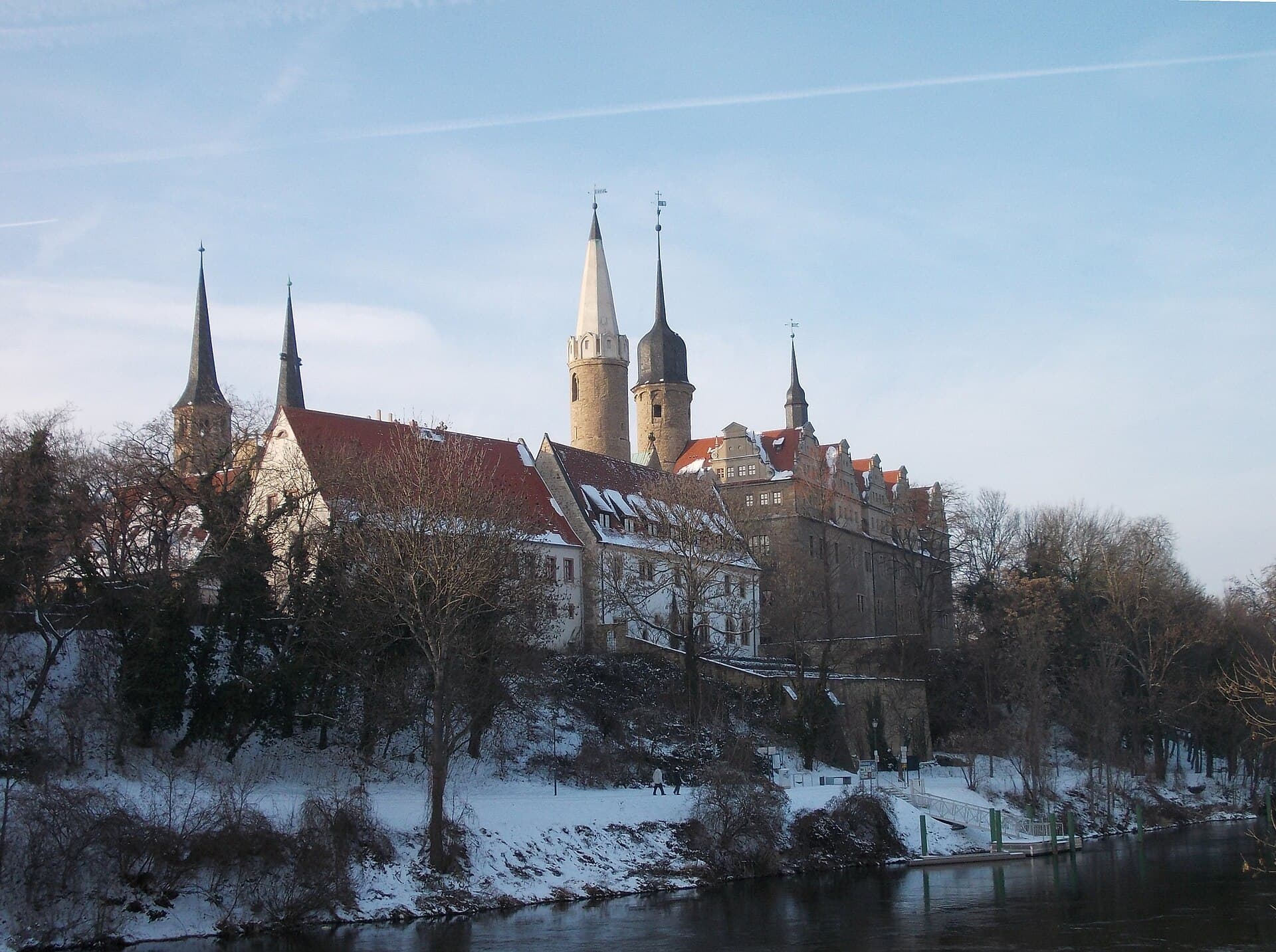
Merseburg Cathedral Library
Within the hushed chambers of the Merseburg Cathedral Library, an 1841 discovery unveiled a profound link to a pre-Christian past.
Full story unlocks in the tour
 Jwaller / CC BY-SA 3.0, via Wikimedia Commons
Self-guided audio walking tour of Merseburg — GPS route, offline playback, story-driven narration in 32 languages.
“Where ancient magic breathes from cathedral walls and ravens stand guard over forgotten vows.”
Not the postcards. The stories even locals don't know — whispered in your ear, right where they happened.
Within the hushed chambers of the Merseburg Cathedral Library, an 1841 discovery unveiled a profound link to a pre-Christian past.
Observe the castle courtyard for a peculiar cage, a lasting testament to a bishop's swift judgment and a pilfering bird.
Beneath the grand arches of Merseburg Cathedral, a mummified hand rests, a stark relic of a medieval power struggle.
Discover every secret of Merseburg
Every address, every reveal in full — in your ear, right where it happened.
You pick your stops. You walk. The voice reveals what the others miss.
Your self-guided audio tour of Merseburg is ready — pick your landmarks, choose your language, and start the moment you arrive.
BuyLume has a built-in augmented-reality guide. Hold your phone up and its camera shows the street ahead of you, with a glowing arrow laid over the real view that always points to your next stop — no map to puzzle over, no wrong turns. Like everything in Lume, it works fully offline.
Merseburg, a city in Saxony-Anhalt, Germany, offers a compelling journey through a thousand years of existence. Positioned on the left bank of the Saale River, south of Halle, Merseburg first appeared in records around 850 AD. Despite considerable damage during World War II, the city retains several notable historical buildings, including its magnificent cathedral and an episcopal palace.
Once an imperial palace and a significant religious center until the Reformation, Merseburg's past is etched into its Romanesque and Gothic architecture. Beyond its grand structures, Merseburg is also known for the "Merseburg Incantations," a singular collection of medieval pre-Christian magic spells, providing a rare glimpse into ancient Germanic pagan beliefs.
Merseburg's origins trace back to approximately 800 AD as a frontier fortress guarding against the Slavs. It swiftly ascended to prominence as a favored dwelling for German kings such as Henry I the Fowler, Otto I, and Henry II during the 10th, 11th, and 12th centuries. In 968, Emperor Otto I established the Merseburg bishopric, solidifying the city's role as a vital religious center until the Reformation in the 16th century.
The foundation stone for Merseburg Cathedral, dedicated to St. John the Baptist and St. Lawrence, was laid in 1015 by Bishop Thietmar of Merseburg, a celebrated chronicler of the Middle Ages. The cathedral was consecrated in 1021 in the presence of Emperor Henry II and his wife Cunigunde, becoming a focal point of imperial power and spiritual life. The city received its charter in 1188.
Merseburg's importance continued through the centuries, even serving as the residence for the Dukes of Saxe-Merseburg from 1656 to 1738. However, the city confronted considerable trials, including its capture by the Swedes in the Thirty Years' War in 1631 and enduring heavy bombing during World War II, which largely devastated its historic core. Despite these adversities, Merseburg has rebuilt and transformed, becoming a hub for the chemical industry in the 20th century and now hosting a technical university.
Merseburg presents a captivating blend of historic landmarks and cultural experiences. The Merseburg Cathedral (Merseburger Dom), a predominantly Gothic edifice, stands as an artistic and historical highlight. Its crypt, circular choir towers, and sections of the transept retain original Romanesque forms, while the main body showcases Gothic reconstruction. Inside, gaze upon the monumental Ladegast organ, one of Germany's largest and most melodious Romantic organs, which inspired Franz Liszt. Do not overlook the Incantations Vault in the south cloister, where a facsimile of the ancient Merseburg Incantations is exhibited.
Adjacent to the cathedral is Merseburg Palace (Schloss Merseburg), a Renaissance three-wing palace that once served as an episcopal residence and later a ducal seat. Today, it houses the Museum of Cultural History, offering insights into local history from prehistory to modern times. The palace is complemented by a beautiful Baroque garden (Schlossgarten), a part of the "Saxony-Anhalt Garden Dreams" project.
Explore the city's other historical sites, such as the Merseburger Ständehaus (Estates' House), a magnificent former parliament building now a congress and cultural center. Discover the Krummes Tor (Crooked Gate), a remnant of the medieval town fortification, and the Franzosen-Brunnen (French Fountain), with its intriguing legend. For a different perspective, visit the Luftfahrt und Technik Museumspark Merseburg (Aviation and Technology Museum Park).
The most agreeable time to experience Merseburg for general outdoor pursuits is from mid-June to early September, when temperatures are comfortable, ranging between 65°F and 80°F. July is typically the warmest month, with an average high of 76°F. For fewer crowds and potentially better value, consider visiting during the quieter months of December through March, which offer a cooler experience. However, winters can be quite cold, snowy, and windy, with January lows averaging 29°F.
Merseburg is well-connected by train and bus, ensuring ease of access for travelers. The city lies approximately 30 kilometers from Leipzig/Halle Airport (LEJ), with roadways B 181 and A 9 providing direct routes. Within Merseburg, public transport options include trains, with key stations such as Merseburg Station and Merseburg Bergmannsring Station. For greater flexibility in exploring the surrounding region, rental cars are available in Merseburg City Center. A suitable itinerary length for Merseburg is one to two days to explore the main sites, with an extended stay of three to four days allowing for a more relaxed pace and deeper discovery. The local cuisine features traditional German dishes like Schnitzel, Bratwurst, and various potato preparations.
Merseburg in Korean, in Chinese or in Hebrew — and 29 more languages, every stop narrated by a native voice. The widest language range of any self-guided audio tour.
Available in: