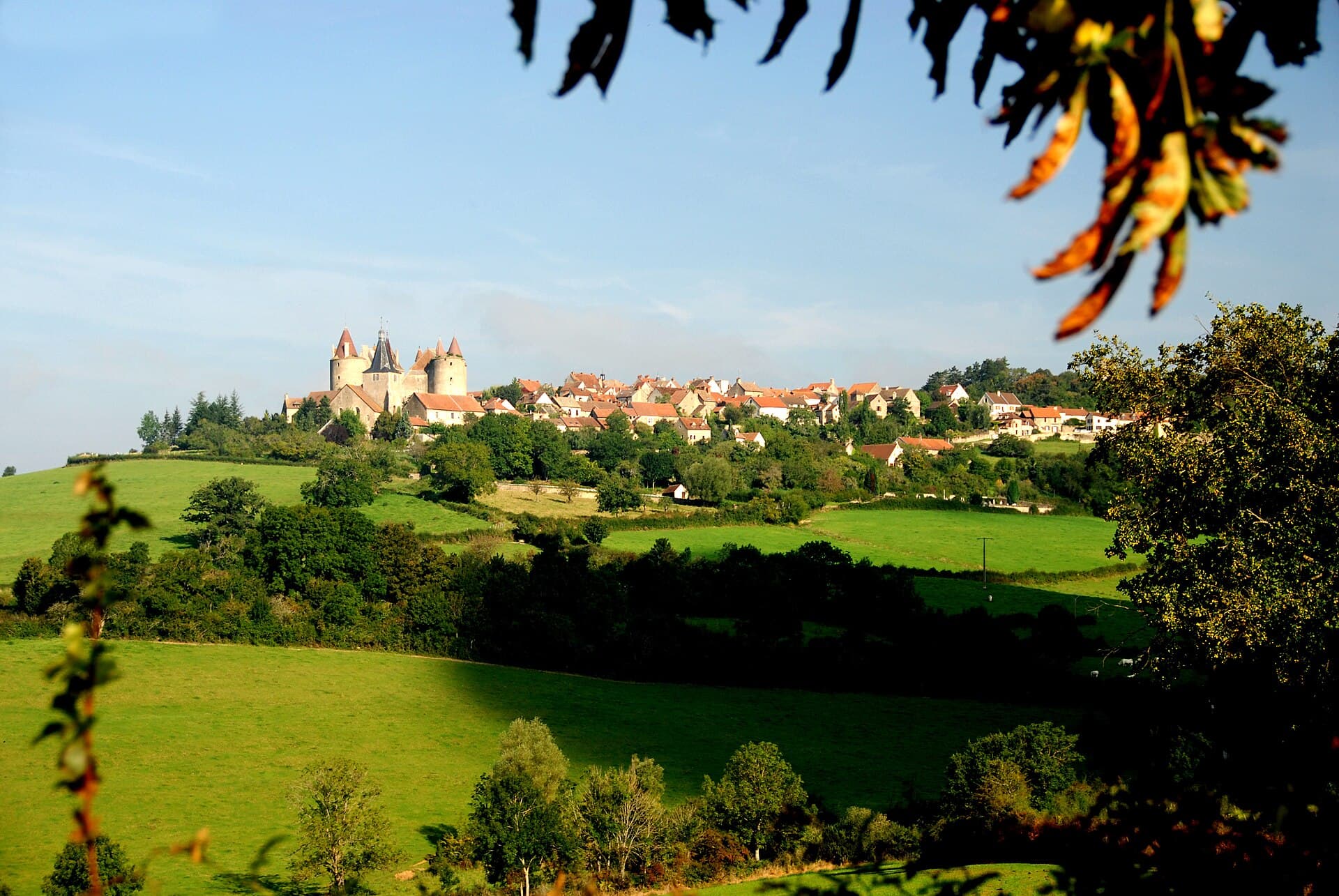
Château de Châteauneuf-en-Auxois
The castle's last heiress met a fiery end, not in battle, but for a more intimate betrayal.
Full story unlocks in the tour
 Jochen Jahnke 16:42, 25. Nov. 2007 (CET) / CC BY-SA 3.0, via Wikimedia Commons
Self-guided audio walking tour of Châteauneuf-en-Auxois — GPS route, offline playback, story-driven narration in 32 languages.
“Where medieval stone recounts tales of dukes, poison, and enduring beauty.”
Not the postcards. The stories even locals don't know — whispered in your ear, right where they happened.
The castle's last heiress met a fiery end, not in battle, but for a more intimate betrayal.
Look closely at some of the older merchant houses, and you might spot a subtle, carved message.
Inside the castle's chapel, a striking effigy tells a story of grief and legacy, but the original is no longer here.
Discover every secret of Châteauneuf-en-Auxois
Every address, every reveal in full — in your ear, right where it happened.
You pick your stops. You walk. The voice reveals what the others miss.
Your self-guided audio tour of Châteauneuf-en-Auxois is ready — pick your landmarks, choose your language, and start the moment you arrive.
BuyLume has a built-in augmented-reality guide. Hold your phone up and its camera shows the street ahead of you, with a glowing arrow laid over the real view that always points to your next stop — no map to puzzle over, no wrong turns. Like everything in Lume, it works fully offline.
Châteauneuf-en-Auxois, a designated "Plus Beaux Village de France" (One of the Most Beautiful Villages in France), rises dramatically from a rocky spur in Burgundy's Côte-d'Or department. This small, fortified village, with a population of less than 100, offers expansive views of the Auxois plain and the Burgundy Canal. Its medieval streets, lined with stone houses and blooming flowers, evoke a sense of stepping back in time.
Dominated by its formidable 12th-century castle, Châteauneuf-en-Auxois served as a strategic stronghold between Dijon and Autun. The village's preserved architectural heritage, from merchant houses with turreted staircases to the imposing castle itself, makes it a captivating destination for those seeking to immerse themselves in French history and allure.
The history of Châteauneuf-en-Auxois traces back to approximately 1180, when Jean de Chaudenay, a local lord, established a fortified site for his younger son, who then became Jean I de Châteauneuf. Initially, the fortifications were likely wooden, with a square stone keep emerging in the 13th century. The village grew around this defensive position, strategically overlooking the valley of the future Burgundy Canal.
Facing the threats of the Hundred Years' War, the lords of Châteauneuf significantly strengthened the castle's defenses, constructing a powerful outer wall and five towers connected by curtain walls around the 12th-century keep. The village flourished commercially in the 14th century, granted two fairs by Duke Eudes IV in 1347, and two more by Duke Philip the Good in 1459. Records indicate a population of over 500 inhabitants during the Middle Ages.
The castle's destiny shifted dramatically in 1457 when, after the tragic death of the last Châteauneuf heiress, Catherine, it was granted by Philip the Good, Duke of Burgundy, to his advisor and godson, Philippe Pot. Pot, a diplomat and Knight of the Order of the Golden Fleece, transformed the fortress into a more comfortable residence, adding two dwellings and a flamboyant Gothic-style chapel. His personal motto, "Tant L Vault," can still be found above the fireplace in the Great Hall.
After Philippe Pot's death without heirs in 1493, the castle passed through various noble families, including the Montmorency and Vienne families. During the French Revolution, royal symbols and coats of arms were damaged or destroyed, and the castle was auctioned off, passing through several private hands. In 1936, the Vogüé family donated the castle to the French state, and it was declared a national monument. Since 2008, the castle has been owned by the regional government, which has undertaken a slow, traditional restoration, allowing visitors to witness its ongoing history.
The main attraction in Châteauneuf-en-Auxois is the Château de Châteauneuf, a medieval fortress situated on a rocky outcrop. Visitors can explore its 12th-century keep, 14th-century south tower, and the 15th-century Gothic-style residence and chapel added by Philippe Pot. The chapel features 15th-century wall paintings depicting Christ and the Apostles. From the castle, enjoy expansive views of the Auxois plain and the Burgundy Canal.
Beyond the castle walls, wander through the village's narrow streets, which are lined with stone houses, many dating from the 12th to 15th centuries. Look for merchant houses with towered staircases and intricate details. The 16th-century Church of Saint-Jacques and Saint-Philippe houses notable polychrome stone and wood statues, including a 14th-century Virgin and Child and a Saint John the Baptist attributed to Claus Sluter. Near the north gate, a belvedere offers a sweeping viewpoint over the canal and the Morvan hills. For those interested in a longer walk, an old Roman road leads from the castle promontory to the ruins of the 13th-century hermitage of Saint-Julien, about half a mile into the woods.
The most pleasant time to visit Châteauneuf-en-Auxois is during May, June, July, August, and September, when temperatures are comfortable, ranging from 20°C to 26°C. July offers the most sunshine, with around 8.6 hours per day. To avoid crowds, consider visiting on a weekday, especially in the early mornings or late afternoons, which also provide excellent light for photography.
Every two years, in late July of even-numbered years, the village hosts the Médiévales festival, a medieval fair with jousting, dances, fire shows, and craft stalls. This event transforms the village into a lively, historical spectacle.
Châteauneuf-en-Auxois is located approximately 43 kilometers from Dijon. While there is no public transport directly serving the village, taxis are available. The Château de Châteauneuf is generally open daily, except Mondays, with specific hours that can vary by season, so it's advisable to check in advance. Admission to the castle typically costs around 5 euros, with reduced rates available, and children under 12 are admitted free. Note that dogs are generally not permitted on the castle grounds.
The village offers several dining options, including traditional French restaurants and cafes. Accommodation includes a hotel and guesthouses. There is no tourist office within the village itself, but information can be found on local websites. The village is small enough to explore on foot, allowing you to discover its charming streets and viewpoints.
Châteauneuf-en-Auxois in Korean, in Chinese or in Hebrew — and 29 more languages, every stop narrated by a native voice. The widest language range of any self-guided audio tour.
Available in: