Temple of Hera Lacinia, Capo Colonna
Imagine a sanctuary so revered, it drew pilgrims from across the ancient Greek world. What became of its immense wealth and countless offerings?
Full story unlocks in the tour
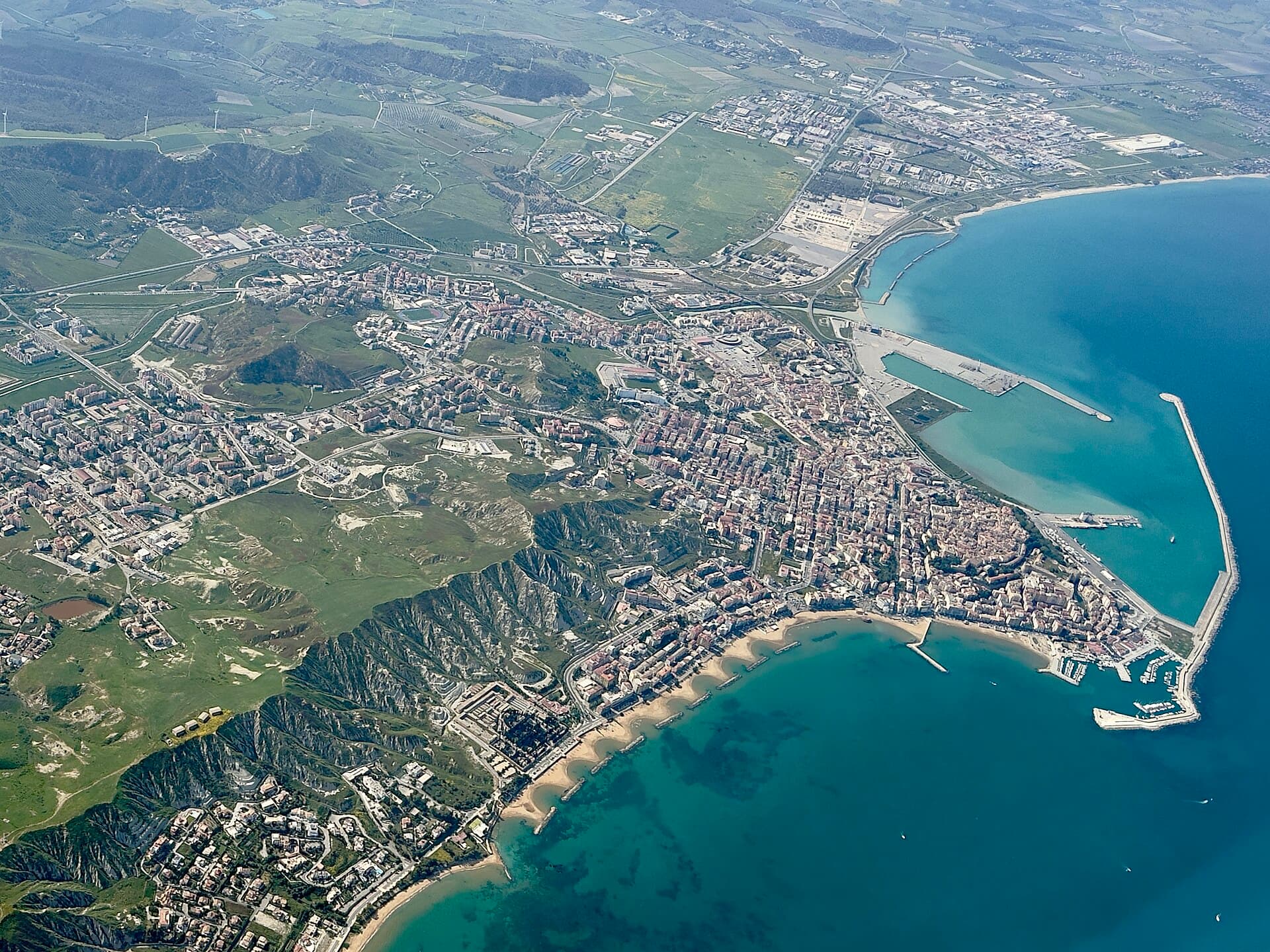 RennyT / CC BY-SA 4.0, via Wikimedia Commons
Self-guided audio walking tour of Crotone — GPS route, offline playback, story-driven narration in 32 languages.
“Where ancient philosophy meets Ionian shores, and secrets linger in every stone.”
Not the postcards. The stories even locals don't know — whispered in your ear, right where they happened.
Imagine a sanctuary so revered, it drew pilgrims from across the ancient Greek world. What became of its immense wealth and countless offerings?
This city produced more Olympic victors than any other Greek colony. Who was their most fabled athlete, and what was his peculiar training regimen?
The great mathematician Pythagoras established his influential school here. What was taught beyond geometry, and what became of his disciples?
Discover every secret of Crotone
Every address, every reveal in full — in your ear, right where it happened.
You pick your stops. You walk. The voice reveals what the others miss.

Your self-guided audio tour of Crotone is ready — pick your landmarks, choose your language, and start the moment you arrive.
BuyLume has a built-in augmented-reality guide. Hold your phone up and its camera shows the street ahead of you, with a glowing arrow laid over the real view that always points to your next stop — no map to puzzle over, no wrong turns. Like everything in Lume, it works fully offline.
Crotone, a city on Italy's Ionian coast in the Calabria region, offers a profound journey through time, where ancient Greek roots intertwine with medieval fortifications and the rhythms of modern Calabrian life. Founded by Greek colonists around 710 BC as Kroton, it quickly became one of Magna Graecia's most powerful and prosperous cities, home to fabled Olympic athletes and the renowned philosopher Pythagoras.
Today, Crotone invites visitors to explore archaeological treasures, imposing castles, and unspoiled Ionian beaches, far removed from the more crowded tourist destinations. The city's character is a blend of its glorious past and its authentic southern Italian present, where narrow alleys and inviting squares lead to historic churches and a lively seafront.
## From Magna Graecia to Modern Crotone Crotone's story begins around 710 BC when Achaean Greeks, led by Myscellus, established the city of Kroton. Guided by the Delphic Oracle, they created a settlement that would rapidly flourish due to its strategic location, healthful climate, and military strength. Ancient Kroton became a central power of Magna Graecia, with a population of 50,000 to 80,000 around 500 BC. It was celebrated for its Olympic champions, most notably the wrestler Milo, and as an intellectual center where Pythagoras established his influential school of philosophy, mathematics, and medicine around 530 BC.
The city's ascendancy was evident in its victory over its rival, Sybaris, in 510 BC, which led to the razing of the competing city. However, Kroton's golden age was not without trials. In the 4th and 3rd centuries BC, it endured attacks from Dionysius I of Syracuse, the Bruttii, and Agathocles of Syracuse, as well as two invasions by Pyrrhus, King of Epirus. The Romans eventually gained possession of the city in 277 BC, marking the close of its political independence.
Throughout the Middle Ages, the city, then known as Cotrone, faced further invasions, including a Saracen sack around 870 AD. It was later conquered by the Normans and experienced periods of Spanish rule, leaving behind enduring structures like the 16th-century Castle of Charles V. The city's name was officially changed back to Crotone in 1928, and in 1992, it became the capital of the newly established Province of Crotone.
The 20th century brought a new chapter with industrial development, transforming Crotone into a major chemical manufacturing site. While this brought economic growth, it also left a legacy of environmental pollution, a challenge the city continues to address. Today, Crotone embraces its layered past, offering a captivating blend of ancient ruins, medieval architecture, and a lively coastal atmosphere.
Begin your exploration at the Castle of Charles V, an imposing 16th-century fortress that presides over the old town and offers sweeping views of the city and the Ionian Sea. Inside, you will find the Civic Museum, housing artifacts from ancient Kroton. A short stroll leads to the National Archaeological Museum of Crotone, a repository of Magna Graecia artifacts, including the exquisite Golden Diadem of Hera. The museum brings to life the history of the Temple of Hera Lacinia and the grandeur of ancient Kroton.
A visit is incomplete without a trip to the Archaeological Park of Capo Colonna, located about 10 kilometers from the city center. Here, the solitary Doric column stands as the last vestige of the once-majestic Temple of Hera Lacinia, offering a profound glimpse into the past against the backdrop of the Ionian Sea. Adjacent to the ruins, the Capo Colonna Archaeological Museum provides further insight into the site's history. For a different historical perspective, consider a trip to Le Castella, an ancient citadel constructed on a small island, accessible via a narrow strip of land. Back in the city, the Duomo di Crotone (Cathedral of Santa Maria Assunta), with its neo-classical facade and Baroque interior, houses the revered Black Madonna icon and a 12th-century baptismal font. Do not miss the Pythagoras Museum and Gardens, a green space dedicated to the city's most celebrated resident.
The ideal time to visit Crotone for exploring its archaeological sites and enjoying the pleasant Mediterranean climate is during late spring (May to June) or early autumn (September to mid-October). During these months, temperatures are comfortably warm without the intense heat of July and August. For a beach holiday, July and August offer hot, sunny weather, with sea temperatures reaching their warmest. While winters are mild, they can have alternating sunny and rainy periods.
Crotone-Sant'Anna 'Pitagora' Airport (CRV) is a minor domestic airport located about 10-15 km southeast of the city center, offering flights to a few Italian and European cities. From the airport, you can reach the city by local bus service, taxi, or car hire. Crotone also has a railway station on the Jonica railway line, with regional and Intercity services connecting to cities like Taranto and Reggio Calabria. However, for long-distance travel, Lamezia Terme Centrale Railway Station (LTZ), about 77.5 km away, is a major hub with broader connections.
Italian is the primary language, though some English may be spoken in tourist areas. Learning a few basic Italian phrases is always appreciated. Crotone is generally considered safe for tourists, but standard precautions against petty theft in crowded areas are advisable. The emergency number for police, ambulance, or fire is 112. Pharmacies are easily identifiable by green crosses. Remember to stay hydrated and use sunscreen, especially during the hot summer months.
Crotone in Korean, in Chinese or in Hebrew — and 29 more languages, every stop narrated by a native voice. The widest language range of any self-guided audio tour.
Available in: