Dmitrov Kremlin
Beyond the impressive Assumption Cathedral, the Dmitrov Kremlin holds a curious secret about its original defenses.
Full story unlocks in the tour
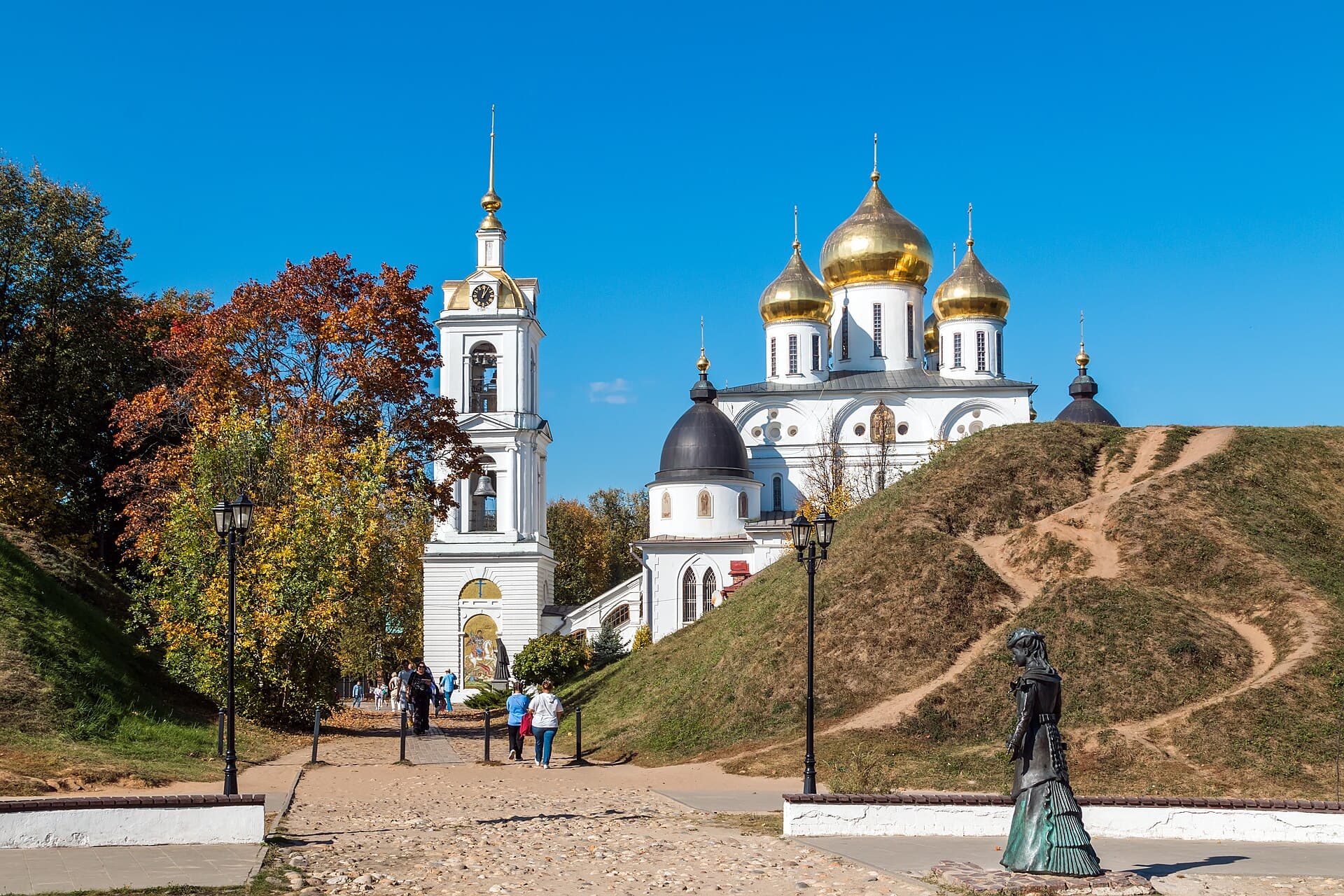 Mike1979 Russia / CC BY-SA 4.0, via Wikimedia Commons
Self-guided audio walking tour of Dmitrov — GPS route, offline playback, story-driven narration in 32 languages.
“Where ancient ramparts guard centuries of stories, and frogs whisper forgotten legends.”
Not the postcards. The stories even locals don't know — whispered in your ear, right where they happened.
Beyond the impressive Assumption Cathedral, the Dmitrov Kremlin holds a curious secret about its original defenses.
This 17th-century church, a 'pearl of medieval church architecture,' survived the Soviet era, but not without some dramatic changes to its interior.
A peaceful stroll down Kropotkin Street reveals charming old wooden homes, but one house, in particular, hosted a revolutionary figure in his final years.
Discover every secret of Dmitrov
Every address, every reveal in full — in your ear, right where it happened.
You pick your stops. You walk. The voice reveals what the others miss.


Your self-guided audio tour of Dmitrov is ready — pick your landmarks, choose your language, and start the moment you arrive.
BuyLume has a built-in augmented-reality guide. Hold your phone up and its camera shows the street ahead of you, with a glowing arrow laid over the real view that always points to your next stop — no map to puzzle over, no wrong turns. Like everything in Lume, it works fully offline.
Dmitrov, a city just 65 kilometers north of Moscow, offers a journey through centuries of Russian history, often feeling like a quieter, more intimate echo of the capital itself. Founded in 1154 by Prince Yuri Dolgoruky, the same ruler who established Moscow, Dmitrov shares a parallel narrative, making it a unique place to experience Russia's past without the bustling crowds.
Surrounded by picturesque landscapes and traversed by the Moscow Canal, Dmitrov blends ancient fortifications with a serene, provincial charm. Its well-preserved Kremlin, with its imposing earthen ramparts and majestic Assumption Cathedral, stands as a testament to its strategic importance and architectural heritage. Beyond the major landmarks, Dmitrov invites exploration of its quiet, tree-lined streets, where every corner seems to hold a story, from medieval trade routes to Soviet-era art.
This compact city is ideal for a day trip or a tranquil weekend escape, offering a respite from the metropolitan rush. Dmitrov's unique character, shaped by its role as a border fortress, a trading hub, and a witness to pivotal historical events, provides a captivating glimpse into the enduring spirit of Russia.
Dmitrov's story begins in 1154, when Grand Duke Yuri Dolgoruky founded it in the marshy valley of the Yakhroma River. He named it in honor of Saint Demetrius, the patron saint of his son Vsevolod, who was born that same year. Strategically positioned on river trade routes and as a fortified border post for Vladimir-Suzdal lands, Dmitrov quickly grew in importance. However, its strategic location also made it a frequent target. The city endured numerous attacks and civil strife, suffering significant damage from Tatar-Mongol invasions in the 13th to 15th centuries, being repeatedly set ablaze.
Despite these turbulent beginnings, Dmitrov experienced a 'Golden Age' during the reign of Prince Yury Ivanovich (1505–1534), the son of Moscow's Grand Prince Ivan III. During this period, the city flourished as a commercial power, playing a pivotal role in north-south trade routes, supplying northern towns with grain and providing Moscow with furs and salt. It was during this time that the magnificent Assumption Cathedral within the Kremlin and the Boris and Gleb Monastery were constructed, marking a shift from wooden structures to grand stone architecture.
Following its golden age, Dmitrov faced a period of decline. In 1569, it was seized and incorporated into the Oprichnina, a territory ruled by Ivan the Terrible's secret police, leading to heavy repression and a substantial decrease in trade. The city suffered further during the Time of Troubles in the early 17th century, being ransacked by Polish troops. Despite these setbacks, Dmitrov was granted a coat of arms in 1781, becoming the center of the Dmitrov District and experiencing a new revival of local trade by the end of the 18th century. The War of 1812, when Napoleon's Grand Armée briefly occupied the city, caused little damage.
The 20th century brought significant transformations. In 1900, the Moscow–Savyolovo railway line connected Dmitrov to the national transport network, boosting its economy. However, the most dramatic change came with the construction of the Moscow Canal between 1932 and 1937. This massive project, which linked the Moskva River with the Volga, transformed Dmitrov into a significant river port with access to five seas, though it was built using the forced labor of Gulag prisoners. During World War II, Dmitrov once again found itself on the front lines. In November 1941, Nazi forces attacked the city, but were ultimately dislodged in a crucial counteroffensive by the Red Army, leading to the liberation of the entire Dmitrov District. For its heroic defense, Dmitrov was awarded the status of City of Military Glory.
Begin your exploration at the Dmitrov Kremlin, the city's oldest and most prominent attraction. Walk along the impressive earthen ramparts, which once served as the primary defense, offering panoramic views of the city. Inside, marvel at the Assumption Cathedral, a white-stone masterpiece with its distinctive nine domes, built between 1509 and 1533. The Kremlin also houses a large history museum, showcasing the region's past from the 18th to 21st centuries, including a curious exhibit of a 19th-century peasant hut.
Just a short walk from the Kremlin, you'll find the Boris and Gleb Monastery, an ancient male monastery dedicated to Russia's first saints. Continue to the city center to see the Monument to Yuri Dolgoruky, the city's founder, marking the legendary spot of his son's prophesied birth. Stroll along the pedestrian Kropotkin Street, lined with charming old wooden homes and dotted with interesting sculptures and monuments, including the former residence of anarchist Pyotr Kropotkin.
For a unique experience, visit the Frog Museum, a quirky tribute to the city's unofficial symbol, housing over a thousand frog-related exhibits. Do not miss the well-preserved Soviet panel houses near the Kremlin, adorned with lively mosaics depicting Russian fairy tales and historical figures. If time allows, consider a leisurely walk along the Moscow Canal, where yachts and motor ships pass by, offering a resort-like atmosphere in summer.
Dmitrov experiences a humid continental climate with distinct seasons. The best time to visit for comfortable sightseeing and outdoor activities is during the summer months, from May to August. July is the warmest month, with average daytime temperatures reaching a pleasant 25°C (77°F). June is the sunniest month, offering around 9.2 hours of sunshine daily. While summer is generally warm, be prepared for moderate rainfall, with June being the wettest month. Spring and autumn offer milder temperatures and beautiful foliage, but evenings can be chilly. Winters are typically frosty and snowy.
Dmitrov is easily accessible from Moscow. The most efficient way to reach Dmitrov is by train from Moscow's Savyolovsky Station, with hourly services that take approximately 1 hour and 14 minutes. Alternatively, buses and rideshares are also available.
Once in Dmitrov, the historical center is compact and best explored on foot, with most major attractions within walking distance. Public transport, consisting of buses and minibuses, is available for reaching outlying areas. Taxi services are well-developed and affordable within the city. For those planning to visit active churches or monasteries, it's advisable for women to carry a headscarf and wear a skirt below the knees, and for men to wear trousers. Most shops, cafes, and museums accept bank cards, but having some cash on hand is recommended for smaller purchases or donations.
Dmitrov in Korean, in Chinese or in Hebrew — and 29 more languages, every stop narrated by a native voice. The widest language range of any self-guided audio tour.
Available in: