Louis Pasteur's Birthplace
The house where a scientific giant was born holds a surprising detail about his father's profession.
Full story unlocks in the tour
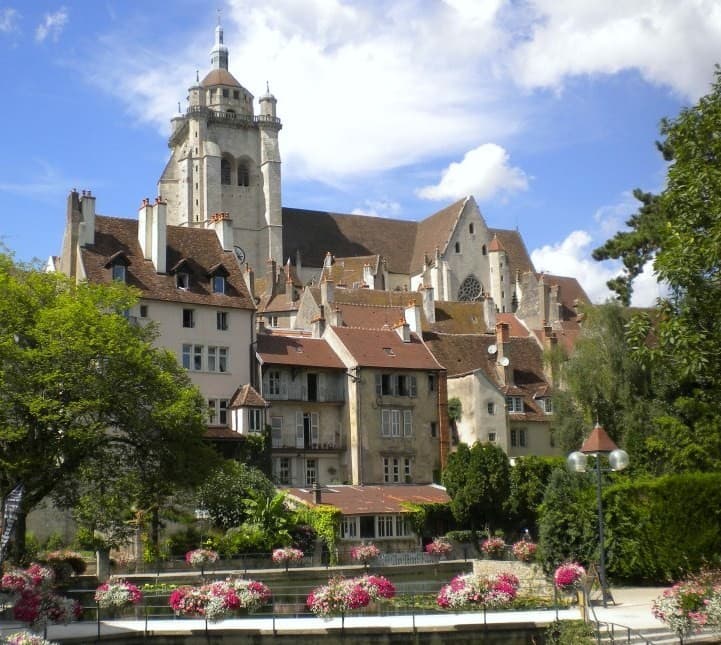 Cjulien21 / cc by-sa 3.0, via Wikimedia Commons
Self-guided audio walking tour of Dole — GPS route, offline playback, story-driven narration in 32 languages.
“Dole: Where history flows with the canals.”
Not the postcards. The stories even locals don't know — whispered in your ear, right where they happened.
The house where a scientific giant was born holds a surprising detail about his father's profession.
This imposing church, a symbol of Dole, once served a drastically different purpose during a turbulent period.
The vision for connecting two major European rivers through Dole has a surprising connection to a famous historical figure's priorities.
Discover every secret of Dole
Every address, every reveal in full — in your ear, right where it happened.
You pick your stops. You walk. The voice reveals what the others miss.


Your self-guided audio tour of Dole is ready — pick your landmarks, choose your language, and start the moment you arrive.
BuyLume has a built-in augmented-reality guide. Hold your phone up and its camera shows the street ahead of you, with a glowing arrow laid over the real view that always points to your next stop — no map to puzzle over, no wrong turns. Like everything in Lume, it works fully offline.
Dole, a captivating city in the Jura department of eastern France, offers a compelling blend of historical depth and tranquil riverside beauty. Once the capital of the Free County of Burgundy, Dole retains much of its architectural heritage, with a well-preserved historic center that invites exploration.
Situated along the Doubs River and the Rhône-Rhine Canal, the city is often referred to as the "Little Venice of Jura" due to its picturesque waterways and old houses. Visitors can wander through narrow streets, discover quiet courtyards, and appreciate the serene atmosphere that sets it apart from larger, more bustling cities.
Dole is also notable as the birthplace of the influential scientist Louis Pasteur, whose early life and groundbreaking work are commemorated in the city. Its enduring past, combined with its scenic setting and cultural offerings, makes Dole a compelling destination for those seeking an authentic French experience.
## From Roman Settlement to Burgundian Capital Dole, originally known as Dolla under the Romans, began to gain significant importance in the 10th century with the creation of the County of Burgundy. By the 12th century, a castle was constructed on a limestone plateau to monitor river traffic, around which a settlement rapidly formed.
## The Golden Age of Franche-Comté In the 13th century, Dole was declared the capital of the County of Burgundy, ushering in a golden age. This period saw the establishment of a parliament in 1386 and a university in 1422, transforming Dole into a significant intellectual and political hub for centuries. The city's economy flourished due to the presence of nobility, active trade, and the development of craft guilds, particularly tanners and clothiers.
## Sieges, Destruction, and Renaissance Dole's strategic location made it a frequent target for conquest, enduring numerous sieges. In 1479, the city was captured and largely destroyed by the forces of King Louis XI of France. However, it was rebuilt in the Gothic style during the 15th century, and following the Treaty of Senlis in 1493, which returned the region to Habsburg rule, Dole experienced a "Golden Age" of reconstruction and architectural flourishing in the 16th century. This era is reflected in many of the historic buildings visible today.
## Annexation to France and Loss of Capital Status Despite its resilience, Dole eventually succumbed to the French crown under Louis XIV, with the region being annexed to the Kingdom of France in 1678. Consequently, Dole lost its status as the capital of Franche-Comté, with the parliament and university being transferred to Besançon. Despite this loss of political prestige, Dole's 16th-century renaissance architecture continues to be a highlight for visitors.
## Modern Era: A City of Art and History In 1967, a protected area encompassing 114 hectares was established, covering Dole's entire old town and its surroundings, preserving its unique character. Today, Dole is recognized as a City of Art and History, celebrated for its remarkable architectural heritage and its connection to Louis Pasteur. The city has reoriented itself towards cultural tourism since the 1960s, inviting visitors to explore its enduring past and scenic beauty.
Begin your exploration of Dole in its well-preserved historic center, a designated conservation area. The city's modest size and pedestrian-friendly streets make it ideal for walking. Follow the "Chat Perché" trail, marked by bronze cat markers on the ground, to discover key monuments and quiet corners.
The imposing Collégiale Notre-Dame, a 16th-century Gothic-style church, dominates the skyline with its 73-meter bell tower. Climb to the top for a sweeping view of Dole, the Doubs River, and the Jura countryside. Nearby, the Hôtel-Dieu, a remarkably restored old hospital, is also worth a visit.
A significant stop is the Maison Natale de Louis Pasteur, the birthplace of the famous scientist. This museum showcases his personal items, models, videos, and writings. Wander along the Canal des Tanneurs, where Pasteur's father worked, and observe period buildings. The Museum of Fine Arts and Archaeology, housed in the former castle of Dole, features Burgundian and Comtois artworks from the Middle Ages to the 19th century, along with contemporary art and archaeological collections.
For a different perspective, consider a boat trip on the Doubs River or a bike ride along the EuroVélo 6 cycle path, which follows the canal. The nearby Forêt de Chaux, one of France's largest forests, offers extensive opportunities for hiking and cycling.
Dole experiences a semi-continental climate with warm summers and cold, wet winters. The most pleasant times to visit are typically from April to June and then from September to October. During these months, temperatures are comfortable, and the surrounding nature is lush, creating ideal conditions for exploring the historic center and riverbanks. July and August are the warmest months, with average highs around 27-28°C, perfect for warm-weather activities, though precipitation can still occur. Winters, from November to March, are cold, with average temperatures around 4-5°C, and can bring frost, fog, and wet snow.
Dole is easily accessible by train, with direct TGV services from Paris taking approximately 2.5 to 3 hours to Dole Station. The nearest airport is Dole-Jura Airport, which mainly serves European low-cost flights, while Geneva and Lyon airports are viable alternatives, located 1.5 to 2 hours away by car. The city center is compact and best explored on foot, with pedestrian streets making walking very enjoyable. For reaching outlying districts or exploring the wider Jura region, a local bus network is available, and cycling is an excellent option, especially along the Doubs River. Taxis are available for occasional trips, though they cannot be hailed on the street.
For accommodation, options range from modern hotels near the train station to charming apartments in the historic center. Campsites are also available near the Doubs River for budget-conscious nature lovers. Dole offers a variety of dining experiences, with traditional restaurants in the historic center serving Jura specialties like Comté fondue and coq au vin jaune. Local markets provide opportunities to sample regional produce such as aged Comté cheese and Morteau sausage.
Dole in Korean, in Chinese or in Hebrew — and 29 more languages, every stop narrated by a native voice. The widest language range of any self-guided audio tour.
Available in: