Dodauer Forst
Deep within a forest near Eutin, a particular oak tree acts as a matchmaker, receiving mail from hopeful romantics worldwide.
Full story unlocks in the tour
 Nordenfan / CC BY-SA 4.0, via Wikimedia Commons
Self-guided audio walking tour of Eutin — GPS route, offline playback, story-driven narration in 32 languages.
“Lakeside serenity meets cultural vibrancy in the 'Weimar of the North'.”
Not the postcards. The stories even locals don't know — whispered in your ear, right where they happened.
Deep within a forest near Eutin, a particular oak tree acts as a matchmaker, receiving mail from hopeful romantics worldwide.
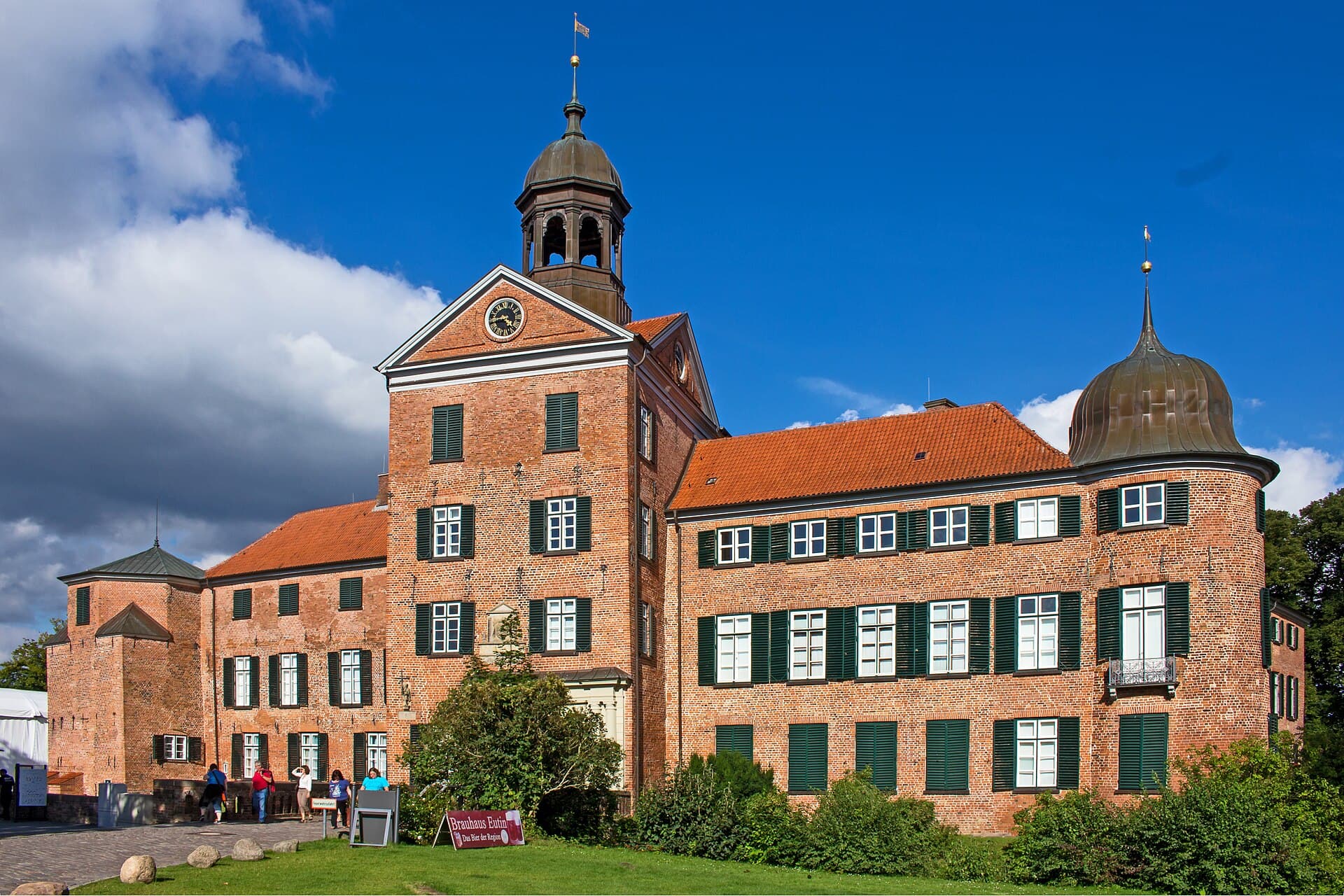
Beyond its grand Baroque facade, Eutin Castle holds a surprising connection to Russian royalty, revealed through unique gifts within its museum.
For a few days each year, Eutin's historic market square transforms into Germany's largest free open-air blues festival, attracting international talent.
Discover every secret of Eutin
Every address, every reveal in full — in your ear, right where it happened.
You pick your stops. You walk. The voice reveals what the others miss.

Your self-guided audio tour of Eutin is ready — pick your landmarks, choose your language, and start the moment you arrive.
BuyLume has a built-in augmented-reality guide. Hold your phone up and its camera shows the street ahead of you, with a glowing arrow laid over the real view that always points to your next stop — no map to puzzle over, no wrong turns. Like everything in Lume, it works fully offline.
Eutin, sometimes called the 'Weimar of the North' and the 'cultural heart of Holstein Switzerland', offers a blend of historical depth and natural allure in Schleswig-Holstein, Germany. Surrounded by a landscape of many lakes, gentle hills, and mixed forests, the town provides an idyllic backdrop for exploration. Its most prominent feature is the Eutin Castle, situated directly on the Großer Eutiner See (Great Eutin Lake), forming a picturesque focal point alongside the historical Old Town.
The town's moniker, 'The Town of Roses' (Rosenstadt), is evident in the delicate fragrances and visual appeal of countless rose trees throughout the city center, including its own rose variety, the 'Eutin Floribunda'. Eutin's charm extends to its paved streets, distinctive shops, and inviting cafes, inviting visitors to experience its authentic character before venturing into the surrounding countryside. This region, known as Holstein Switzerland, offers opportunities for forested walks, scenic bike trails, and paddling on tranquil waters, all accessible from Eutin's lakeside promenade.
Eutin's cultural significance is further highlighted by the Eutin Festival, an open-air opera and summer concert series held in the castle park, and its association with the renowned composer Carl Maria von Weber, who was born here. With a history spanning over a millennium, Eutin invites visitors to step back in time while enjoying its lively cultural offerings and serene natural environment.
The origins of Eutin trace back to the 7th and 8th centuries AD when the Slavic Obotrites tribe settled eastern Holstein. They established a fortress on an island in what is now known as the Großer Eutiner See, an island today called Pheasant Island. The name Eutin itself is of Slavic origin, likely derived from the personal name 'Uta'. In the 12th century, Dutch settlers arrived, and by 1156, Eutin had become a market town, granted town rights in 1257.
Eutin's significance grew as it became the official seat of the Prince-Bishopric of Lübeck from 1309, primarily because Lübeck itself was an imperial free city. The castle, which originated as a medieval fortress, began its transformation into a grand residence during this period. The four-winged palace visible today evolved through centuries of expansion and refurbishment.
In 1773, Eutin passed to Oldenburg, and with the secularization of the Prince-Bishopric of Lübeck in 1803, Eutin became part of the Duchy of Oldenburg. During the late 18th century, Duke Peter Frederick Louis initiated significant changes to the castle grounds, converting the formal Baroque garden into an English landscape garden. This era, from 1770 onwards, saw Eutin develop into one of northern Germany's intellectual centers, earning it the epithet 'Weimar of the North'. Notable figures like the translator Johann Heinrich Voss, the painter Johann Heinrich Wilhelm Tischbein, and the composer Carl Maria von Weber, who was born in Eutin, lived or visited the town during this time.
Eutin Castle continued to be regularly occupied until the 20th century, with much of its original interior preserved. In 1937, the Greater Hamburg Act transferred Eutin from Oldenburg to the Prussian Province of Schleswig-Holstein, and after World War II, it became part of the modern German state of Schleswig-Holstein. Today, the castle operates as a museum, showcasing furnished state rooms, a two-story chapel, and courtly collections, managed by a family foundation of the House of Oldenburg.
Begin your exploration at Eutin Castle (Schloss Eutin), a four-winged palace that evolved from a medieval fortress. Explore its museum, which offers insights into aristocratic life with original furnishings, paintings, and a two-story chapel. Stroll through the surrounding English landscape garden, which naturally incorporates Lake Eutin and hosts the annual Eutin Festival.
Just steps from the castle, the Historical Old Town (Altstadt) invites leisurely walks through paved streets, revealing charming buildings, distinctive shops, and inviting cafes. The Eutin Market Square (Marktplatz) is the heart of the Old Town, surrounded by historic structures like the St. Michaelis Cathedral and the former widow palais.
For panoramic views, climb the Water Tower, built in 1909. It is the highest point in Eutin, offering vistas over the city and, on clear days, extending to the Baltic Sea and the Holstein Switzerland region. A few kilometers outside Eutin, on the Ukleisee, discover the Hunting Lodge at Lake Uklei (Jagdschlösschen am Ukleisee), a late Baroque pavilion built in 1776 for private gatherings and hunting parties. The region's many lakes, including the Großer Eutiner See, Kleiner Eutiner See, and Kellersee, offer opportunities for boating, canoeing, swimming, and fishing.
The ideal time to visit Eutin for warm-weather activities and cultural events is from late June to late August. During these summer months, temperatures are mild, averaging around 23°C (73°F) in July, and daylight hours are long. This period coincides with the renowned Eutin Festival, featuring open-air opera and musical theatre performances at the lakeside stage in Eutin Castle's park. Spring (March, April, and May) offers sunny days and blooming flowers, though it can still be chilly. Autumn (September, October, and November) is also pleasant, with fewer tourists and comfortable temperatures.
Eutin is well-connected and can be reached by car, bus, or train, with regular train services from larger cities like Lübeck and Kiel. For those flying, Hamburg or Lübeck airports are convenient options. Once in Eutin, the town is easily navigable on foot, especially the Old Town and castle area. Bicycle tours are popular around the lakes, with shaded forest paths and quiet swimming spots. The Tourist-Info Eutin, located in a half-timbered house on the market square, offers informative flyers, hiking maps, and city plans, along with local tips. They also provide ticket services for local and national events, including the Eutin Festival. For those traveling with bikes or luggage, the Tourist-Info at Eutin station offers free, lockable bicycle boxes.
Eutin in Korean, in Chinese or in Hebrew — and 29 more languages, every stop narrated by a native voice. The widest language range of any self-guided audio tour.
Available in: