The Circus
Putbus carries the affectionate nicknames "The White Town" and "The Rose Town." The latter, however, stems from a rather specific and enduring directive.
Full story unlocks in the tour
 Unukorno / CC BY-SA 3.0, via Wikimedia Commons
Self-guided audio walking tour of Putbus — GPS route, offline playback, story-driven narration in 32 languages.
“Where neoclassical elegance meets Baltic Sea breezes.”
Not the postcards. The stories even locals don't know — whispered in your ear, right where they happened.
Putbus carries the affectionate nicknames "The White Town" and "The Rose Town." The latter, however, stems from a rather specific and enduring directive.
The grand princely palace, once the architectural anchor of Putbus's meticulously planned layout, no longer graces the landscape. Its disappearance was not the result of natural calamity or wartime destruction.
A short distance from Putbus, the small coastal village of Lauterbach holds a significant distinction in German history.
Discover every secret of Putbus
Every address, every reveal in full — in your ear, right where it happened.
You pick your stops. You walk. The voice reveals what the others miss.


Your self-guided audio tour of Putbus is ready — pick your landmarks, choose your language, and start the moment you arrive.
BuyLume has a built-in augmented-reality guide. Hold your phone up and its camera shows the street ahead of you, with a glowing arrow laid over the real view that always points to your next stop — no map to puzzle over, no wrong turns. Like everything in Lume, it works fully offline.
Putbus, along Rügen Island's southeastern coast, stands as a town unlike any other in Germany. Established in 1810 by Prince Wilhelm Malte I zu Putbus, it was conceived as a meticulously planned neoclassical residence town, earning it the moniker "The White Town" due to its uniformly white buildings. This architectural harmony extends to its green spaces, with elegant structures curving around cultivated squares and quiet thoroughfares adorned with rose bushes, giving it another nickname: "Rose Town."
The town offers a tranquil escape, blending historic appeal with natural splendor. Visitors can wander peaceful streets, explore historic squares, and discover nearby beaches that are often calmer and less crowded than those found in larger resorts. Putbus also serves as a gateway to the wider Southeast Rügen Biosphere Reserve, with forests, wetlands, and serene shores just a short distance away.
The story of Putbus is inextricably linked to Prince Wilhelm Malte I (1783–1854), a figure who shaped the town from its very foundations. A scion of an old Slavic noble family with roots tracing back to the 12th century, Wilhelm Malte I was elevated to the rank of prince in 1807 by King Gustav IV Adolf of Sweden, as Rügen was then under Swedish rule. After Rügen became part of Prussia in 1815, he continued to hold significant influence.
His vision for Putbus began to materialize in 1810 when he established the town as his personal residence. Drawing inspiration from the classical architectural styles he admired, particularly the Circus in Bath, England, Prince Malte I embarked on an ambitious building program. He mandated that all public buildings be painted white and that every house feature at least one rose bush, contributing to the town's distinctive appearance.
The town's neoclassical ensemble grew steadily under the Prince's direction. The iconic Circus, a large circular square lined with elegant white buildings and an obelisk at its center, was laid out from 1828 and completed with its surrounding houses by 1845. The Putbus Palace itself, originally a 14th-century castle that had undergone Renaissance and Baroque renovations, was redesigned in a neoclassical style between 1827 and 1832 by Berlin architect Johann Gottfried Steinmeyer. Other significant structures, such as the residence theatre (1819–1821), the princely stables (1821–1824), and the Orangerie (initially 1824, redesigned 1853), were also constructed during this period, forming a harmonious union with the palace and its extensive English-style park.
Tragically, the grand Putbus Palace, a symbol of the princely family's legacy, was demolished by the East German communist regime in 1962, with its remnants removed by 1964. Today, only the outline of the building and the lakeside terrace remain visible in the park, though an association founded in 2019 is exploring plans for its reconstruction.
Following the political changes of 1991, the historic town center, including the Circus, market square, town hall, Orangerie, and the former princely stables (now a theater), underwent extensive renovation as part of urban development and heritage conservation projects. Putbus has been a state-recognized resort town since 1997, solidifying its status as a significant destination on Rügen.
Putbus offers a collection of well-preserved neoclassical architecture and serene green spaces. Begin your exploration at the Circus, the town's central point, a circular square framed by sixteen white neoclassical buildings and a central obelisk. Many visitors find it one of the most picturesque spots on the island.
Adjacent to the Circus lies the Schlosspark (Palace Park), a sprawling English-style landscape garden. Though the original palace was demolished, its footprint is still discernible. Within the park, you'll discover the Orangerie, a late-classical building that now hosts art exhibitions and events. Also in the park are the Mausoleum of the Putbus family and the Palace Church.
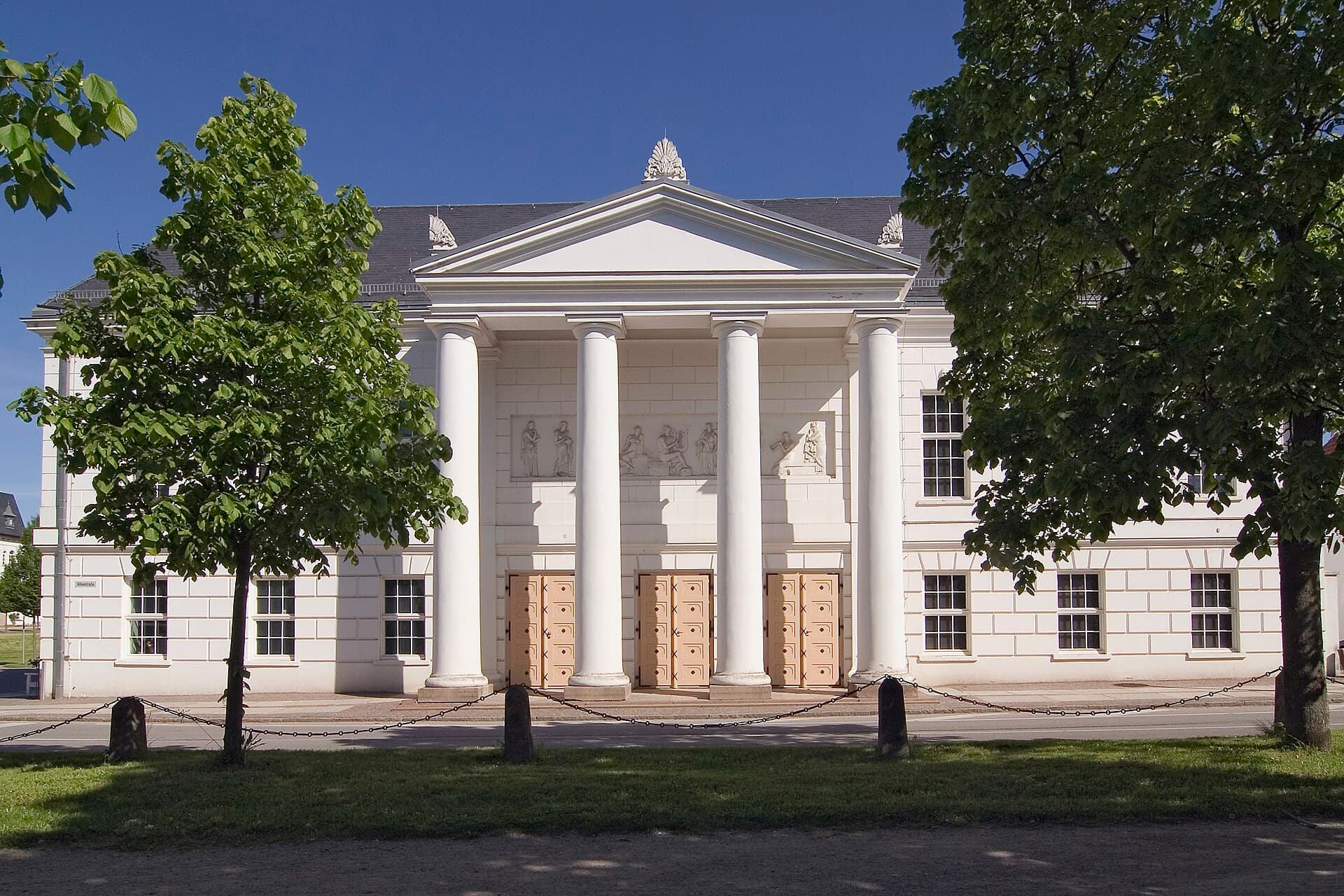
The Theater Putbus, a charming classicist festival hall constructed between 1819 and 1821, ranks among the oldest theaters in Mecklenburg-Vorpommern and continues to host concerts and cultural events. For a distinctive experience, consider a ride on the Rasender Roland (Racing Roland), a historic narrow-gauge steam train that connects Putbus with other seaside resorts on Rügen like Binz and Sellin.
Just 2 kilometers from Putbus, the village of Lauterbach offers a fishing and sailing harbor and is recognized as Germany's first seaside resort. From Lauterbach, you can also embark on a boat trip to the undeveloped island of Vilm, part of the Southeast Rügen Biosphere Reserve, for guided nature walks.
The most pleasant time to experience Putbus for warm-weather activities extends from late June to early September. During these months, daytime temperatures typically range from 20–24°C (68–75°F), making conditions ideal for exploring the town, strolling through the parks, and enjoying the nearby Baltic beaches. The Baltic Sea also reaches its warmest temperatures, around 20–22°C (68–71°F), in July and August, perfect for swimming.
Spring (April to May) and early autumn (September to early October) also offer agreeable conditions. In spring, temperatures are comfortable (13–18°C / 55–65°F), gardens blossom, and rapeseed fields turn bright yellow across the island. Early autumn provides mild weather (16–20°C / 60–68°F) and lovely fall foliage, creating scenic backdrops for walks. Travelers seeking fewer crowds and potentially lower hotel rates might consider visiting between March and May.
Putbus is situated on the island of Rügen in the state of Mecklenburg-Western Pomerania, Germany. The town is well-connected by roads and cycle tracks. The nearest major airport is Rostock-Laage Airport (RLG), approximately 150 kilometers away. From there, you can rent a car or take public transportation to Rügen. The Rasender Roland steam train provides a scenic connection to other towns on the island.
Public parking is available in several locations, including a large parking lot at Schlosspark, and smaller options at Markt and Circus for shorter stays. Paid parking is also available near Lauterbach Harbor and Vilmnitzer Weg, with some spots becoming free after 8:00 PM. Public restrooms are available at the Orangerie, and seasonally at beach areas like Neuendorf, Wreechen, and Goor, as well as at Lauterbach Harbor.
While the town is walkable, comfortable shoes are recommended for exploring the parks and wider area. Many hotels and guesthouses are available in Putbus and the surrounding villages like Lauterbach.
Putbus in Korean, in Chinese or in Hebrew — and 29 more languages, every stop narrated by a native voice. The widest language range of any self-guided audio tour.
Available in: