St. Burchardi Church
Imagine a musical performance that began in 2001 and won't conclude until the year 2640.
Full story unlocks in the tour
 marsupium photography / CC BY-SA 2.0, via Wikimedia Commons
Self-guided audio walking tour of Halberstadt — GPS route, offline playback, story-driven narration in 32 languages.
“Where medieval echoes meet avant-garde silences, and history is a 639-year-long song.”
Not the postcards. The stories even locals don't know — whispered in your ear, right where they happened.
Imagine a musical performance that began in 2001 and won't conclude until the year 2640.
Beyond its Gothic grandeur, the Cathedral holds a collection so rare it includes tapestries older than any other in Europe.
Standing prominently in the market square is a knight, a symbol of civic liberty, whose origins predate most of Germany's similar figures.
Discover every secret of Halberstadt
Every address, every reveal in full — in your ear, right where it happened.
You pick your stops. You walk. The voice reveals what the others miss.
Your self-guided audio tour of Halberstadt is ready — pick your landmarks, choose your language, and start the moment you arrive.
BuyLume has a built-in augmented-reality guide. Hold your phone up and its camera shows the street ahead of you, with a glowing arrow laid over the real view that always points to your next stop — no map to puzzle over, no wrong turns. Like everything in Lume, it works fully offline.
Halberstadt, often called the 'Gateway to the Harz Mountains,' is a city in Saxony-Anhalt, Germany, that offers a compelling blend of medieval history and surprising contemporary culture. Though significantly damaged during World War II, its resilient spirit is evident in the careful reconstruction and preservation of its historic core. Wandering through its winding alleys, you'll discover a city that proudly displays its past while embracing unique modern artistic endeavors.
Beyond its architectural treasures, Halberstadt provides a tranquil escape with its proximity to the Harz Mountains, offering opportunities for nature exploration and scenic views. It’s a place where the echoes of ancient bishops and Hanseatic traders mingle with the sustained notes of a centuries-long musical performance, creating an experience that feels both deeply rooted in history and remarkably forward-thinking.
## From Bishopric to Bombing and Rebirth Halberstadt's history stretches back to the 9th century, with its establishment as an episcopal see by Carolingian emperor Louis the Pious around 814. It quickly grew into an important trading center, granted market rights in 989 by King Otto III, and by the 13th-14th centuries, it was one of Germany's most significant trading cities. The city joined a league of towns with Quedlinburg and Aschersleben in 1326 and became a member of the Hanseatic League in 1387, further solidifying its economic power.
The city's ecclesiastical importance is evident in its magnificent churches, particularly the Halberstadt Cathedral, which began its Gothic reconstruction in 1236 and was consecrated in 1491. Halberstadt's journey was not without hardship. It endured burning by Emperor Heinrich V in 1113 and Heinrich the Lion in 1179, and was occupied alternately during the Thirty Years' War. The bishopric was secularized in 1648, becoming a principality within Brandenburg-Prussia.
A darker chapter unfolded at the end of World War II. On April 8, 1945, in a devastating 16-minute attack nicknamed 'Operation Sardine,' American bombers destroyed nearly the entire historic town center after local Nazi leaders refused to surrender. Over 550 tons of bombs fell, destroying 82% of the city and leaving 2,500 civilians dead and 35,000 homeless. Despite this immense destruction, Halberstadt has undergone a remarkable reconstruction, with many half-timbered houses and historic buildings carefully restored or rebuilt, especially from the 1990s onward, allowing its past to shine through once more.
Begin your exploration at the magnificent Halberstadt Cathedral (Dom St. Stephanus und St. Sixtus), a Gothic masterpiece considered one of Germany's most beautiful. Don't miss the Cathedral Treasury, housing an extraordinary collection of medieval art, including Europe's oldest surviving tapestries.
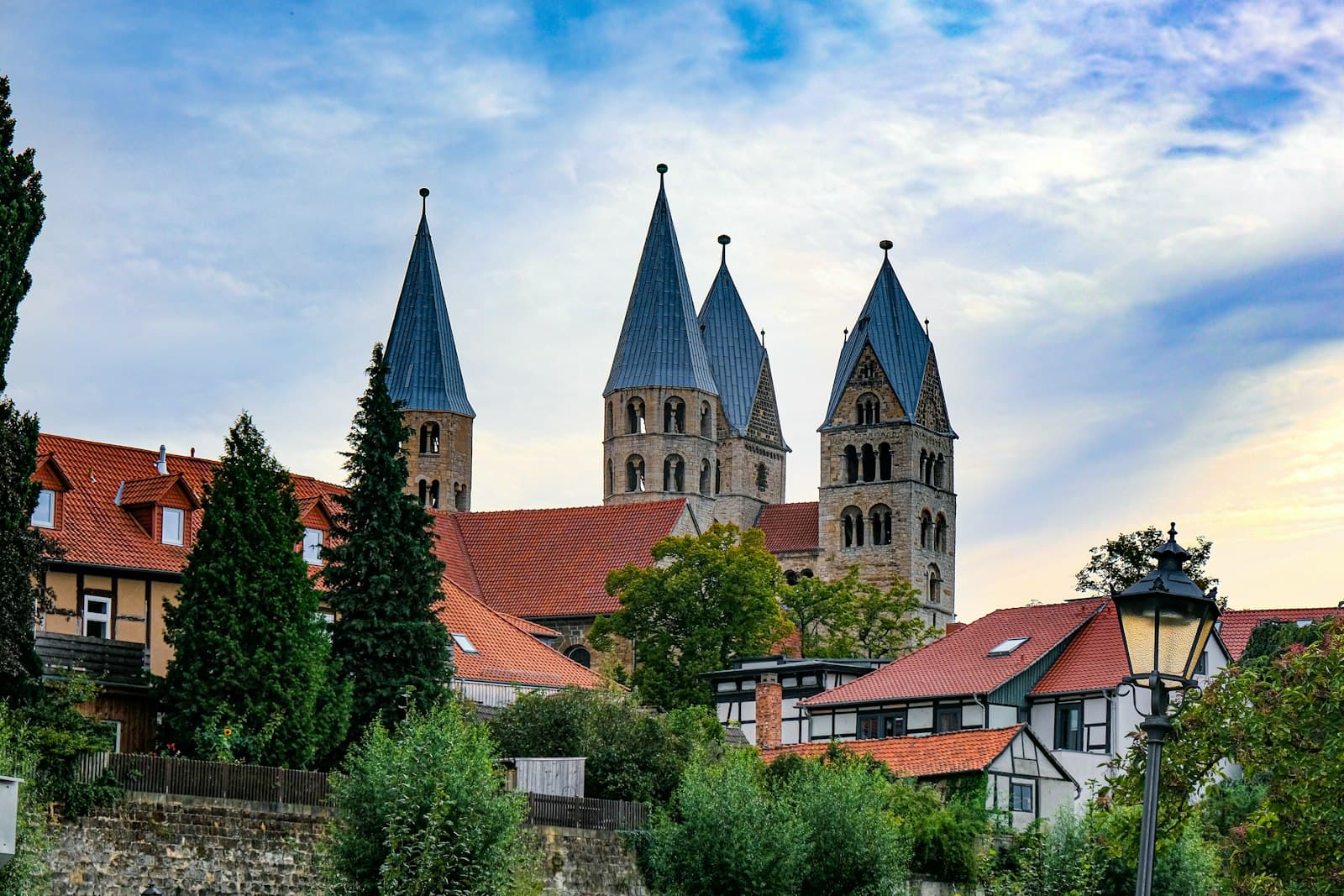
Just a short walk away is the Liebfrauenkirche (Church of Our Lady), a Romanesque basilica with distinctive four towers and unique medieval chancel screens. For a truly unique experience, visit St. Burchardi Church, home to John Cage's 'ORGAN²/ASLSP,' a musical performance designed to last 639 years.
Wander through the Historic Old Town, where you'll find beautifully preserved half-timbered houses and charming squares that survived or were meticulously rebuilt after WWII. In the Jewish Quarter, explore the Berend Lehmann Museum of Jewish History and Culture and the Klaus Synagogue to learn about the city's once-thriving Jewish community.
Observe the Roland statue in the market square, a symbol of civic freedom and one of Germany's oldest. For a break from urban exploration, head to the Spiegelsberge Landscape Park, featuring a Baroque hunting lodge and the world's oldest giant wine barrel. Just outside the city, the Langenstein Cave Dwellings offer a glimpse into a unique historical way of life.
The best time to visit Halberstadt is during spring and early autumn (May to September) when the weather is mild and pleasant for exploring the city's historic streets and surrounding landscapes. Spring brings blooming flowers, while autumn paints the nearby Harz Mountains in vivid colors, ideal for scenic hikes. For a unique cultural experience, consider visiting in early September for the Halberstadt Onion Market, a centuries-old festival. Winter also offers a charming visit, with festive warmth from Halberstadt's holiday markets.
Halberstadt is easily accessible by train from major German cities. Once in the city, its compact size makes it ideal for exploring on foot or by bike. Public transportation, including trams and buses, is also available for getting around. To make the most of your visit, start early for sightseeing, as popular attractions like the Cathedral and St. Burchardi Church can get busy. Consider combining city sights with nature by planning a day trip to the nearby Harz Mountains, packing comfortable shoes and snacks for hiking. Don't forget to sample local culinary specialties, such as Halberstädter Würstchen (a local sausage), and hearty dishes from the Harz region at family-owned restaurants or traditional taverns.
Halberstadt in Korean, in Chinese or in Hebrew — and 29 more languages, every stop narrated by a native voice. The widest language range of any self-guided audio tour.
Available in: