Spook Hall (Lawrence Memorial Hall)
This community center has a spectral resident who once walked a very different path.
Full story unlocks in the tour
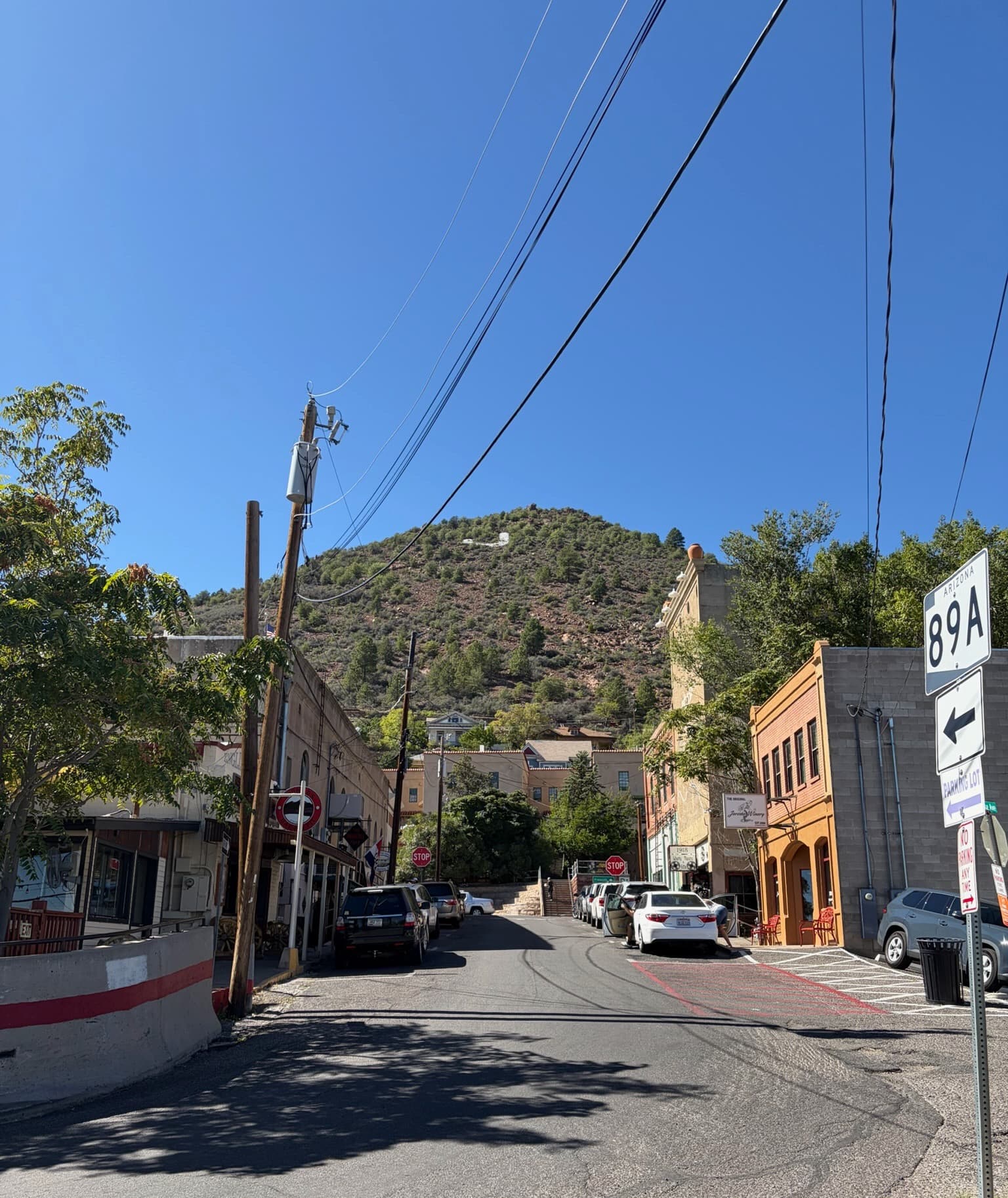 Seasider53 / CC BY 4.0, via Wikimedia Commons
Self-guided audio walking tour of Jerome — GPS route, offline playback, story-driven narration in 32 languages.
“Where copper fortunes and restless spirits linger on a shifting hillside.”
Not the postcards. The stories even locals don't know — whispered in your ear, right where they happened.
This community center has a spectral resident who once walked a very different path.
This historic inn has more than just guests checking in for the night.
Peer into a massive chasm that once yielded immense wealth, and perhaps, a lingering presence.
Discover every secret of Jerome
Every address, every reveal in full — in your ear, right where it happened.
You pick your stops. You walk. The voice reveals what the others miss.
Your self-guided audio tour of Jerome is ready — pick your landmarks, choose your language, and start the moment you arrive.
BuySituated on Cleopatra Hill, overlooking the Verde Valley, Jerome, Arizona, is a town that defies easy categorization. Once a booming copper mining camp, it earned the moniker "Wickedest City in the West" for its boisterous saloons, numerous brothels, and opium dens. Today, with a population hovering around 450, it has transformed into a thriving artistic community and a captivating National Historic Landmark.
Jerome’s story is one of dramatic highs and lows, a testament to both human ambition and the unforgiving nature of the land. Its steep, winding streets and historic buildings evoke a past of millionaires and miners, pioneers and prostitutes, all drawn by the promise of copper and a wild frontier spirit. Visitors come not only for the expansive views of the Verde Valley and Sedona's red rocks but also for the palpable sense of history and the lingering legends of its spirited past.
The story of Jerome begins long before its boomtown days. The Hohokam people inhabited the Verde Valley between 700 AD and 1125 AD, and later Native American tribes worked the ore bodies around the hills for pigments. In the late 16th century, Spanish explorers arrived, seeking gold, but deemed the copper deposits "poor" and moved on.
Modern mining began in 1875 when claims were staked on copper deposits near Cleopatra Hill. The United Verde Copper Company, financed by Eugene Jerome, for whom the town was named, started operations in 1883. The town rapidly grew from a collection of canvas and board shacks into a bustling community. By 1900, Jerome's population had swelled to over 2,500, and the United Verde Mine became the leading copper producer in the Arizona Territory. The copper deposits were among the most productive ever found, yielding nearly 33 million tons of copper, gold, silver, lead, and zinc ore over 77 years.
During its prosperous years in the early 1900s, Jerome was a diverse community of nearly 15,000 people from over 30 different nationalities. It was a town of immense wealth and equally immense vice, earning its infamous nickname, "The Wickedest City in the West," by a New York newspaper in 1905. Fires repeatedly ravaged the hastily constructed town, and landslides, exacerbated by mining blasts, destroyed entire sections. The ground beneath Jerome was so unstable that the town's jail famously slid 225 feet downhill.
Copper production peaked in 1929, but the Great Depression and dwindling high-grade ore reversed Jerome's fortunes. Major mining activities ceased in 1953, and the population plummeted to fewer than 100 people by the late 1950s. Many sound buildings were even demolished for their materials.
Rather than fading into oblivion, Jerome's remaining residents, determined to save their town, focused on tourism. The Jerome Historical Society was founded in 1953, and the Douglas Mansion, home of the Little Daisy Mine owner, became Jerome State Historic Park in 1962. In 1967, Jerome was designated a National Historic Landmark. In the 1960s and '70s, artists and "free spirits" discovered the town's unique character, restoring old buildings and opening galleries and shops, breathing new life into the former mining camp. Today, Jerome is a bustling artistic community that embraces its past, its panoramic views, and its reputation as "America's Largest Ghost Town."
Begin your exploration at the Jerome State Historic Park, housed in the historic Douglas Mansion, which offers a comprehensive look at the town's mining past and expansive views of the Verde Valley. Nearby, the Audrey Shaft Headframe Park provides a glimpse into the massive mining operations with a plexiglass barrier offering a view down a 1,900-foot shaft.
No visit to Jerome is complete without seeing the infamous Sliding Jail, a concrete cell block that famously moved 225 feet down the hillside. Wander the steep, narrow streets, which are best explored on foot (wear comfortable shoes!). You'll find a variety of art galleries, boutique shops, and wine-tasting rooms in buildings that once served very different purposes, from bordellos to opium dens. Do not miss Nellie Bly, which claims to have the world's largest kaleidoscope gallery.
For those interested in Jerome's spectral residents, consider a ghost tour to hear stories of its spirited past. The Jerome Grand Hotel, a former hospital, is a prime location for paranormal encounters and offers sweeping views. You can also visit the Jerome Historical Society Mine Museum for more artifacts and photographs from the boomtown era.
The best times to visit Jerome are spring and fall, when temperatures are mild and comfortable for walking the town's steep streets and enjoying the clear views. Weekdays are generally quieter than weekends. While summer can be warm, Jerome's elevation often makes it cooler than lower desert areas. Winter offers crisp air, fewer crowds, and expansive long-distance views, though significant snowfall can occur. October is a popular, albeit busy, month due to events like the Jerome Ghost Walk.
Jerome is located off State Highway 89A, about 100 miles north of Phoenix and 45 miles southwest of Flagstaff, making it a convenient day trip from many Northern Arizona locations. Parking in the historic district is limited, so it's advisable to use public lots at the top or bottom of town and explore on foot. Be prepared for steep climbs and descents, often aided by narrow stairways. Even in summer, evenings can be cool, so a light jacket is recommended. The Jerome Chamber of Commerce Visitors Center, located at 310 Hull Ave, can provide maps and information on tours. Combine your visit with nearby attractions like Old Town Cottonwood, Tuzigoot National Monument, or the Verde Canyon Railroad in Clarkdale.
Jerome in Korean, in Chinese or in Hebrew — and 29 more languages, every stop narrated by a native voice. The widest language range of any self-guided audio tour.
Available in: