Olympos Village
In a village where time seems to stand still, the colorful costumes worn by women carry a silent language.
Full story unlocks in the tour
 Magnus.chronicles / CC BY 4.0, via Wikimedia Commons
Self-guided audio walking tour of Karpathos — GPS route, offline playback, story-driven narration in 32 languages.
“Where ancient traditions meet windswept shores.”
Not the postcards. The stories even locals don't know — whispered in your ear, right where they happened.
In a village where time seems to stand still, the colorful costumes worn by women carry a silent language.
There's a living monument here that has witnessed centuries of island history, yet it remains unmarked.
For centuries, a sophisticated communication network existed across the island's rugged terrain, long before modern technology.
Discover every secret of Karpathos
Every address, every reveal in full — in your ear, right where it happened.
You pick your stops. You walk. The voice reveals what the others miss.


Your self-guided audio tour of Karpathos is ready — pick your landmarks, choose your language, and start the moment you arrive.
BuyLume has a built-in augmented-reality guide. Hold your phone up and its camera shows the street ahead of you, with a glowing arrow laid over the real view that always points to your next stop — no map to puzzle over, no wrong turns. Like everything in Lume, it works fully offline.
Karpathos, the second-largest island in Greece's Dodecanese, is a place where dramatic contrasts define its beauty. From wild, rugged landscapes to pristine beaches with crystalline waters, the island offers a distinct experience in the southeastern Aegean Sea. Karpathos has maintained a strong connection to its roots, preserving unique traditions and a slower pace of life that feels untouched by the rapid development seen on some neighboring islands.
The island's remote location has contributed to its authentic atmosphere, making it a compelling destination for those seeking a genuine Greek experience. Karpathos has recently gained recognition as an emerging global destination, inviting visitors to explore its cultural heritage and natural splendor.
Evidence suggests human habitation on Karpathos dates back to the Neolithic Period, between 6,000 and 4,000 BCE. The Minoans heavily influenced the island's early civilization. The Mycenaeans arrived around the 14th century BCE, building the Acropolis of Arkassa. Later, Phoenicians settled, followed by the Dorians around 1,000 BCE, who brought prosperity and established four fortified cities: Arkasia, Vrykous (Vroukounta), Karpathos, and Saros on the islet of Saria.
Karpathos participated in the First Athenian Alliance in 478 BCE and sided with Athens during the Peloponnesian Wars. After Athens' defeat in 404 BCE, the island briefly fell to the Spartans before regaining independence and rejoining the Athenian Alliance in 397 BCE. During the Hellenistic Period, Karpathos became a province of the Rhodian State. The island prospered under Roman rule, beginning in 42 BCE, due to its strategic natural harbor. After the Roman Empire's division in 395 CE, Karpathos became part of the Byzantine Empire.
From the 7th to 10th centuries, Karpathos faced consistent raids by Arab pirates. In the 14th century, the island was granted as a fief to Genoese corsairs before falling under the control of the Venetian Cornaro family in 1306. The Venetians maintained control until 1538, when the island passed to the Ottoman Turks. Unlike other conquerors, the Ottomans showed little interest in developing Karpathos, primarily sending officers to collect taxes.
Karpathos rebelled during the Greek War of Independence from 1821 to 1822, providing refuge to revolutionaries and contributing funds for the war effort. Although it briefly gained independence in 1823, the island was returned to Ottoman rule in 1830. In 1912, during the Italo-Turkish War, Karpathos, along with other Dodecanese islands, came under Italian control. Italian occupation lasted until World War II, when German forces took control in 1943. The island was liberated by Allied forces in 1945 and, along with the rest of the Dodecanese, was formally incorporated into modern Greece in 1947.
Karpathos offers a variety of experiences, from exploring traditional villages to relaxing on beautiful beaches. The capital, Pigadia, also known as Karpathos Town, is on the east coast and serves as the main harbor and commercial center. Here, you can find remnants of the ancient acropolis. Menetes, a village situated above Pigadia, features pastel-colored houses and a traditional house museum. Olympos, in the northern part of the island, is often described as a 'live museum' where locals still wear traditional costumes and speak a dialect with Doric elements. The village is also a starting point for hiking trails.
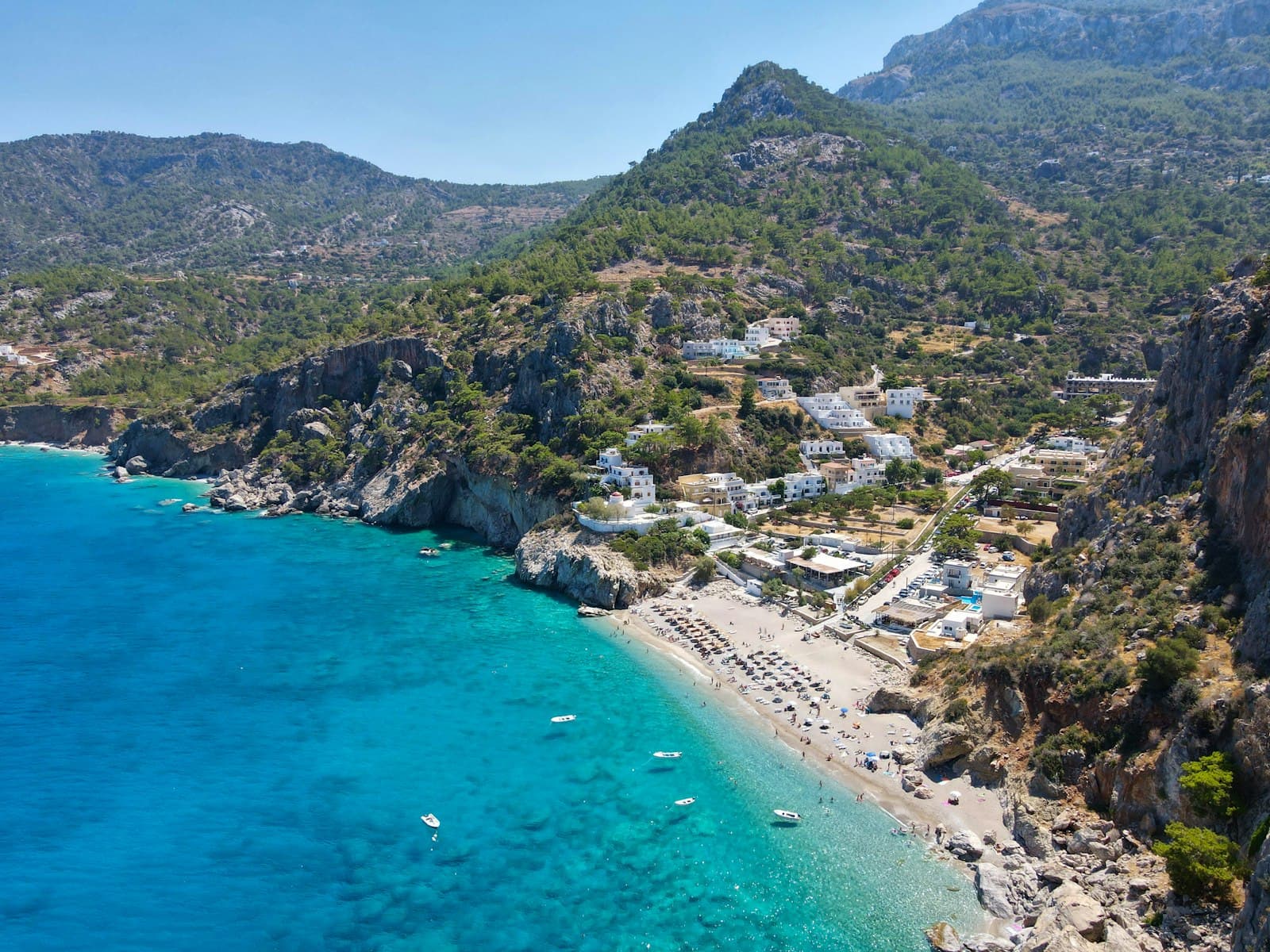
For beach enthusiasts, Karpathos offers several notable spots. Apella Beach, known for its clear waters and pine forests, is considered one of the Aegean's most iconic. Other popular choices include Pigadia Beach and Amoopi Beach. The island's diverse landscapes also encourage exploration, with opportunities for hiking and discovering local crafts such as hand-carved wooden articles, leather goods, and textiles.
The ideal time to visit Karpathos is during the shoulder seasons: May through early June and September. During these months, the weather is pleasantly warm, and the island is less crowded. June offers warm temperatures and most accommodations are open. Late September is also recommended for comfortable temperatures and quieter surroundings as the season winds down. Winters are mild with some rain, while summers can be quite warm.
The official currency in Karpathos, and throughout Greece, is the Euro (EUR). Credit and debit cards are widely accepted, particularly in tourist areas, but it's advisable to carry some cash, especially when visiting more remote parts of the island or for smaller purchases. The primary language spoken is Greek, though many locals, especially in tourist-frequented areas, also speak English, and some may speak German or other European languages.
Karpathos Island National Airport (AOK) connects the island with Athens, Rhodes, Crete, and various European cities. A bus service directly links the airport to Pigadia, the capital. Ferries also provide access to Karpathos from Piraeus, Kasos, Crete, and Rhodes. On the island, public buses operate, and taxis are available. Renting a car or scooter is a popular option for exploring the island independently.
Karpathos in Korean, in Chinese or in Hebrew — and 29 more languages, every stop narrated by a native voice. The widest language range of any self-guided audio tour.
Available in: