The main square
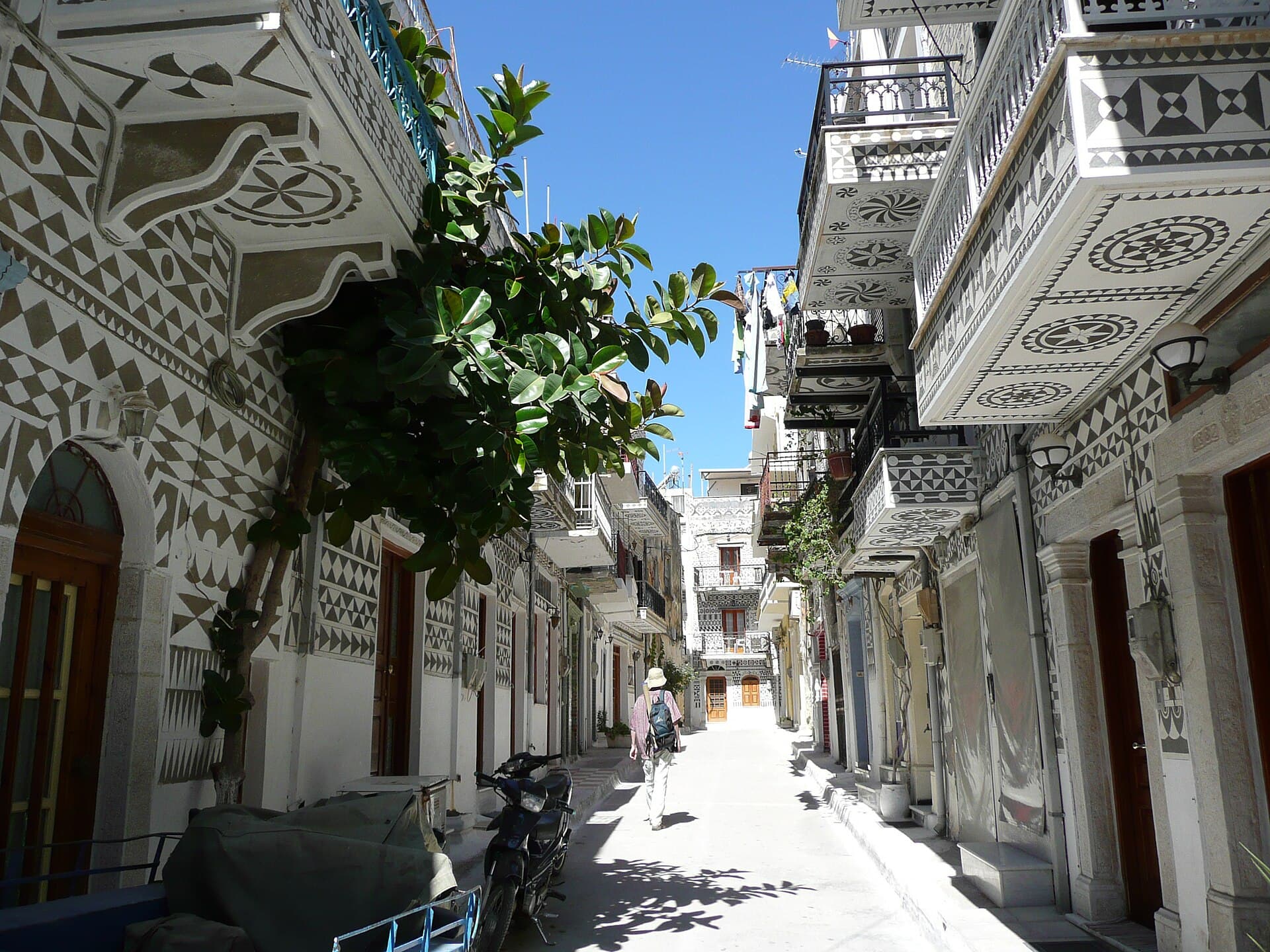
The geometric patterns that adorn nearly every building facade in Pyrgi are a point of immense local pride, but their origins are a bit of a mystery.
Full story unlocks in the tour
 Petille / CC BY-SA 2.0, via Wikimedia Commons
Self-guided audio walking tour of Pyrgi — GPS route, offline playback, story-driven narration in 32 languages.
“Where every wall tells a story in scratched-out patterns of black and white.”
Not the postcards. The stories even locals don't know — whispered in your ear, right where they happened.
The geometric patterns that adorn nearly every building facade in Pyrgi are a point of immense local pride, but their origins are a bit of a mystery.
Pyrgi is one of the 'Mastic Villages,' where a unique resin is harvested. This 'tear of Chios' was once so valuable it could cost you your life.
The tightly packed houses and narrow, winding alleys of Pyrgi weren't just for aesthetics.
Discover every secret of Pyrgi
Every address, every reveal in full — in your ear, right where it happened.
You pick your stops. You walk. The voice reveals what the others miss.


Your self-guided audio tour of Pyrgi is ready — pick your landmarks, choose your language, and start the moment you arrive.
BuyLume has a built-in augmented-reality guide. Hold your phone up and its camera shows the street ahead of you, with a glowing arrow laid over the real view that always points to your next stop — no map to puzzle over, no wrong turns. Like everything in Lume, it works fully offline.
Pyrgi, a medieval village on the Greek island of Chios, is often called the "painted village" due to its distinctive architectural style. Situated in the southern part of the island, approximately 25 kilometers from Chios town, Pyrgi distinguishes itself with intricate black-and-white geometric patterns, known as xysta, adorning nearly every building facade. This unique art form, created by scratching away a top layer of plaster to reveal a darker layer beneath, transforms the village into an engaging open-air gallery.
Designated as a preserved medieval settlement, Pyrgi offers a journey back in time. Its dense, labyrinthine layout, with narrow, vaulted alleyways and stone houses built seamlessly together, reflects its fortified past. The village is one of the largest of the Mastihohoria, the mastic-producing villages of Chios, a region recognized by UNESCO for its intangible cultural heritage. Pyrgi's blend of unique artistry, medieval character, and deep heritage makes it a compelling destination for visitors seeking an authentic Greek experience.
Pyrgi's history stretches back centuries, with some sources tracing its existence to the 11th century, though the earliest written reference dates to 1362. The village's development was significantly shaped by the need for defense against persistent pirate raids in the Aegean. Early inhabitants gathered here to find safety, leading to the growth of the settlement.
In the 14th century, when the Genoese took control of Chios and its profitable mastic trade, they rebuilt Pyrgi in its present form as a kastrochori, or "castle-village." This defensive design featured thick outer walls enclosing the village, houses built close together to form a protective perimeter, and a central tower. The tower, once 18 meters high, served as the defensive and administrative heart of the village, with its entrance several meters above ground, accessible only by a pull-up ladder for added security. This medieval urban plan, designed to safeguard the island's valuable mastic, remained largely intact through the Ottoman period and even after Chios' liberation in 1912.
The most striking aspect of Pyrgi's heritage is its xysta, the unique black-and-white geometric patterns that cover almost every building facade. This decorative technique, which involves scratching away a top layer of white plaster to reveal a darker layer beneath, is found nowhere else in Greece. While the exact origins are debated, the technique is believed to have been influenced by Italian sgraffito, brought by the Genoese. The patterns, often featuring triangles, diamonds, semicircles, and other symbols, are not merely decorative but are a form of expression and a vital element of the island's cultural identity.
During the 19th and 20th centuries, xysta flourished, with notable instances like the decoration of buildings around the central square in 1934, financed by Philippos Argenti. In the 1960s, architect Aris Konstantinidis recognized the cultural value of Chios' medieval villages and oversaw their restoration and conservation. Today, while new xysta are generally not permitted on medieval houses to preserve their integrity, they can be added to new buildings or those with historical evidence of their presence. The village successfully maintained its medieval character, even surviving the devastating 1881 earthquake that impacted much of Chios.
Strolling through Pyrgi's narrow, car-free streets is an experience in itself, with every turn revealing new xysta patterns on the building facades. The village square serves as a lively hub, with cafes and tavernas where you can observe daily life. Notice strings of cherry tomatoes and drying peppers hanging from balconies, adding to the village's character.
One of the most significant historical monuments is the Church of the Holy Apostles (Agioi Apostoloi), a well-preserved 13th-century Byzantine church. Its architecture echoes that of the famous Nea Moni Monastery, and it features frescoes dating back to 1665 by Cretan painter Antonios Domestichos. Other historic churches include the Church of the Virgin's Assumption, built in 1694, and the Church of Taxiarchis from 1680.
For a deeper understanding of the region's most famous product, visit the Chios Mastic Museum, located just outside the village. It offers interactive exhibits detailing the cultivation, processing, and trade of mastic, the unique resin that has shaped Chios' identity for centuries.
Pyrgi experiences a Mediterranean climate, characterized by long, warm summers and mild winters. The ideal time to visit is during the shoulder seasons, from April to June and September to October. During these months, the weather is pleasant with comfortable temperatures, fewer crowds, and waters warm enough for swimming. July and August are the warmest months, with average daily maximums around 33°C, and also the busiest. If you plan to visit in summer, consider early June or late August to balance good weather with slightly fewer crowds.
Pyrgi is located approximately 25 kilometers south of Chios town. You can reach Chios island via ferry from Rafina, east of Athens. Once on Chios, Pyrgi is accessible by car, motorbike, or taxi, with the journey from Chios town taking about 35 minutes. The village itself is easily walkable, with its narrow, car-free alleys best explored on foot.
While in Pyrgi, consider staying in a local guesthouse to fully immerse yourself in the village's atmosphere. The main square offers cafes and tavernas where you can enjoy local cuisine, including mastic-flavored sweets and coffee. Souvenir shops in the village sell locally made mastic products and handcrafted xysta keepsakes.
Pyrgi in Korean, in Chinese or in Hebrew — and 29 more languages, every stop narrated by a native voice. The widest language range of any self-guided audio tour.
Available in: