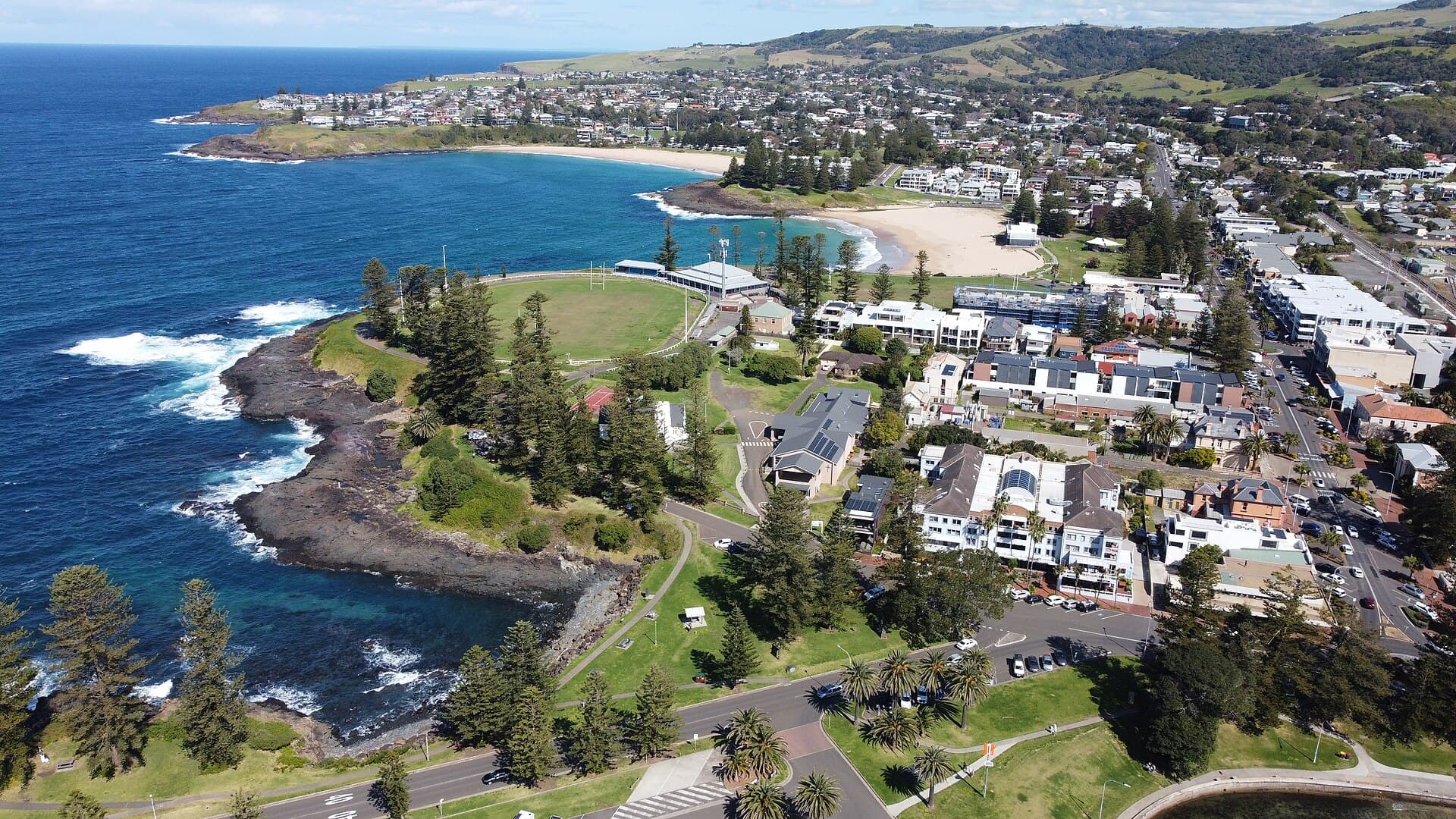
Kiama, AustraliaMaksym Kozlenko / CC BY-SA 4.0, via Wikimedia Commons
AU

Kiama

Self-guided audio walking tour of Kiama — GPS route, offline playback, story-driven narration in 32 languages.

Where the Pacific Ocean carves stories into ancient rock.

The secrets of Kiama

Kiama, as no one tells it.

Not the postcards. The stories even locals don't know — whispered in your ear, right where they happened.

3 secrets below. Many more wait inside the tour.
Kiama Blowhole

The dramatic plumes of water from the Kiama Blowhole are a well-known spectacle, but the story behind its name reveals a deeper connection to the land's original inhabitants.

Full story unlocks in the tour
Kiama Lighthouse

Kiama's iconic white lighthouse has guided ships since 1887, but its early operation was more hands-on than you might imagine.

Full story unlocks in the tour
Collins Street Terrace Houses

The charming Terrace Houses on Collins Street now host boutiques and cafes, but their original purpose was far more industrious.

Full story unlocks in the tour
The full tour

Discover every secret of Kiama

Every address, every reveal in full — in your ear, right where it happened.

Get the key to Kiama

You pick your stops. You walk. The voice reveals what the others miss.

Kiama — A pier, building, and palm trees by the blue ocean.
Photo: Rijan Gurung / Unsplash
Kiama — brown rock formation beside body of water during daytime
Photo: Eetzwa Wang / Unsplash
Kiama — rock formation beside body of water
Photo: Maria / Unsplash
Choose your time

How long do you have in Kiama?

Your self-guided audio tour of Kiama is ready — pick your landmarks, choose your language, and start the moment you arrive.

Buy
About Kiama

The story of Kiama

Kiama, a coastal town approximately 120 kilometers south of Sydney, New South Wales, offers a blend of natural spectacle and historical character. The town is known for its iconic blowhole, a geological formation that sends plumes of seawater high into the air. Beyond this natural wonder, Kiama presents a relaxed seaside atmosphere with beaches, cafes, and historical architecture.

The landscape around Kiama is defined by its dramatic coastline, where ancient volcanic activity has shaped the cliffs and rock formations. The town's name, derived from an Aboriginal word meaning 'where the sea makes a noise' or 'good fishing ground,' reflects its deep connection to the ocean and the Wodi Wodi people, who have inhabited this land for over 12,000 years. This heritage, coupled with its later colonial development, gives Kiama a distinct character that invites exploration.

History

From Ancient Lands to Colonial Endeavors

The history of Kiama stretches back over 12,000 years, rooted in the traditions of the Wodi Wodi people, part of the broader Dharawal language nation. Their lives were intimately connected to the rhythms of the ocean, forests, and estuaries, sustaining themselves through fishing, shellfish gathering, and hunting. Archaeological evidence, such as middens along the Minnamurra River, confirms their long-standing presence and care for this coastal land. Aboriginal dreaming stories are also deeply woven into the landscape, with one tale describing Gurrungutch, the Great Giant Eel, and the formation of Cathedral Rocks.

The first recorded European encounter with the Kiama coast occurred in 1797 when explorer George Bass sailed along the South Coast. He noted the towering spray and thunderous sound of the blowhole, a geological feature formed by ancient volcanic activity and coastal erosion. Permanent British settlement began in 1821 with David Smith. By 1812, cedar logging was underway, and Kiama Harbour developed as a port to ship cedar to Sydney. By the 1820s, 90% of the cedar arriving in Sydney originated from the Kiama area.

Kiama was officially laid out as a town in 1839 and recognized as a municipality in 1859. Early industries diversified from unreliable wheat farming to dairying, establishing Kiama as one of Australia's earliest centers of dairy production, including the country's first dairy factory and co-operative in 1884. From the 1870s, basalt quarrying, known as 'blue metal,' became a major industry, providing material for railway lines and road construction in Sydney and beyond. The Kiama Lighthouse was constructed in 1887 to guide coastal shipping, and the railway from Sydney reached Kiama in 1893, further connecting the town to trade and tourism.

What to see

The Kiama Blowhole is the town's most famous natural attraction, a geological formation where waves surge into an underground chamber, forcing water dramatically skyward. Its activity depends on the tide, wind, and swell, with strong south-easterly swells often producing the most impressive displays. A short distance south, the Little Blowhole offers a more consistent, though smaller, display.

Standing above the main blowhole is the Kiama Lighthouse, established in 1887. The area around the lighthouse, on Blowhole Point, is popular for picnics and offers coastal views. Nearby, the Pilot's Cottage Museum, housed in the original assistant keeper's cottage, shares stories of maritime history and local industry.

For a glimpse into Kiama's past, explore the Historic Terrace Houses on Collins Street. These 1886-built weatherboard cottages, once home to quarry workers, now house a variety of shops and cafes. Behind the terraces, the Sandstone Walk offers additional small shops.

Nature enthusiasts can walk all or part of the Kiama Coast Walk, a 20-kilometer trail stretching from Minnamurra River to Gerringong, offering coastal views, geological formations, and beaches. The Bombo Headland Quarry is a unique geological site with basalt columns, offering a striking landscape, particularly at sunrise. For rainforest immersion, the Minnamurra Rainforest Centre is a short drive inland.

When to visit

The best times to visit Kiama are during spring (September to November) and early autumn (March to April). These shoulder seasons offer a pleasant balance of mild temperatures, lower humidity, and fewer weather extremes. Spring brings warmer days, while early autumn is generally settled and less crowded after the summer peak. Summer (December to March) is ideal for beach activities, though temperatures are higher and the area can be busier. Winter (June to August) is cooler and quieter, suitable for relaxed itineraries, and is the best time for whale watching.

Practical

Kiama is approximately a 1.5 to 2.5-hour drive south of Sydney. The scenic train journey from Sydney to Kiama Station takes just over two hours, and the Blowhole is within walking distance of the station. Street parking is available for those driving. For those arriving by air, Shellharbour Airport is a 15-minute drive north of Kiama, with flights from Brisbane and Melbourne.

Accommodation options in Kiama range from hotels and motels to vacation rentals. The town offers a variety of cafes and restaurants, many serving fresh South Coast produce. Kiama is a walkable town, with many attractions, including the blowholes, lighthouse, and town center, easily accessible on foot.

Good to know
What is the Kiama Blowhole?
The Kiama Blowhole is a natural geological formation where ocean waves force air and water through a rock cavern, creating a spectacular spout of seawater.
When is the best time to see the Kiama Blowhole in action?
The blowhole is most active during high tide and when strong south-easterly swells are present.
Is there a smaller blowhole in Kiama?
Yes, the Little Blowhole, located south of the main town, is smaller but often more consistently active, even in calmer sea conditions.
What are the Historic Terrace Houses?
These are a row of 1886-built weatherboard cottages on Collins Street, originally housing quarry workers, now home to shops and cafes.
Can I go inside the Kiama Lighthouse?
No, there is no public access to the inside of the Kiama Lighthouse.
What is the Kiama Coast Walk?
The Kiama Coast Walk is a 20-kilometer scenic trail stretching from Minnamurra River to Werri Beach, offering coastal views, beaches, and geological wonders.
On the map
Kiama
€9.90
No booking · activate anytime · 12h to walk it
Load on Wi-Fi, then walk offline — no roaming abroad
Get the key to Kiama