Lake Memphremagog
Magog draws its name from its expansive lake, and for centuries, locals have spoken of an elusive resident. What presence stirs beneath the surface of Lake Memphremagog?
Full story unlocks in the tour
 Hayden Soloviev / CC BY 4.0, via Wikimedia Commons
Self-guided audio walking tour of Magog — GPS route, offline playback, story-driven narration in 32 languages.
“Where the lake murmurs and mountains stand sentinel.”
Not the postcards. The stories even locals don't know — whispered in your ear, right where they happened.
Magog draws its name from its expansive lake, and for centuries, locals have spoken of an elusive resident. What presence stirs beneath the surface of Lake Memphremagog?
Magog's oldest enduring house was constructed by its 'founding father,' a man who was not only a developer but also an American Revolutionary. What unexpected role did he fulfill in the early settlement?
For decades, Magog's economy was shaped by a single industry, leading to a pivotal historical event. What occurred at the Dominion Textile cotton mill in 1900 that marked Canadian labor history?
Discover every secret of Magog
Every address, every reveal in full — in your ear, right where it happened.
You pick your stops. You walk. The voice reveals what the others miss.


Your self-guided audio tour of Magog is ready — pick your landmarks, choose your language, and start the moment you arrive.
BuyLume has a built-in augmented-reality guide. Hold your phone up and its camera shows the street ahead of you, with a glowing arrow laid over the real view that always points to your next stop — no map to puzzle over, no wrong turns. Like everything in Lume, it works fully offline.
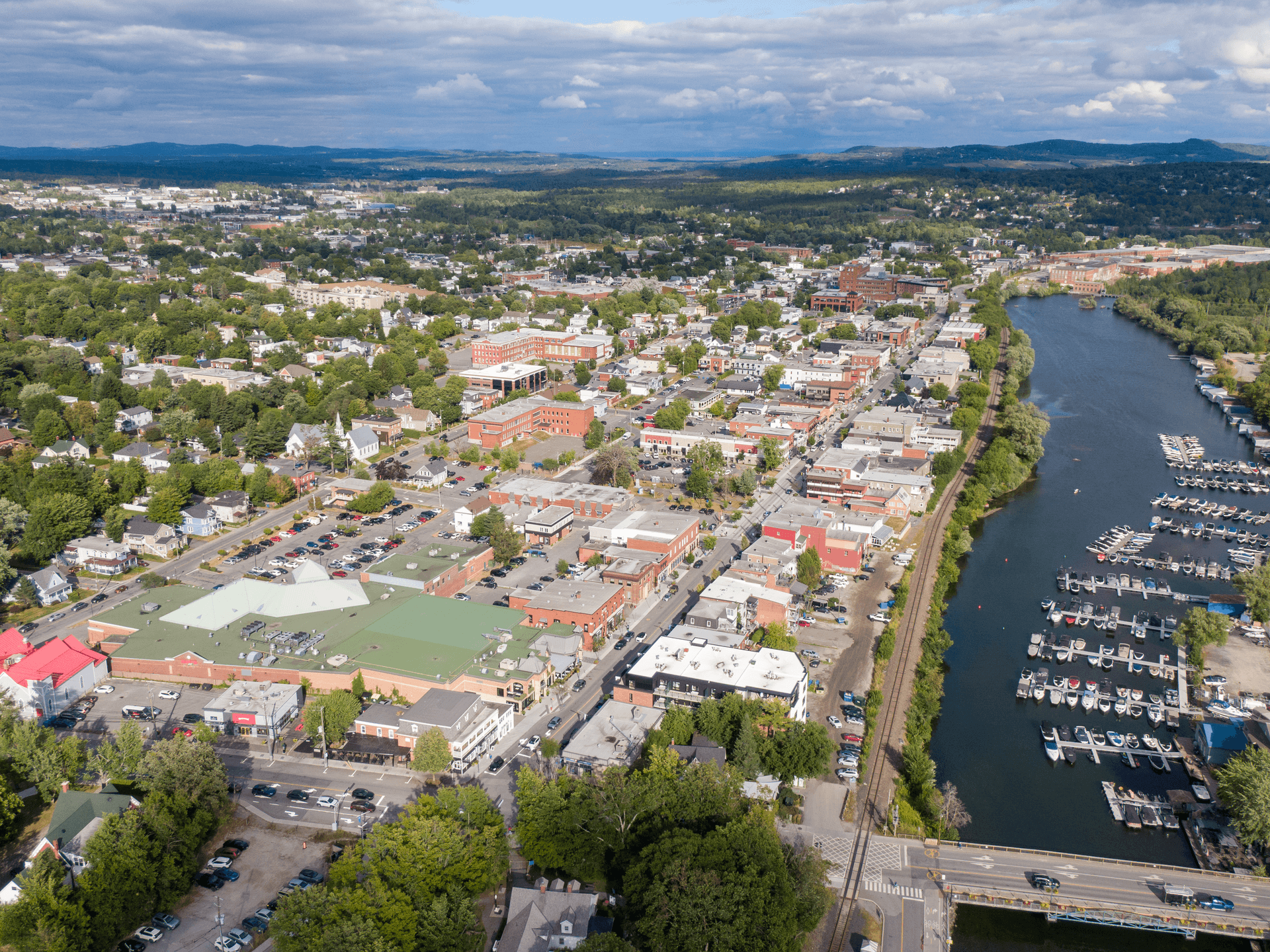
Magog, a city in southeastern Quebec, Canada, lies approximately 120 kilometers (75 miles) east of Montreal. It rests at the convergence of Lake Memphremagog, the Rivière aux Cerises, and the Magog River. The city stands as a prominent center within the Regional County Municipality of Memphremagog and a key part of the Eastern Townships tourist region.
Known for its evocative landscapes, Magog is framed by mountains and undulating countryside, with Lake Memphremagog stretching behind. The city offers a lively downtown area and a reputation as a sought-after destination throughout the year.
Magog presents a blend of outdoor recreation, cultural encounters, and gastronomic pleasures, making it suitable for both active explorers and those seeking repose. From traversing marshlands to savoring local vineyards, the city offers a diverse array of activities for visitors.
The area now known as Magog was initially an Indigenous encampment and a stopping point on the trail connecting the Connecticut River to the St. Lawrence River. The Abenaki people were the first inhabitants, frequently visiting Lake Memphremagog and its waterways. The name 'Memphremagog' itself originates from the Abenaki word 'mamhlawbagak,' meaning 'large expanse of water' or 'vast lake.' The name 'Magog' is thought to be a shortened version of the lake's name, or perhaps derived from 'namagok,' meaning 'the lake where there is brook trout.'
European settlement commenced around 1776 with the arrival of Loyalists from Vermont, who referred to the area as 'The Outlet,' owing to its position where the lake's waters flowed into the Magog River. In 1798, water-powered gristmills and sawmills were constructed, and a school opened in 1818. Ralph Merry III, an American Revolutionary who settled in the area in 1799, is credited as Magog's founding father, having acquired surrounding lots and serving as mayor, judge, and developer of 'The Outlet' village. He constructed a house in 1821, which remains the oldest standing house in the city.
The settlement was formally designated Magog in 1855, when it was incorporated as a town. The late 19th and early 20th centuries saw the textile industry, particularly the Dominion Textile cotton mill, shape Magog's economy. However, by the 1960s and 1970s, the city diversified its economy through tourism, services, and the establishment of an industrial park. In 2002, the City of Magog merged with the Township of Magog and the Village of Omerville as part of a municipal reorganization in Quebec.
Magog offers a range of attractions for visitors. The Parc de la Baie-de-Magog is a central point, featuring walking paths, a beach, and a boat launching dock. Here, you can enjoy swimming in the clear waters of Lake Memphremagog at Plage des Cantons or Plage de la Baie-de-Magog, both offering picnic areas and lifeguard supervision during the bathing season.
History enthusiasts can explore The Merry House, Magog's oldest house, which provides glimpses into the city's past and its founder, Ralph Merry III. The downtown area, particularly Rue Principale Ouest, is home to boutiques, art galleries, cafes, and restaurants. The Vieux Clocher, a former church, is now a venue for live music and theater productions.
For those who cherish nature, the Marais de la Rivière-aux-Cerises (Cherry River Marsh) offers walking paths through preserved marshlands, ideal for bird watching and experiencing a tranquil environment. Just a short drive away, Mont-Orford National Park provides numerous hiking trails for all levels, with compelling views, particularly vivid during autumn. Visitors can also explore local vineyards like Vignoble Le Cep d'Argent for wine tastings.
Magog experiences a continental climate with four distinct seasons. The most pleasant time for warm-weather activities is from late June to early September, when average daily high temperatures are above 19°C (66°F). July is typically the warmest month, with an average high of 24°C (76°F). This period is ideal for enjoying the lake, beaches, and outdoor sports.
For those who appreciate autumn foliage, the Eastern Townships, including Magog, are particularly beautiful in the fall when the leaves change color. Winter offers opportunities for ice skating on Lake Memphremagog's frozen path, ice fishing, and skiing or snowshoeing at Mont-Orford National Park.
Magog is approximately 120 kilometers (75 miles) east of Montreal, making it accessible by car, typically a 90-minute drive. While specific public transportation within Magog isn't extensively detailed, the city is compact enough that many attractions, particularly in the downtown area and along the lake, are accessible on foot or by bicycle. Bicycle rentals are available for exploring the numerous paths, including the Magog-Orford trail.
Accommodation options in Magog include hotels and bed and breakfasts, which are particularly active during the summer months. Dining choices range from casual bistros and cafes to diverse restaurants. When visiting, especially during summer, consider packing light clothing, but also a light jacket or sweater for cooler evenings or rain, as precipitation occurs year-round. Sunscreen and a hat are advisable for clear days.
Magog in Korean, in Chinese or in Hebrew — and 29 more languages, every stop narrated by a native voice. The widest language range of any self-guided audio tour.
Available in: