The New Castle of Manzanares el Real
This imposing fortress, a symbol of the powerful Mendoza family, conceals a cinematic past.
Full story unlocks in the tour
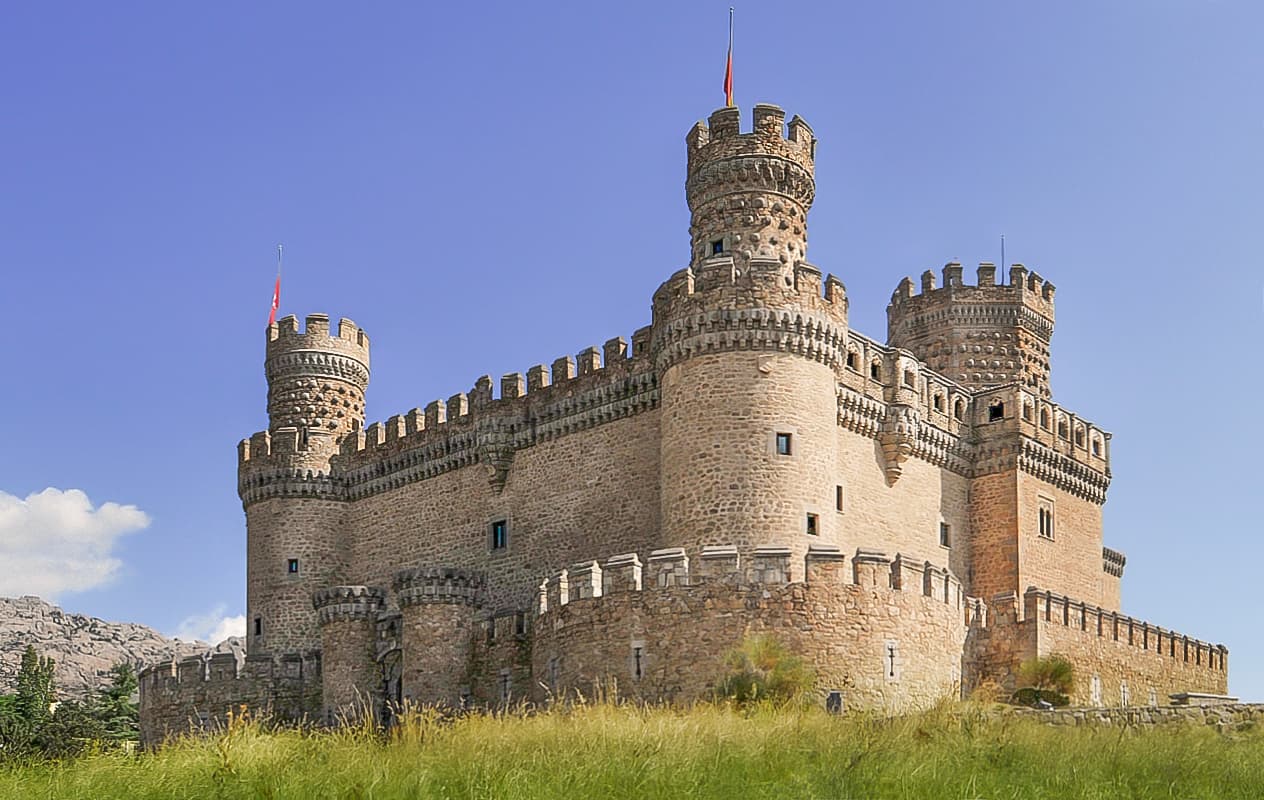 Ramón Durán / cc by 2.0, via Wikimedia Commons
Self-guided audio walking tour of Manzanares el Real — GPS route, offline playback, story-driven narration in 32 languages.
“Where granite peaks meet medieval grandeur.”
Not the postcards. The stories even locals don't know — whispered in your ear, right where they happened.
This imposing fortress, a symbol of the powerful Mendoza family, conceals a cinematic past.
The dramatic granite formations of La Pedriza are more than a climber's haven; they are also connected to ancient, mystical practices.
Beneath the surface of the Santillana Reservoir lies a remnant of an earlier engineering feat.
Discover every secret of Manzanares el Real
Every address, every reveal in full — in your ear, right where it happened.
You pick your stops. You walk. The voice reveals what the others miss.
Your self-guided audio tour of Manzanares el Real is ready — pick your landmarks, choose your language, and start the moment you arrive.
BuyLume has a built-in augmented-reality guide. Hold your phone up and its camera shows the street ahead of you, with a glowing arrow laid over the real view that always points to your next stop — no map to puzzle over, no wrong turns. Like everything in Lume, it works fully offline.
Manzanares el Real, a town in the Community of Madrid, offers a passage to the Sierra de Guadarrama National Park and the distinct granite landscape of La Pedriza. Located approximately 50 kilometers from Madrid, it presents a convergence of natural splendor and historical depth. The town is a sanctuary for outdoor enthusiasts, providing opportunities for hiking, climbing, cycling, and birdwatching amidst its varied flora and fauna. Its most recognizable landmark, the New Castle of Manzanares el Real, stands as a testament to its long past, surveying the Santillana Reservoir and the dramatic mountain scenery.
The municipality is part of the Upper Manzanares River Basin Regional Park, designated a Biosphere Reserve by UNESCO in 1993, emphasizing its environmental importance. The town's atmosphere blends the calm of a mountain village with the allure of a historical site, making it a compelling destination for those seeking both adventure and cultural exploration.
The history of Manzanares el Real stretches back to prehistoric times, with archaeological evidence of early human settlements. Rock paintings in Los Aljibes de La Pedriza, dating to the Late Bronze Age (around 1400–1200 BC), and fragments of ceramics and stone tools from the Neolithic and Bronze Age, confirm its ancient origins. Later, around 1000 BC, local tradition suggests the presence of druids, with echoes of their rites found in the religious celebration of the Virgin of Peña Sacra.
During the Roman conquest, the region experienced a Roman presence, leaving its mark on the area. The town, as it is known today, was established in 1248 during the Reconquista. The territory, known as the Real de Manzanares, was granted to Pedro González de Mendoza by King John I in 1383, marking the beginning of the powerful Mendoza family's influence. Under their lineage, the Real de Manzanares experienced its greatest period of flourishing in the 15th and 16th centuries. This era saw significant construction, including the Church of Nuestra Señora de las Nieves, a hermitage, and the magnificent New Castle of Manzanares el Real.
The New Castle, a palace-fortress, began construction in 1475 on the site of a Romanesque-Mudéjar hermitage. Commissioned by Diego Hurtado de Mendoza, the 1st Duke of the Infantado, it was later completed by his son, Íñigo López de Mendoza, under the direction of architect Juan Guas. This imposing granite structure, with its four circular towers and distinctive Isabelline Gothic style, was designed as a luxurious residence and a display of the Mendoza family's power. It features a rectangular courtyard with porticos and galleries, including a Gothic gallery on the first floor considered one of the most beautiful in Spanish military architecture. A barbican with loopholes, carved with the cross of the Holy Sepulchre of Jerusalem, encircles the castle.
Despite its grandeur, the castle's role as a palatial residence lasted only about a century. Following the death of Íñigo López de Mendoza y Pimentel, the 4th Duke of the Infantado, in 1566, economic problems and inheritance disputes led to its abandonment. The 17th century marked a period of decline for the town, with a significant population loss. However, the castle has undergone restorations in the 20th century and today stands as one of the best-preserved fortresses in the Community of Madrid, now functioning as a museum.
Manzanares el Real played a significant role in the establishment of Madrid's autonomy. In 1982, the New Castle hosted the constitution of the Assembly of Parliamentarians of Madrid and the appointment of the drafting committee for the Statute of Autonomy. Today, the town's economy has largely shifted towards the service sector and tourism, drawing visitors with its natural beauty, historical sites, and opportunities for outdoor activities.
The New Castle of Manzanares el Real, also known as the Castle of los Mendoza, is the town's most prominent attraction. This 15th-century palace-fortress, built entirely of granite, is remarkably well-preserved and exhibits a blend of Isabelline Gothic and Mudéjar architectural styles. Inside, you can explore its six floors, including a basement, a main floor with grand halls, and upper galleries, some displaying 17th-century Flemish tapestries. The views from its towers across the Santillana Reservoir and La Pedriza are particularly striking.
Beyond the castle, explore the Old Castle (Castillo Viejo), whose remains, consisting of two walls, lie across the Manzanares River. The Church of Nuestra Señora de las Nieves, also from the 15th century, is another historical site worth visiting. For nature lovers, La Pedriza, a vast area of granite rock formations within the Sierra de Guadarrama National Park, offers numerous hiking trails and rock climbing opportunities. The Santillana Reservoir provides a habitat for a large colony of aquatic birds and is a popular spot for fishing. The Ethnological Museum houses archaeological remains found in the municipality and a reconstruction of a traditional home, offering insight into local history and culture.
Manzanares el Real is best visited in late spring or early autumn for general outdoor activities, specifically from mid-May to mid-July and mid-August to early October, with a peak in the third week of September. During these periods, the weather is generally clear and pleasant, with perceived temperatures between 65°F and 80°F. For hot-weather activities, such as enjoying the Santillana Reservoir, late June to late August is ideal, with July being the warmest month, averaging a high of 85°F. Winters are cold, with January lows around 31°F, and skies are cloudiest in December.
Manzanares el Real is approximately 50-60 kilometers from Madrid. You can reach it by bus line 724 from the Plaza de Castilla Intercambiador station in Madrid; the journey takes about an hour. If driving, take the M-607 to Cerceda, then the M-608 directly to Manzanares. The town offers a tourist information office for maps and guidance. While the New Castle is a major draw, it's advisable to check its current opening status, as it has experienced periods of closure for licensing procedures. Many hiking routes in La Pedriza begin from the Canto Cochino parking and information center; downloading an app like Maps.me for detailed trail maps is recommended. The town also provides essential public services, including a health center, local police, and pharmacies.
Manzanares el Real in Korean, in Chinese or in Hebrew — and 29 more languages, every stop narrated by a native voice. The widest language range of any self-guided audio tour.
Available in: