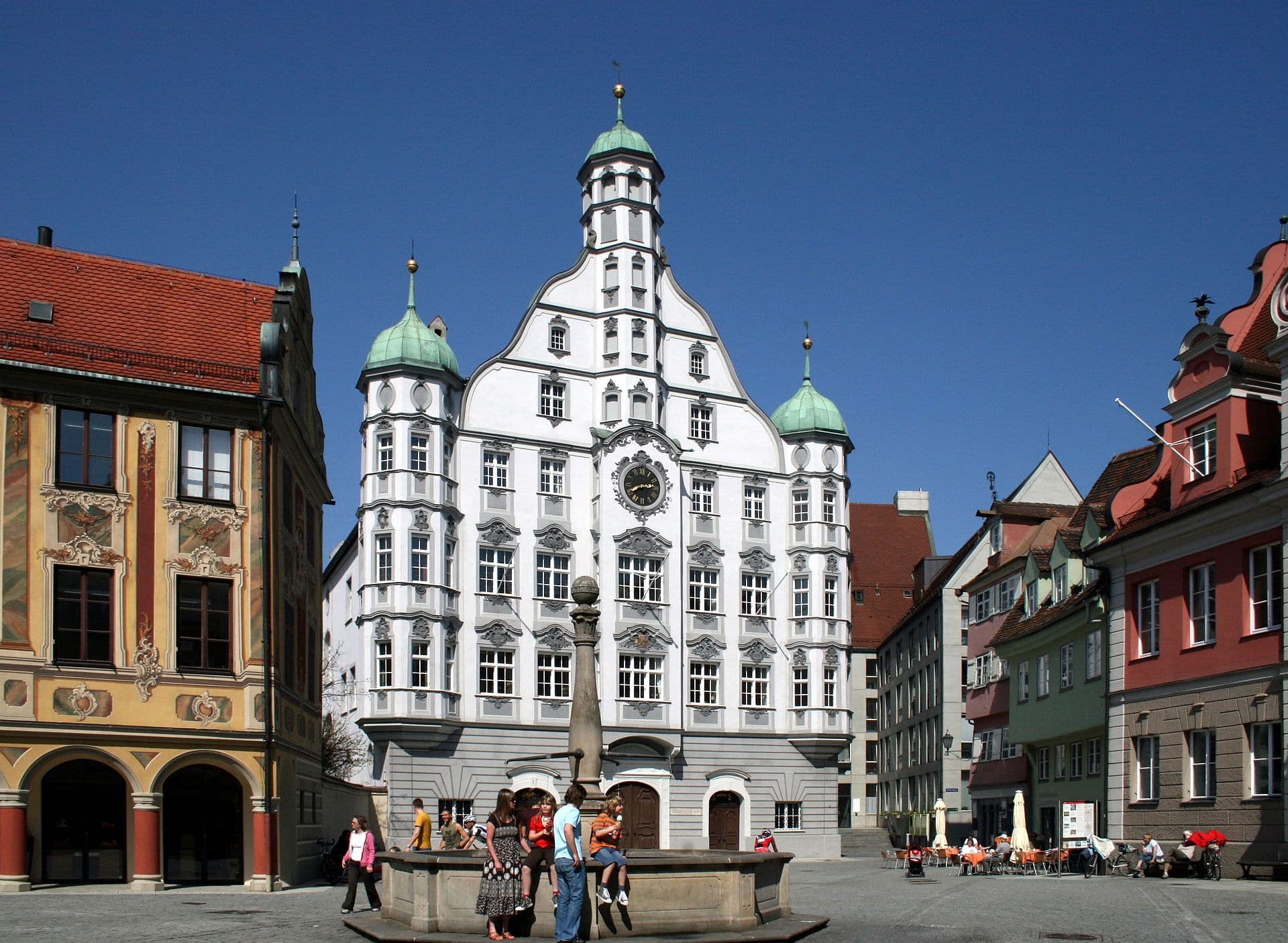
Marktplatz
The city's central square, the Marktplatz, is bordered by architectural splendors, yet one structure conceals a fascinating detail about its original purpose.
Full story unlocks in the tour
 Johannes Böckh / CC BY-SA 3.0, via Wikimedia Commons
Self-guided audio walking tour of Memmingen — GPS route, offline playback, story-driven narration in 32 languages.
“Where ancient walls meet contemporary life, Memmingen invites you to uncover stories etched into its very fabric.”
Not the postcards. The stories even locals don't know — whispered in your ear, right where they happened.
The city's central square, the Marktplatz, is bordered by architectural splendors, yet one structure conceals a fascinating detail about its original purpose.
Beyond its venerable stones and spiritual significance, the Frauenkirche holds an artistic revelation that diverges from typical church art.
Residents of Memmingen carry a whimsical moniker—the 'Moon Catchers'—a name that originates from an amusing historical misunderstanding.
Discover every secret of Memmingen
Every address, every reveal in full — in your ear, right where it happened.
You pick your stops. You walk. The voice reveals what the others miss.

Your self-guided audio tour of Memmingen is ready — pick your landmarks, choose your language, and start the moment you arrive.
BuyLume has a built-in augmented-reality guide. Hold your phone up and its camera shows the street ahead of you, with a glowing arrow laid over the real view that always points to your next stop — no map to puzzle over, no wrong turns. Like everything in Lume, it works fully offline.
Memmingen, a captivating town in Bavaria, Germany, offers a delightful fusion of medieval allure and contemporary energy. Known as the 'City of Gates and Towers' due to its remarkably preserved fortifications and historic architecture, it serves as an economic and cultural nexus in the Swabia region. With a population of approximately 45,000 residents, Memmingen provides an intimate yet lively experience, featuring a walkable historic center adorned with colorful facades, meandering canals, and ancient pathways.
Its strategic location makes it an excellent gateway to the scenic Allgäu region and the foothills of the Alps, often earning it the moniker 'Gateway to the Allgäu'. Whether you are passing through via its regional airport or planning a dedicated stay, Memmingen promises a delightful experience infused with Bavarian hospitality and profound historical roots. The town's dedication to preserving its heritage is evident in its well-maintained old city walls and the tranquil Stadtbach stream that flows through, enhancing its romantic atmosphere.
Memmingen's origins reach back to Roman times, with a small military town likely named Cassiliacum existing on its site. An Alemannic settlement followed in the 5th century, and by the 7th century, a Frankish king's palace stood here. The town, then known as Mammingin, was first officially mentioned in 1128. Its strategic position on major trade routes, including a salt road connecting to Bohemia, Austria, and Munich, and an important route to Italy, helped Memmingen thrive as a trading center.
Duke Welf VI officially established the town in 1158, and in 1286, it achieved the significant status of a Free Imperial City, answering only to the Holy Roman Emperor. The 15th century saw extensive fortification, with the city walls, gates, and towers being significantly expanded and strengthened, many of which remain today.
Memmingen played a pivotal role during the Reformation and the German Peasants' War in the early 16th century. Christoph Schappeler, a preacher at St. Martin's Church, was instrumental in advocating for peasant rights. In 1525, the 'Twelve Articles,' considered one of Europe's earliest declarations of human rights, were drafted in Memmingen. This historical document, a religious petition drawing from Luther's ideas, appealed for peasant rights and saw 25,000 copies circulated across Europe within two months of its publication. In recognition of this, Memmingen has awarded the Memmingen Freedom Prize 1525 every four years since 2005 to individuals who have made outstanding contributions to human rights.
The town also found itself at the center of the Thirty Years' War in the 1630s, with Imperial generalissimo Wallenstein quartered there before his dismissal. From 1632, Memmingen was briefly garrisoned by the Swedish army. After the reorganization of Germany in 1802, Memmingen became part of Bavaria. The 19th century brought economic decline, only reversed with the arrival of the railway in 1863, which spurred industrial growth. Since World War II, Memmingen has experienced economic growth exceeding the Bavarian average.
Memmingen's historic center is a repository of well-preserved medieval architecture. The Marktplatz (Market Square) is the city's heart, encompassed by impressive buildings such as the Renaissance-style Town Hall and the distinctive Steuerhaus (Tax House) with its arcades. The Großzunft (Great Guildhall), a patrician house, also stands proudly on the square.
St. Martin's Church, a Gothic basilica built between 1325 and 1500, is a prominent landmark. Its nearly 65-meter-high tower offers sweeping views of the town and the distant Alps. Inside, admire the elaborately carved Gothic choir stalls and well-preserved frescoes. The Frauenkirche (Church of Our Lady), one of Upper Swabia's oldest churches, is notable for its late Gothic wall paintings, including a distinctive depiction of a unicorn hunt.
Explore the remnants of the old city walls and gates, which underscore Memmingen's historical fortifications. For a cultural immersion, visit the Antonite Monastery, which now houses the town library and two museums, including the Strigel Museum, featuring artworks by the Strigel family. The Herman Residence, a former city palace, now serves as the town museum. The Fugger Residence, built between 1581 and 1597 as a home and warehouse, has hosted historical figures like Generalissimo Albrecht von Wallenstein. For a peaceful escape, wander through the Memmingen City Park Neue Welt, an expansive recreational area just north of the historic center.
The ideal time to visit Memmingen is during late spring and summer (May to September) for pleasant weather, perfect for outdoor activities and exploration. Summers are mild and comfortable, with average daytime temperatures around 22-23°C (72-73°F). This period is also when the city comes alive with festivals. Late July brings the traditional 'Fischertag' (Fishermen's Day), and every four years, Memmingen hosts the 'Wallensteinfestspiele,' Europe's largest historical reenactment. Early autumn (September) also offers mild temperatures, around 18.6°C (65°F), before the pre-winter cooling. Winter is cool, with average temperatures around 1.0°C (34°F) in January, and the city hosts atmospheric Christmas markets in December.
Memmingen is a very safe city for visitors with a low crime rate. The local currency is the Euro (€). While major hotels and supermarkets accept credit cards, it is wise to carry some cash for smaller purchases at bakeries, cafes, and traditional inns. ATMs are readily available. Tipping is customary; rounding up the bill or leaving 5-10% is polite. German is the primary language, but English is also spoken.
Memmingen is well-connected by road, rail, and air. Memmingen Airport (FMM), also known as Allgäu Airport Memmingen, is an international airport located about 3.8 km (2.4 miles) from the city center, offering low-cost flights to various European destinations. An airport shuttle runs approximately every 30 minutes. The Memmingen train station is centrally located, just a 10-minute walk from the Marktplatz, and serves EuroCity, Intercity, and regional trains. The station is accessible and offers amenities like luggage lockers and free Wi-Fi. The main bus station (ZOB) is conveniently located next to the train station, providing regional and international connections. The city's compact nature makes it easy to explore on foot, though local buses and bike rentals are available.
Memmingen in Korean, in Chinese or in Hebrew — and 29 more languages, every stop narrated by a native voice. The widest language range of any self-guided audio tour.
Available in: