Pieter van Gent Winery & Vineyard
Step into a cellar door unlike any other, where the past quite literally surrounds you.
Full story unlocks in the tour
 MDRX / cc by-sa 4.0, via Wikimedia Commons
Self-guided audio walking tour of Mudgee — GPS route, offline playback, story-driven narration in 32 languages.
“Where sun-drenched vineyards meet the clear, star-scattered sky.”
Not the postcards. The stories even locals don't know — whispered in your ear, right where they happened.
Step into a cellar door unlike any other, where the past quite literally surrounds you.
The orderly layout of Mudgee's streets wasn't a trial run for a grander city, as local legend once suggested.
This historic pub, a central Mudgee landmark, holds a secret beneath its lively facade.
Discover every secret of Mudgee
Every address, every reveal in full — in your ear, right where it happened.
You pick your stops. You walk. The voice reveals what the others miss.


Your self-guided audio tour of Mudgee is ready — pick your landmarks, choose your language, and start the moment you arrive.
BuyLume has a built-in augmented-reality guide. Hold your phone up and its camera shows the street ahead of you, with a glowing arrow laid over the real view that always points to your next stop — no map to puzzle over, no wrong turns. Like everything in Lume, it works fully offline.
Mudgee, a town in the Central West of New South Wales, Australia, offers a captivating blend of colonial charm, gourmet experiences, and natural splendor. Situated in the fertile Cudgegong River valley, approximately 261 km north-west of Sydney, the town is the largest in the Mid-Western Regional Council. Its name, derived from the Wiradjuri Aboriginal word 'Moothi', means 'nest in the hills,' aptly describing its setting surrounded by mountains and rugged bushland. Mudgee has earned a reputation as a premier destination for food and wine enthusiasts, with over 35 cellar doors and a thriving culinary scene featuring vineyard restaurants, cafes, and local breweries.
Beyond its gastronomic appeal, Mudgee provides a relaxed country escape with a sophisticated yet informal atmosphere. The town's wide, tree-lined streets are home to beautifully preserved 19th-century colonial buildings, reflecting its deep past. Visitors can explore historic sites, admire Aboriginal rock art, or venture into nearby national parks for outdoor adventures. Mudgee's clear night skies also offer an additional gift for stargazers, adding another dimension to its diverse offerings.
Recognised as one of Australia's top tourism towns, Mudgee seamlessly blends its heritage with a contemporary lifestyle, making it an ideal destination for those seeking both indulgence and exploration.
The Mudgee region has been home to the Wiradjuri people, specifically the Mowgee clan, for thousands of years. Their profound connection to the Cudgegong River, used for navigation, sustenance, and as boundaries, is central to their identity as 'River people.' The name 'Mudgee' itself originates from the Wiradjuri word 'Moothi', meaning 'nest in the hills,' a fitting description of the valley's topography.
European exploration of the Mudgee area began in 1821 with James Blackman, who was the first European to cross the Cudgegong River. Soon after, Lieutenant William Lawson, commandant of Bathurst, also made expeditions, finding the area to be an Aboriginal settlement inhabited by approximately 100 people. Permanent European settlement followed swiftly, with George and Henry Cox establishing a grazing property at Menah, 3 km north of the current town, in February 1822. Early relations between settlers and the Wiradjuri people were amicable, but as European numbers grew, conflict escalated. The wholesale slaughter of kangaroos and possums, desecration of sacred sites, and seizure of prime riverside land led to increased violence, culminating in martial law being declared in 1824, which severely impacted the Wiradjuri population.
Mudgee was officially granted village status in 1838, and by 1841, it had 36 buildings, including three hotels, a hospital, a post office, and the first Anglican church. The town's population was around 200 in 1851 when gold was discovered in nearby Hargraves, triggering a gold rush. While Mudgee itself wasn't a gold-mining site, its strategic location made it a vital service centre for the surrounding goldfields of Gulgong, Hill End, and Windeyer. This influx of people saw Mudgee's population skyrocket to 1,507 by 1861, and it was declared a municipality in 1860, making it the second oldest municipality west of the Great Dividing Range. The prosperity generated during this period is still evident in the well-preserved heritage buildings that line the main streets.
The Mudgee wine industry also has deep roots, with the first commercial grapes planted in 1858 by German immigrant Adam Roth at his 'Rothview' property (later 'Craigmoor') in Eurunderee. The thirsty miners of the gold rush created a ready market for local wines, helping the industry to flourish. The region played a significant role in Australian viticulture, with the country's first Chardonnay cuttings planted here in the early 1970s. Today, Mudgee continues its legacy as a respected wine-producing area, known for its full-bodied red wines and diverse varietals.
Mudgee offers a diverse range of attractions, from its renowned wineries to its natural landscapes and historical sites. Wine tasting is a primary draw, with over 35 cellar doors showcasing a variety of red and white wines, including Shiraz, Cabernet Sauvignon, Chardonnay, and Riesling. Many wineries offer unique tasting experiences, such as the barrel-lined cellar door at Pieter van Gent Winery & Vineyard.
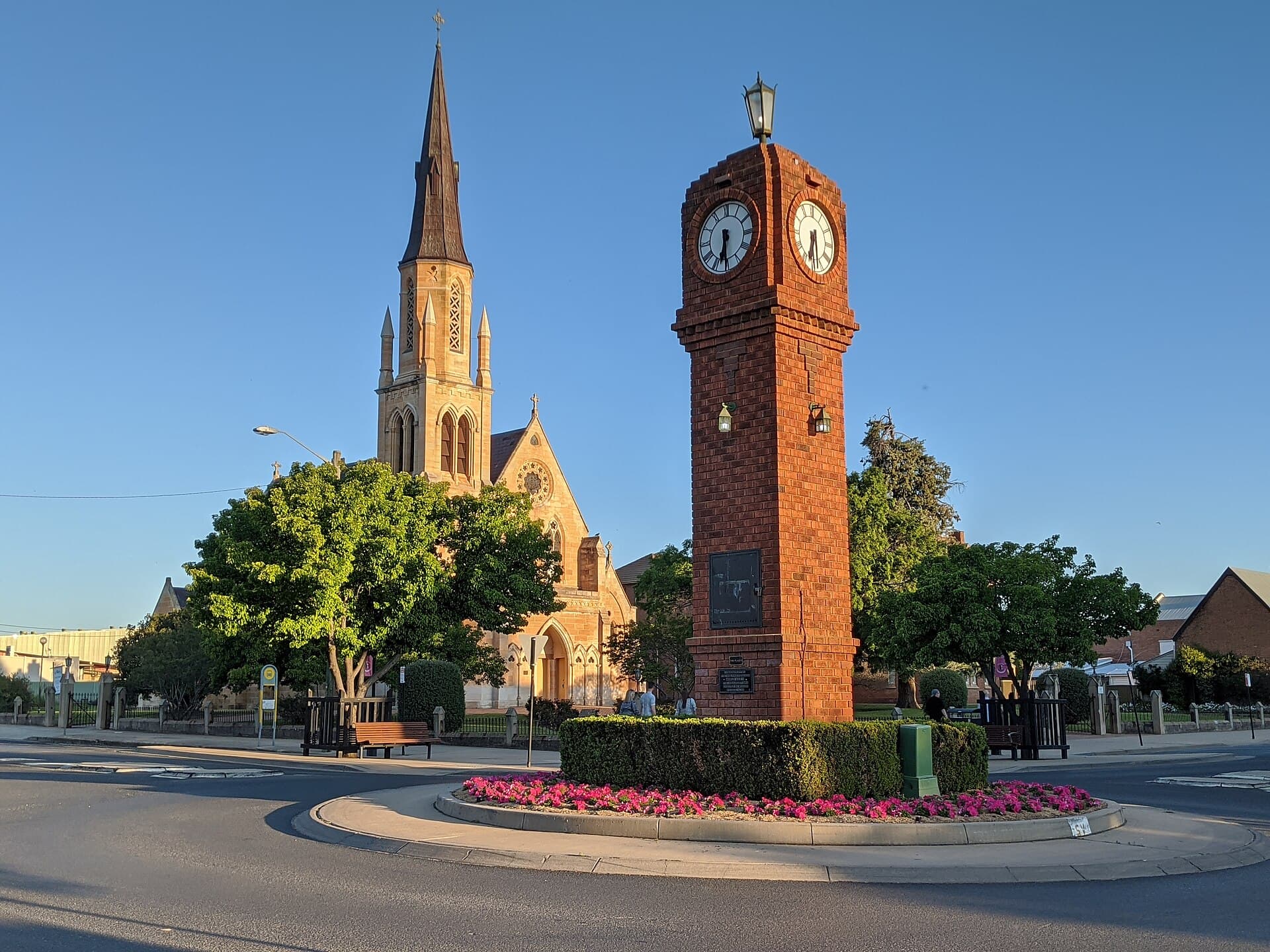
For those interested in the town's heritage, a stroll through Mudgee's main streets reveals beautifully preserved 19th-century buildings, including the Mudgee Post Office (built in 1862), St Mary's Catholic Church (dating back to 1857), and the Mudgee Library (originally the town hall, built in 1880). The Colonial Inn Museum houses an extensive collection of local artifacts, offering a deeper dive into the region's past.
Nature enthusiasts can explore the surrounding areas, including Ganguddy-Dunns Swamp in the World Heritage-listed Wollemi National Park, popular for kayaking, bushwalking, and camping. The Drip Gorge walking track leads to a 'Great Dripping Wall' where rainwater trickles through sandstone. For a glimpse into Aboriginal history, the Hands on the Rocks and Babyfoot Cave sites feature ancient rock art and tool-making evidence.
Beyond the vineyards and historical buildings, Mudgee offers an active arts scene, with the Mudgee Arts Precinct hosting contemporary exhibitions and workshops. The Mudgee Fine Foods Farmers Market, held on the third Saturday of each month in Robertson Park, is a great place to sample local produce. For a unique perspective, consider a hot air balloon ride over the vineyards at sunrise.
The most agreeable times to visit Mudgee for pleasant weather and outdoor activities are spring (September to November) and autumn (March to May). During these months, temperatures are mild, ranging from 20°C to 25°C, providing ideal conditions for exploring vineyards and enjoying outdoor dining. Spring brings blooming cherry blossoms and the Mudgee Wine + Food Month in September, though this is also a time of increased crowds and accommodation prices. Autumn offers vivid landscapes and a more relaxed pace before winter. Summers (December to March) are warm, with average daily highs above 29°C, while winters (June to August) are cold with frosty mornings, though often clear and crisp days.
Mudgee is approximately a 3.5-hour drive northwest of Sydney, making it a popular weekend getaway destination. While self-driving offers flexibility for exploring the wineries and surrounding areas, guided wine tours are available for those who prefer not to drive. The town centre is walkable, with many historic buildings, cafes, and shops concentrated along Market Street. Accommodation options in Mudgee are varied, ranging from bed and breakfasts and farm stays to luxury cabins and glamping experiences, but it's advisable to book in advance, especially for weekend visits, as popular options fill up quickly. The Mudgee Visitor Information Centre is a valuable resource for maps, local insights, and booking assistance. For those interested in local produce, the Mudgee Fine Foods Farmers Market is held on the third Saturday of every month in Robertson Park.
Mudgee in Korean, in Chinese or in Hebrew — and 29 more languages, every stop narrated by a native voice. The widest language range of any self-guided audio tour.
Available in: